
WhatsApp Usernames: What Meta’s Move Means for Privacy, Brands and Digital Marketing
WhatsApp Usernames: What Meta’s Move Means for Privacy, Brands and Digital Marketing
WhatsApp is preparing for one of its biggest identity changes in years.
The platform is introducing usernames, giving users a way to connect without immediately sharing their phone numbers. For a platform that has always been built around mobile numbers, this is not a small product update. It changes how people are found, how businesses receive enquiries, how customers build trust, and how brands protect their identity online.
On June 29, 2026, WhatsApp announced that users can start reserving optional usernames ahead of the full rollout later in the year. The company said usernames are meant to make WhatsApp more private by allowing people to chat without handing over their phone numbers in some new conversations. WhatsApp also said there will be no public username directory and no suggestions, meaning someone will need to know your exact username before contacting you for the first time.
At Samodigital Agency, we see this as more than a WhatsApp feature. It is part of a wider shift in how brands will build direct relationships with customers in a more private, mobile-first and conversation-led digital environment.
What Are WhatsApp Usernames?
WhatsApp usernames will allow users to reserve a unique handle that can be shared instead of a phone number.
This means that instead of giving someone your mobile number immediately, you may be able to share a username such as @yourname or @brandname, depending on availability and WhatsApp’s rules.
The feature is optional. WhatsApp is not removing phone numbers completely. Users will still need a phone number to register an account, and people who already have your phone number may still see it. The privacy benefit mainly applies to new conversations with people or businesses that do not already have your number.
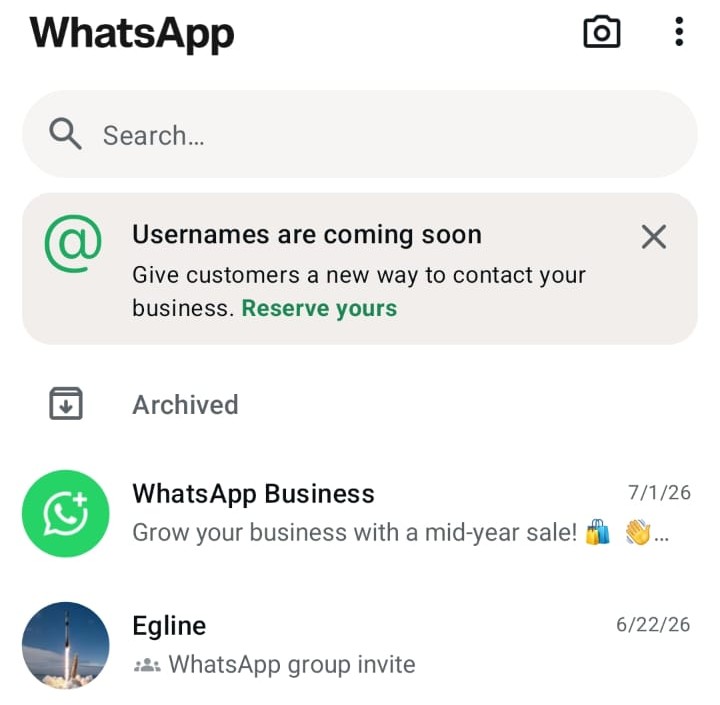
WhatsApp is also introducing an optional username key. This adds another layer of control because a person may need both your username and your key before they can message you. This is meant to reduce unwanted messages, spam and abuse if your username becomes public.
Why Meta Is Introducing WhatsApp Usernames
1. Privacy and Identity Protection
The biggest reason is privacy.
A phone number is not just a contact detail. It is tied to mobile money, banking, family, work, business accounts, two-factor authentication, social media, and many other parts of everyday life. Once someone has your number, they can contact you outside the original reason you connected.
This has always been one of WhatsApp’s weak points. The app offers end-to-end encrypted conversations, but it has not always protected the user’s identity at the point of contact. If you join a group, attend an event, network with new people, or contact a business, sharing your number can feel too personal.
WhatsApp usernames are meant to reduce that exposure. They give users a lighter way to connect without immediately handing over a sensitive personal identifier.
2. More Control for Users
People increasingly want to control how they are found online.
On Instagram, TikTok, X, LinkedIn and Telegram, users are already familiar with social media handles. WhatsApp has remained different because it is built around phone numbers. That has made it feel personal, but also less flexible.
Usernames give WhatsApp a modern identity layer without turning it into a fully public social network. This distinction matters. WhatsApp says there will be no public directory, no username browsing and no suggestions. Someone will need to know your exact username before contacting you for the first time.
That means WhatsApp is not trying to become Instagram. It is adding a private contact option, not a public discovery system.
3. Competition With Other Messaging Platforms
WhatsApp is also responding to what users already experience on other messaging platforms.
Telegram and other messaging apps have offered username-based contact options for years. Users now expect to have some way of connecting without exposing their phone number immediately.
WhatsApp is arriving late to this feature, but its scale makes the update significant. WhatsApp says it has over three billion users, which is one reason username reservation is being opened early to reduce overlap and give people time to claim names that matter to them.
4. Business and Customer Communication
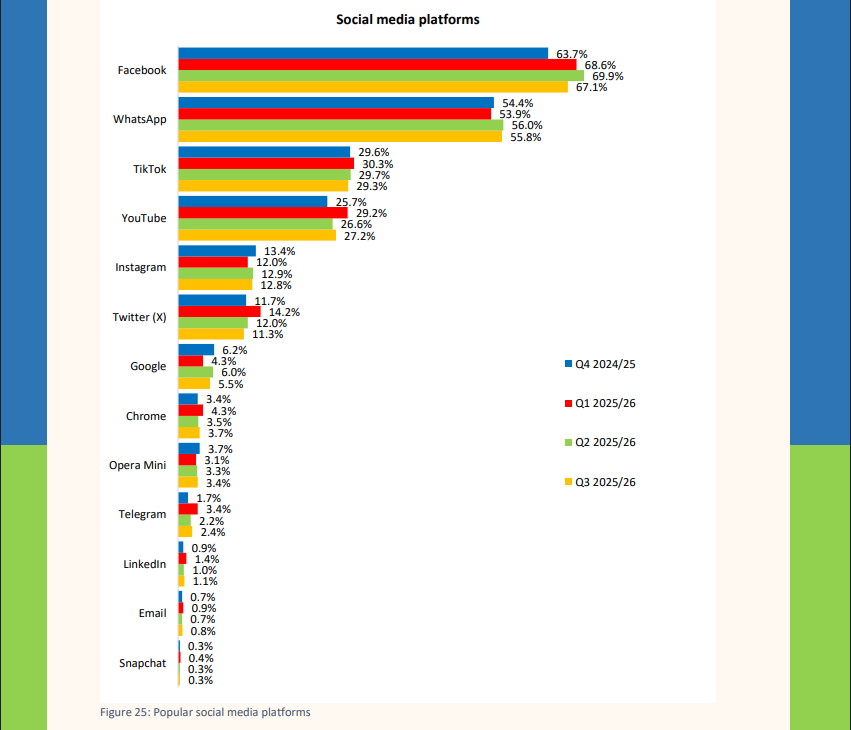
WhatsApp is no longer just where people chat with family and friends. It is where customers ask about products, schools send updates, churches coordinate members, chamas communicate, small businesses receive orders, creators build communities, and brands handle customer care. This is not surprising, given that WhatsApp ranks as Kenya’s second most-used social media platform, according to the Communications Authority of Kenya’s April 2026 Audience Measurement and Industry Trends Report. For businesses, usernames could make customer communication smoother. A customer may be more comfortable messaging a business username than saving a phone number or exposing their own number at the first interaction.
For creators, businesses and organizations, WhatsApp is also allowing eligible users to claim existing Instagram or Facebook usernames where available. This supports cross-platform consistency across Meta’s ecosystem.
What Users Gain From WhatsApp Usernames
1. Better Privacy in New Conversations
The biggest user benefit is privacy.
A username gives people another way to connect without exposing their phone number at the first point of contact. This matters in online communities, WhatsApp groups, professional networking, events, customer enquiries, training sessions and marketplace interactions.
For example, a trainer can share a WhatsApp username after a workshop instead of sharing a personal number. A freelancer can receive enquiries without exposing their direct line. A student can connect with classmates without giving out a number to everyone in a group.
This does not remove phone numbers from WhatsApp completely, but it reduces unnecessary exposure.
2. Safer Public Sharing
Many people already share WhatsApp numbers on posters, social media bios, websites, event pages, campaign material and business profiles.
That creates risk. A phone number can be copied, saved, added to spam lists, or used outside the original purpose.
A username is safer to share publicly because it is less tied to a person’s full real-world identity. This is especially useful for creators, small business owners, consultants, trainers, journalists, public-facing professionals and anyone who receives enquiries from people they do not know personally.
3. More Control Over Who Can Reach You
The optional username key is one of the most important parts of the update.
Without it, someone who knows your exact username may be able to message you. With a username key, your username alone may not be enough. The person may also need the key before they can reach you.
This gives users more control, especially when a username is shared publicly or circulates beyond the intended audience.
4. Reduced Phone Number Harvesting
WhatsApp usernames will not end spam, but they can reduce one common problem: phone number harvesting.
Today, once your number is visible in a group, poster, directory or public page, it can be copied and reused. With usernames, users can create a contact layer that does not immediately expose the number behind the account.
Scammers will adapt, but WhatsApp is removing one of the easiest ways bad actors collect personal contact details.
What Businesses and Creators Gain
1. Stronger Brand Identity
For businesses, usernames make WhatsApp more brandable.
A handle is easier to remember than a long phone number. It can be placed on websites, social media bios, ads, posters, packaging, email signatures, influencer campaigns, newsletters and customer support material.
Instead of saying “save this number,” a business can say “message us on WhatsApp at @brandname.”
That sounds simple, but it matters. Easy contact points reduce friction. In digital marketing, reduced friction can increase enquiries, conversions and customer engagement.
2. Easier Customer Entry Points
Many customers are comfortable using WhatsApp, but not everyone wants to expose their phone number to every business they interact with.
Usernames may reduce that hesitation. A customer can start a conversation with a business without feeling like they have given away too much personal information too early.
This could make WhatsApp even stronger for lead generation, bookings, product enquiries, customer service, after-sales support and social commerce.
3. Cross-Platform Consistency
A consistent handle across Instagram, Facebook, WhatsApp, LinkedIn, TikTok, X and a website domain helps customers identify the right brand. This is important because impersonation is already a major online problem. If a brand uses one name on Instagram, another on Facebook, another on WhatsApp and another on X, customers can easily get confused.
WhatsApp usernames could become part of official brand identity. For some organizations, the WhatsApp handle may soon become as important as the website domain, Instagram username or verified page.
4. Better Professional Boundaries
For founders, consultants, creators, trainers, sales teams and customer service staff, usernames can help separate personal numbers from professional communication. Many people currently use their personal phone numbers for work because WhatsApp is convenient. Over time, usernames could give professionals a cleaner way to manage public contact without exposing private numbers everywhere.
This is useful for SMEs, consultants, agencies, schools, churches, public offices, community groups and service-based businesses that already depend on WhatsApp for communication.
5. New Customer Identity Systems
There is also a technical side that businesses must not ignore.
For businesses using WhatsApp integrations, usernames affect how customers are identified in backend systems. Twilio says WhatsApp usernames introduce a Business Scoped User ID, or BSUID. When a user adopts a username, their phone number may no longer appear in some webhook payloads. Instead, the business may receive the BSUID in fields such as ExternalUserId.
This matters for businesses using CRMs, WhatsApp Business API integrations, chatbots, automation tools, helpdesks and reporting dashboards.
The simple version is this: businesses should not assume every WhatsApp customer identifier will always be a phone number. Systems may need to handle phone numbers, usernames and business-scoped IDs.
The Downsides and Risks of WhatsApp Usernames
1. User Confusion
WhatsApp’s biggest strength has always been simplicity.
You have someone’s number, you message them. That is easy to understand.
Usernames introduce another layer. Some users may not immediately understand the difference between a phone number, display name, profile name, username and username key.
This may create confusion, especially during a gradual rollout where some users have the feature and others do not.
2. Phone Numbers Are Still Required
Usernames are not a complete replacement for phone numbers.
WhatsApp users will still need a phone number to register. The feature improves privacy in some new conversations, but it does not remove the phone number from WhatsApp’s core account structure. Reuters also reported that WhatsApp said the feature was not yet live and would roll out slowly later in 2026, with phone numbers still required for registration.
This distinction matters. A username protects how you are contacted in some situations. It does not make WhatsApp completely phone-number-free.
3. Impersonation Risk
Any platform that introduces unique handles also creates competition for names. Public figures, businesses, government agencies, media houses, schools, banks, creators and organizations will need to secure official usernames early. If they do not, someone else may claim a confusingly similar name. WhatsApp has said some high-profile names, including those linked to celebrities and politicians, have already been reserved to prevent others from claiming them.
That is useful, but it does not remove the risk completely. Impersonators can still use misspellings, extra dots, underscores, abbreviations or lookalike names.
4. Username Squatting
Username reservation creates a digital land-grab moment. We are already seeing conversations online where some Kenyan users have posted about securing names linked to prominent people, while others have joked about taking up handles associated with brands. At first, it may look like harmless online banter. But it points to a real brand and reputation risk.
Usernames are digital real estate. Once people understand that a WhatsApp handle can represent a person, company, media house, public office, school, bank or creator, the race for recognizable names becomes serious.
5. Brand and Reputation Risk
For brands, the risk is not only losing a preferred username. The bigger concern is customer confusion and impersonation. A fake or confusing WhatsApp username could be used to pose as a bank, delivery company, school, government office, media brand, ecommerce store or customer care desk.That could lead to scams, fake payment instructions, personal data collection, phishing or reputational damage.
This is particularly important in markets where WhatsApp is deeply embedded in daily communication. If someone imitates a trusted name, the damage can move quickly through private chats, screenshots and groups.
6. Regulatory Concerns
The rollout has already attracted regulatory attention. Reuters reported that India asked WhatsApp to halt the username rollout in the country until consultations are complete. According to Reuters, Indian authorities raised concerns that the feature could increase online fraud, phishing and impersonation because bad actors could contact victims without revealing phone numbers. India is WhatsApp’s biggest market, with more than 500 million users. That concern is not limited to India. Any country dealing with mobile scams, phishing, fake customer support accounts and online fraud will be watching this feature closely.
The tension is clear. Users want privacy. Regulators want traceability and accountability. WhatsApp will have to prove that the feature can protect both.
7. Scammers Will Adapt
Scammers follow user behaviour. If usernames become common, fraud tactics will shift. We may see fake bank support handles, fake government service handles, fake school accounts, fake delivery support handles, fake customer care accounts and fake creator accounts. This is why businesses will need to educate customers clearly.
Just as brands tell customers not to send money to unofficial numbers, they will need to tell customers which WhatsApp username is official.
How WhatsApp Usernames Will Shape Digital Marketing
1. Messaging Will Become More Central to Customer Journeys
Social media feeds are crowded. Posts move fast. Ads are becoming more expensive. Algorithms keep changing. Messaging is different because it creates direct customer relationships. WhatsApp already plays this role for many businesses. Usernames could make the platform even more useful because customers may feel safer starting conversations without exposing their phone numbers immediately.
For marketers, this means WhatsApp should not be treated as an afterthought. It should be part of the customer journey, from awareness to enquiry, conversion, support and retention.
2. Handles Will Become Trust Signals
A WhatsApp username may soon become part of a brand’s trust infrastructure.
Customers will ask: Is this the real handle? Is this the official account? Is this the same name used on Instagram, Facebook, LinkedIn or the company website?
That means brand monitoring will need to go beyond social media pages. Businesses will also need to watch for username squatting, impersonation attempts, fake support accounts and confusing variations.
3. Brand Protection Will Become More Urgent
Many organizations are reactive when it comes to digital identity. They wait until there is a fake account, scam page or public complaint before acting. WhatsApp usernames should change that mindset. Brands should reserve official handles early, communicate them clearly and monitor lookalike names. This is especially important for banks, schools, media houses, public institutions, ecommerce brands, hospitals, churches, political actors and service businesses.
4. Customer Data Systems Will Need to Evolve
For businesses using WhatsApp at scale, customer identity will become more complex. It will no longer be enough to think only in terms of phone numbers. Businesses may need to track usernames, phone numbers, BSUIDs, CRM records, consent, customer history and support interactions.
This is especially important for brands using WhatsApp Business API, chatbots, CRMs, automated responses, lead management systems and customer support dashboards.
5. Content and Conversion Strategies Will Change
When brands promote WhatsApp usernames, calls to action will become simpler. Instead of asking users to save a number, click a long link or fill a form, brands can direct them to a memorable WhatsApp handle. This could improve conversion in campaigns, especially for service businesses, ecommerce, events, education, training, real estate, health services and customer support.
For example:
“Message @brandname on WhatsApp to book a consultation.”
“Need help choosing the right package? Chat with us on WhatsApp at @brandname.”
“Join the class updates through our official WhatsApp username @brandname.”
This creates a cleaner bridge between social media content and private customer conversations.
What Businesses Should Do Now
1. Reserve Your Official Username Early
Businesses, creators, public institutions, media houses, schools, banks, agencies and high-profile individuals should reserve their preferred WhatsApp usernames as soon as the feature becomes available.Where possible, the username should match existing handles on Instagram, Facebook, LinkedIn, TikTok, X and the brand’s website domain.
This is not a small admin task. It is brand protection.
2. Audit Your WhatsApp Presence
Organizations should check how they currently use WhatsApp. For instance, do you use one number or multiple numbers? Do you use the WhatsApp Business App or WhatsApp Business Platform? Do you have CRM integrations, bots, customer support tools or automation workflows? Or do customers know which number is official? This audit will help businesses prepare for usernames and avoid confusion later.
3. Update Customer Communication
Once your username is active, communicate it clearly. Add it to your website, social media bios, customer service scripts, email signatures, posters, packaging, ads, booking pages, newsletters and support materials. Do not assume customers will automatically know your official handle.
4. Train Customer-Facing Teams
Sales, marketing, community and customer support teams should understand how WhatsApp usernames work. They should know what customers will see, how to explain the feature, how to handle confusion, and how to report fake accounts or suspicious activity. This is especially important for businesses that deal with payments, personal data, bookings, deliveries or sensitive customer information.
5. Monitor Impersonation
Brands should monitor for fake or confusing variations of their names. This is important for banks, schools, media houses, public institutions, creators, agencies, e-commerce brands, hospitals, churches, political actors and service businesses.
A fake handle can damage trust quickly, especially on a platform where conversations are private and screenshots can move fast.
6. Prepare Your Systems
Businesses using WhatsApp APIs, CRM systems, chatbots or helpdesk tools should check whether their systems are ready for BSUIDs and username-based interactions.
If your system assumes every WhatsApp customer must be identified by a phone number, this is the time to review that setup.
What This Means for Brands in Kenya
For Kenyan businesses, this update matters because WhatsApp is already deeply woven into how customers communicate. People use WhatsApp for customer care, product enquiries, school updates, chama coordination, church groups, delivery communication, event planning, community mobilization and business transactions.
That makes WhatsApp usernames more than a privacy update. They are likely to influence how Kenyan brands manage visibility, trust, customer conversations and reputation. A business that secures a clear WhatsApp username early will have an advantage. It will be easier to promote, easier to remember and easier to verify.
A business that waits may face confusion, missed usernames or impersonation risks.
Final Thoughts
WhatsApp usernames are not just another app update.
They represent a shift in how people and businesses connect on one of the world’s most important communication platforms. The phone number will still matter, but it will no longer be the only way to start a conversation.
For users, this means more privacy and control, while for businesses, it means stronger branding, smoother customer entry points and a need to protect official handles.
On the other hand, for marketers, it means WhatsApp should be treated as part of the customer journey, not just a chat app. For scammers, it creates new tactics, which means brands and users must stay alert.
Meta is trying to solve a real user problem without turning WhatsApp into a public social network. Whether it succeeds will depend on how well the rollout handles safety, impersonation, user education and business readiness.
For now, one thing is clear: WhatsApp identity is changing.
Any brand, creator, public institution or marketer that uses WhatsApp should start preparing early. At Samodigital Agency, our advice is simple: secure your brand identity, update your customer communication, monitor for impersonation, and make WhatsApp part of a wider digital marketing and customer experience strategy. The next phase of digital marketing will not only happen on public feeds. It will also happen in private conversations, trusted handles and direct customer relationships.
Is SEO Dead or Evolving in 2026? How AI, AEO and GEO Are Changing Search
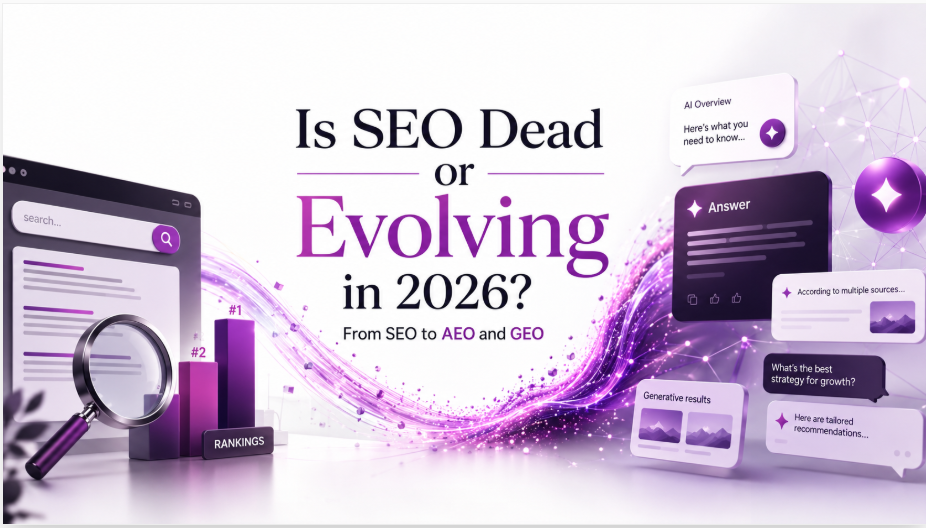
Is SEO Dead or Evolving in 2026?
Every few years, someone declares SEO dead. This happened when social media grew. It happened when voice search became popular. It happened when Google introduced featured snippets. Again, it is happening because of AI Overviews, ChatGPT, Gemini, Perplexity and other answer engines.
But SEO is not dead. What is dying is the narrow version of SEO that depended on keyword stuffing, thin blog posts, weak backlinks and chasing page-one rankings without understanding user intent.
SEO in 2026 is no longer just about appearing in blue links. It is about being discoverable, trusted, cited and chosen across search engines, AI answers, social search, voice search, local search and generative discovery.
The real question is not whether SEO is dead. The better question is whether your SEO strategy has evolved enough to match how people now search.
Search Behaviour Has Changed
SEO in the age of AI has changed. People are no longer searching only with short phrases such as “SEO agency Nairobi” or “best PR firm Kampala”. They are asking full questions, comparing options, using voice, searching on TikTok and YouTube, and expecting summarized answers.
For instance, a user might ask, “Which digital agency is best for SMEs in Kenya and why?” or “How can a PR team measure online reputation after a crisis?” These are no longer simple keyword searches. They are intent-rich questions.
Search systems are now trying to understand context, meaning, credibility and usefulness. This is why the old SEO playbook is not enough. Ranking for a keyword still matters, but it is no longer the full game.
Your content must answer real questions, show expertise, prove authority and be structured well enough for search engines and AI systems to understand it.
Why SEO Is Still Important in the Age of AI
Google itself has been clear that SEO best practices remain relevant for AI features such as AI Overviews and AI Mode. Google says its generative AI features are rooted in its core Search ranking and quality systems.
In simple terms, if your website cannot be crawled, indexed, understood and trusted by Google, it is unlikely to perform well in AI-driven search experiences.
That is an important correction to the noise around “AI SEO hacks”. You do not need to abandon SEO. You need to strengthen it.
-
Technical SEO Still Matters
Your website must be fast, mobile-friendly, secure and crawlable. A slow, broken or poorly structured website will struggle to rank, even when the content is useful.
Search engines need to access your pages, understand your structure and index your content correctly. Without that foundation, your visibility is already weak.
-
On-Page SEO Still Matters
Your titles, headings, internal links, images, schema, meta descriptions and page structure still help search engines understand your content.
Good on-page SEO is no longer about forcing keywords into every paragraph. It is about helping both humans and search engines understand what the page is about, who it serves and why it is useful.
-
Off-Page SEO Still Matters
Credible backlinks, media mentions, reviews, social references and brand mentions still shape authority. In the AI era, reputation across the open web matters even more because AI systems rely on trusted signals when deciding what to retrieve, summarize or cite.
The Evolution: From SEO to AEO and GEO
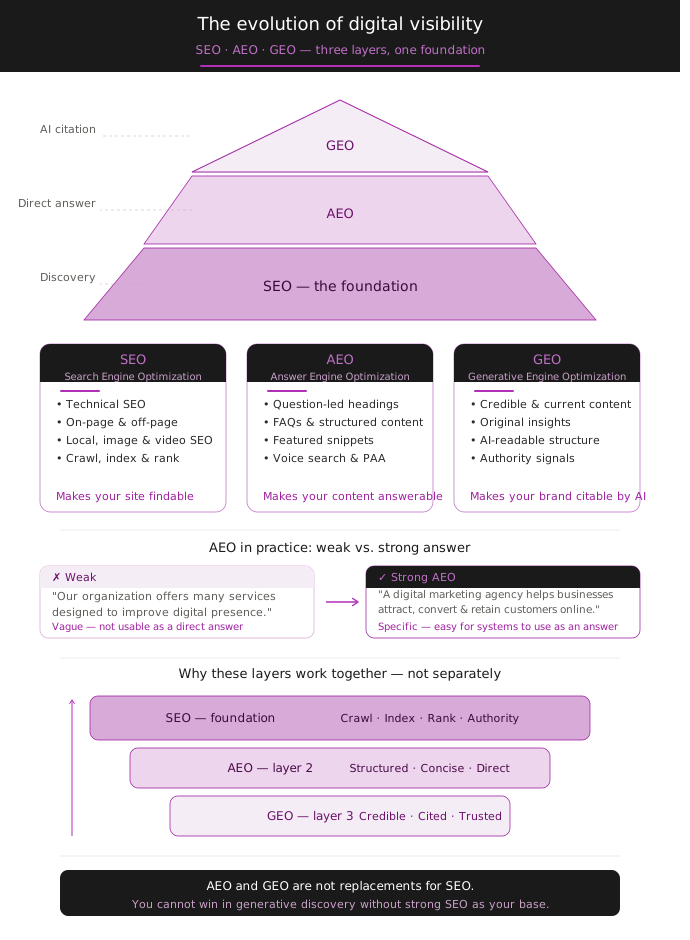
Modern visibility now has three connected layers: SEO, AEO and GEO. These three are not competing ideas. They work together.
SEO: Getting Discovered in Search Results
SEO, or Search Engine Optimization, is the foundation. It helps search engines discover, crawl, index and rank your website.
It includes technical SEO, on-page SEO, off-page SEO, local SEO, image SEO and video SEO. Without SEO, your website is harder to find and harder for search engines to understand.
AEO: Getting Selected as the Direct Answer
AEO, or Answer Engine Optimization, is about making your content easy to select as a direct answer.
This matters because users increasingly get answers without clicking through several websites. AEO focuses on question-led headings, concise explanations, FAQs, structured content, featured snippets, voice search and People Also Ask results.
For example, a weak paragraph might say:
“Our organization offers many services designed to improve digital presence.”
A stronger AEO-style answer would say:
“A digital marketing agency helps businesses attract, convert and retain customers online through SEO, paid ads, social media, content marketing, analytics and conversion optimization.”
The second version is clearer, more specific and easier for a search system to use as an answer.
What is GEO: Getting Cited by AI Answer Systems
GEO, or Generative Engine Optimization, is about making your brand, expertise or content more likely to be retrieved, trusted, synthesized and cited by AI answer systems. GEO matters because AI tools do not always show users a traditional list of links. They summarize information and cite selected sources. To be cited, your content needs to be credible, current, original and easy to interpret.
Why AEO and GEO Do Not Replace SEO
The mistake many brands are making is treating AEO and GEO as replacements for SEO. They are not replacements. They are layers on top of SEO.
You cannot win in generative discovery if your basic website structure, content quality and authority signals are weak.
SEO in the Age of AI: What Has Changed?
AI has changed search in several important ways. These shifts explain why marketers, communicators, PR professionals and organizations need to rethink how they approach search visibility.
-
Users Are Asking Longer and More Complex Questions
Instead of searching “media monitoring tools”, a user may now ask, “What is the best media monitoring tool for PR teams in Kenya tracking brand sentiment across social media and news?”
That kind of query needs more than a keyword-matched page. It needs a useful, contextual and credible answer.
-
Zero-Click Search Is Growing
Many users now get answers directly on the search results page. They may see a featured snippet, People Also Ask result, knowledge panel or AI-generated summary before clicking any website.
This means brands must measure visibility differently. A click is still valuable, but visibility, mentions, snippets and citations also matter.
-
Search Is Becoming Multimodal
People now search using text, images, video, screenshots and voice. This makes image SEO, video SEO and structured visual content more important.
A brand that only optimizes written articles is missing part of the search opportunity.
-
Authority Is Becoming Harder to Fake
AI systems and search engines need trusted sources. Clear authorship, expert credentials, original data, case studies, reviews, reputable mentions and consistent brand information now matter more.
Generic content is easy to produce. Trusted content is harder to build. That is where serious brands can win.
-
AI Search Uses Query Fan-Out
AI search can break one user question into several related searches before generating an answer. This means your content must cover topics deeply, not just target one narrow keyword.
If your website has one shallow blog post on a topic, that is not enough. You need depth, related pages, evidence, examples and a clear point of view.
How to Do SEO in the Age of AI
SEO in 2026 needs a stronger operating rhythm. It is not a one-off website task. It sits at the intersection of content, communications, product, analytics and leadership.
1. Start With the SEO Basics
Many brands want to jump into GEO before fixing the foundation. That is a mistake.
Check whether your website is indexed. Use Google Search Console. Fix crawl errors. Improve page speed. Make sure your site works well on mobile. Use HTTPS. Remove broken links. Update old pages.
A technically weak website loses visibility even when the content is good.
2. Build Content Around Intent, Not Just Keywords
Keywords still matter, but they should guide your understanding of what people want.
For every important topic, ask:
- What does the user want to know?
- What decision are they trying to make?
- What fear, confusion or problem are they bringing to search?
- What answer would actually help them?
A page that answers intent will outperform a page that simply repeats keywords.
3. Create Answer-Ready Content for AEO
Use question-based H2 and H3 headings. Give a direct answer immediately after the heading before expanding. Add FAQs to service pages. Use tables where comparison is needed. Use numbered steps for how-to content.
Write in a natural style that can be read aloud for voice search. This is how you build for Answer Engine Optimization.
4. Create Original, Expert-Led Content for GEO
AI can summarize generic content easily. It cannot replace your real experience, data, local insight, client work, industry observations or case studies.
In East Africa especially, there is still a major gap in credible local content. This is an opportunity for consultants, agencies, universities, public sector organizations, NGOs and brands to own their niche through original explainers, research reports, local examples and expert commentary.
If you want AI systems to cite you, publish content worth citing.
5. Strengthen Your Entity Signals
Search engines and AI systems need to understand who you are, what you do, where you operate and why you should be trusted.
Keep your organization name, address, phone number, service descriptions and profiles consistent across your website, Google Business Profile, LinkedIn, media mentions, directories and partner pages.
Add author bios. Show credentials. Link to credible sources. Publish an About page that actually explains your expertise.
6. Use Structured Data, But Do Not Obsess Over It
Schema can help search engines understand your content and qualify your pages for rich results.
Use the FAQ schema, Article schema, LocalBusiness schema, Product schema or HowTo schema where relevant. But schema is not a shortcut for weak content. It supports clarity; it does not create authority by itself.
7. Build Topic Clusters
One blog post is rarely enough to prove authority.
If you want to rank and be cited for digital marketing, PR measurement, media monitoring, social listening or AI search, build a cluster of related pages.
Create pillar guides, practical how-to articles, FAQs, case studies, glossary pages, comparison pages and industry insights. Search engines and AI systems reward depth, consistency and topical authority.
8. Do Not Ignore Local SEO
For businesses in Kenya and East Africa, local visibility is still powerful.
Claim and optimize your Google Business Profile. Keep your name, address, and Phone number consistent. Encourage reviews. Respond to reviews. Add local service pages. Use natural location references such as Nairobi, Kenya, Kampala, Dar es Salaam or Mombasa where relevant.
Local SEO is especially important for agencies, consultants, training institutions, restaurants, health facilities, public services, real estate firms and professional service businesses.
9. Optimize for Images, Video and Social Search
Search is no longer limited to Google’s traditional results page. Users search on YouTube, TikTok, Instagram, LinkedIn, Pinterest and AI tools.
Use descriptive file names, alt text, captions, transcripts and clear titles for images and videos. Repurpose strong articles into carousels, short videos, explainers and LinkedIn posts. This improves discoverability across platforms where audiences are already searching.
10. Measure Beyond Rankings
In 2026, SEO reporting should not stop at keyword rankings.
Track organic traffic, impressions, click-through rate, indexed pages, Core Web Vitals, backlinks, featured snippet ownership, People Also Ask visibility, local pack appearances, branded search growth, AI Overview appearances, AI citations and conversions.
The master metric is visibility share: how often your brand appears across traditional search, answer engines and AI-generated responses for the conversations that matter in your sector.
What This Means for Brands and Organizations
The brands that will win search in 2026 are not the ones producing the most content. They are the ones producing the most useful, credible and findable content.
Organizations need to stop treating SEO as a technical task left to one person after the website is built. SEO now affects brand reputation, thought leadership, customer acquisition, public communication and digital trust.
- A public institution should ask: are citizens finding accurate answers from us or from third-party summaries?
- A PR team should ask: when people search our brand during a crisis, what do they find first?
- A university should ask: are prospective students finding clear programme pages, credible faculty profiles and useful application information?
- A business should ask: when AI tools recommend service providers in our sector, are we visible or invisible?
- These are no longer small questions. They are visibility, reputation and revenue questions.
So, Is SEO Dead?
To conclude, No. SEO is not dead. It is becoming more strategic, more technical, more content-led and more reputation-driven.
What is dead is lazy SEO. Publishing generic articles, adding keywords mechanically, buying weak backlinks and hoping Google will reward you is no longer a serious strategy. The brands that will win in 2026 are the ones that understand how people search, how AI systems retrieve information, and how trust is built across the open web.
SEO has evolved from ranking pages to earning visibility. AEO helps you become the answer. GEO helps you become the cited source. But SEO remains the foundation that makes both possible.
If Google, ChatGPT or Gemini introduced your organization to a stranger today, would you be proud, worried, shocked or invisible?
That is the real SEO audit for 2026.
Contact us for SEO and Website Optimization services at info@samodigitalagency.com

AI Slop in Marketing Isn’t Failure: Ketepa, NTSA, and the Messy Middle
TLDR: AI-generated marketing can misfire — or create what’s called AI slop. Ketepa Tea, NTSA, and Coca-Cola show how public feedback and iteration turn AI missteps into stronger campaigns.
February is the month of love, a season when brands lean heavily into emotion, gifting, and cultural moments. This year in Kenya, however, Valentine’s conversations went beyond flowers and chocolates. The Central Bank of Kenya cautioned against the misuse of banknotes amid the growing trend of money bouquets, highlighting how cultural moments, regulations, and public behavior intersect.
Against this backdrop, brands and public institutions turned to AI-generated images to participate in the moment. Ketepa Tea shared an AI-generated image of tea sachets arranged as a bouquet, prompting criticism around tone, timing, and authenticity.
Around the same time, the National Transport and Safety Authority (NTSA) faced backlash after publishing an AI-generated #UsalamaBarabarani image that appeared to contradict its own road safety message. In both cases, audiences quickly identified the gaps and voiced their feedback.
These moments sparked a broader conversation about AI-generated images and videos in marketing and the growing phenomenon often referred to as AI slop. More than isolated missteps, they reveal how brands are learning to use AI in public — navigating feedback, iterating in real time, and refining their approach as audiences become more AI-aware.
What is AI slop in Marketing?
AI slop refers to low-quality, obviously AI-generated content that fails authenticity tests and lacks the human oversight necessary for quality marketing. It is characterized by visual tells like distorted hands, impossible physics, nonsensical text, and, perhaps most critically, missing cultural context that make content resonate.
AI slop is not simply “bad content.” It often results from:
- Over-reliance on AI tools
- Weak or rushed prompting
- Limited human oversight
- Speed prioritized over strategy
Crucially, AI slop reflects process gaps, not proof that AI itself does not work. Many of these outputs are not failures, but early-stage experiments published too quickly.
But here’s what makes AI slop particularly problematic in 2025: today’s consumers are AI-literate. They can spot it instantly, and they expect better.
Why AI Slop Happens, Especially With Images and Video
AI slop is most visible in visual marketing for several reasons.
First, AI lacks lived context. Generative tools do not understand cultural nuance, regulation, emotion, or local realities. They work from patterns, not experience. Without human review, inconsistencies slip through.
Second, AI accelerates execution faster than judgment. What once took days of creative review can now be produced in minutes. When thinking does not keep pace with production, mistakes become public.
Third, visual content leaves no room for explanation. Audiences interpret images instantly. A single contradiction can undermine an entire message.
A Global Example: Coca-Cola’s Christmas Controversy and AI-Generated Creativity
In 2024 and 2025, Coca-Cola attempted to recreate its iconic “Holidays Are Coming” Christmas campaign using AI generation. The result? A soulless recreation that lost all the warmth and nostalgia of the beloved hand-crafted original. Visible AI artifacts and uncanny valley effects prompted hashtags like #BoycottCokeAI to trend. The message from consumers was clear: when you’re a heritage brand built on emotion, AI cost-cutting feels like betrayal.
Kenyan Case Study: NTSA and the #UsalamaBarabarani Campaign
Kenya’s National Transport and Safety Authority’s campaign #Safewalking #UsalamaBarabarani (Road Safety) campaign, advocating for zebra crossing usage, offers a clear example of contextual misalignment.

One of their AI-generated image shared on social media showed both a zebra crossing and a footbridge in the same frame. The public response was immediate: “Why would anyone use a ground-level crossing when there’s a safer footbridge option?” The image undermined the entire safety message, demonstrating AI’s inability to understand contextual logic.
NTSA deleted the post, but the damage to credibility was done. Here is the next post they shared on X.
Every minute saved is not worth a life lost.
Use the footbridge, it’s there to protect you.
#SafeWalking #UsalamaBarabarani pic.twitter.com/NBsFRiLWW3— NTSA KENYA (@ntsa_kenya) February 4, 2026
Ketepa Tea: Turning AI Backlash Into Iteration
Unlike the others, Ketepa’s response became a masterclass in crisis management. Ketepa Tea’s response stands out as a positive example of how brands can move forward after criticism.
After backlash over its AI-generated sachet bouquet, Ketepa did not defend the output or disengage. Instead, the brand listened. Here is the post that received a lot of criticism online.
Ketepa wishes to remind the public that section 1 of the Love Languages Code – aka the gifting of Ketepa Tea bags in decorative and romantic bouquet displays during this month of love is an enshrined freedom that all Kenyans across all walks can engage in without fear of… pic.twitter.com/c6rmS4ZGgb
— Kenya Tea Packers (@KetepaLtd) February 3, 2026
Kenya Tea Packers followed up with a new post featuring real flowers, real tea sachets, and a human presence, accompanied by the message “From AI to real tea.”
Ilibidi tutea.
Ketepa Tea Bouquet iko official,
romantic, inabrew love live.
Mapenzi ni vitendo… na tea ni lugha yetu.#KetepaTeaBouquet#ChaiNiKetepa#BrewLove pic.twitter.com/bbdehAiMOD— Kenya Tea Packers (@KetepaLtd) February 6, 2026
This shift mattered. It showed responsiveness, humility, and an understanding that AI should support storytelling, not replace human connection.
The Messy Middle of AI in Marketing
These examples illustrate what can be described as the messy middle, the phase between experimentation and mastery.
Marketing has always evolved this way. Early social media content was awkward. Early mobile ads were intrusive. AI is no different. The difference today is visibility. AI compresses timelines and exposes learning curves publicly.
The case of Coca-Cola, Ketepa Tea, and NTSA, among others, who have boldly shared their AI-generated campaigns are example of brands that are no longer iterating behind closed doors. They are doing so in real time, with audiences actively participating in the feedback loop.
They proved that listening and adapting create more trust than getting it perfect the first time.
Each public failure trains marketers on what doesn’t work. Failed examples become case studies that refine our collective understanding of AI’s appropriate use. Community feedback improves prompt engineering industry-wide. The messy middle isn’t where brands get stuck; it’s where they build the institutional knowledge that leads to mastery.
Today’s Awakened Consumer
What makes 2026 different from even two or three years ago is audience sophistication. Some consumers can increasingly spot AI-generated content through visual tells, tonal genericness, and logical inconsistencies. More importantly, they expect better. The sentiment you see on social media isn’t “don’t use AI”, it’s “if you’re using AI, at least make it good.”
This creates what is known as the authenticity paradox: brands must use AI for efficiency and creativity, yet audiences crave human connection and genuineness. The solution is not choosing between AI and authenticity. It needs brands to use AI as a tool while keeping humans as decision-makers.
Moving From AI Slop to AI-Smart Marketing
The difference between AI slop and AI success comes down to process. Successful AI marketing follows this framework:
- Generate multiple versions using AI for speed and scale.
- Review through multi-stakeholder quality checks that include cultural consultants and brand guardians. Refine based on expert input and cultural context.
- Test with small audience segments before full rollout. Approve only after final human sign-off confirming brand alignment.
- Monitor real-time sentiment post-publication. Iterate continuously based on learnings.
The critical element? Human oversight at every stage. AI should accelerate creativity, not replace judgment.
Brands must also build internal AI governance: documented learnings, prompt libraries with proven results, brand-specific guidelines, and team training on AI literacy. Quality thresholds should be established before generation begins, not after problems arise.
Conclusion
AI slop is not the end state of AI in marketing. It is a transitional phase that reflects experimentation, learning, and adjustment.
What defines strong brands is not the absence of mistakes, but how they respond. Brands that listen, iterate, and humanize their use of AI will build stronger trust and more resilient connections with their audiences.
In marketing, progress has never been perfectly polished. With AI, the learning just happens in public and when handled well, that visibility can become a strength rather than a weakness.
10 Proven Strategies to Boost Your Business on X in 2025
X formerly Twitter remains a powerhouse for real-time engagement, thought leadership, and customer connection in 2025. For marketers, brands, social media managers, businesses, solopreneurs, and creators, mastering X can drive visibility and conversions. In this article we share 10 actionable strategies to elevate your presence on X platform.
1. Optimize Your Profile for Maximum Impact
The first thing you need to do on X is to optimize your profile. Craft a profile that stands out. Use a clear logo or headshot, a professional header. Also have a bio that nails your brand’s value proposition. As you craft your bio, include niche-specific keywords and a link to your website to boost discoverability and conversions.
You can also add location and link to your other platforms or website.
2. Post Consistently with Diverse Content
Having an account on X without posting won’t bear you fruit. You need to post content consistently.Aim for 1-2 daily posts to stay visible without spamming followers. Mix text updates, images, short videos, and polls to keep your feed engaging. Data shows visuals and emojis can lift engagement by 30%. Keep posts concise (under 280 characters) for X’s fast-moving feed.
If you need to post content beyond 280 characters, you need to subscribe to X Premium. Understand the different features offered and go for the one that you can afford. X Premium also promises to boost your visibility on X.
3. Prioritize Real-Time Engagement
On X users expect quick responses 59% use the platform for news and updates. Therefore, you need to reply to comments, mentions, and DMs promptly to build trust. Moreover, you also need to join trending conversations in your industry to establish authority and use relevant hashtags to expand reach. This enhances visibility on the platform and helps you grow your brand and build an engaging community.
4. Embrace Video and Audio Features
X is doubling down on video and audio in 2025. Over time, they have made enhancements on video features such as introducing the ability to upload longer and 4K high quality videos. With that in mind, you need to create short-form videos (e.g., product demos or behind-the-scenes clips) to capture attention. Besides posting videos, you can also host Spaces for live audio discussions on industry topics to connect authentically with your audience. You can have thematic areas and recurring days when you are hosting Spaces.
Our Corporate Banking clients are at the heart of our success. With a customer-first approach and a comprehensive suite of solutions, I&M Bank is your partner for sustainable business growth.#IMBank #OnYourSide pic.twitter.com/Jo5MxJVgD6
— I&M Bank Kenya (@imbankke) May 26, 2025
5. Tell Stories That Resonate
Trends come and go, but storytelling drives conversions. There are different approaches to story telling. You can share customer success stories, company updates, or relatable insights. Repurpose high-performing content from Instagram or TikTok, but tweak it for X’s conversational vibe.
While on a routine wildlife health assessment in Meru National Park, the Meru Mobile Veterinary Unit encountered a solitary plains zebra stallion that had distanced itself from its herd. The zebra showed signs of severe pain, lack of appetite, and difficulty walking—prompting an… pic.twitter.com/aM3rGhhH5x
— Kenya Wildlife Service (@KWSKenya) April 24, 2025
6. Leverage Analytics for Smarter Posting
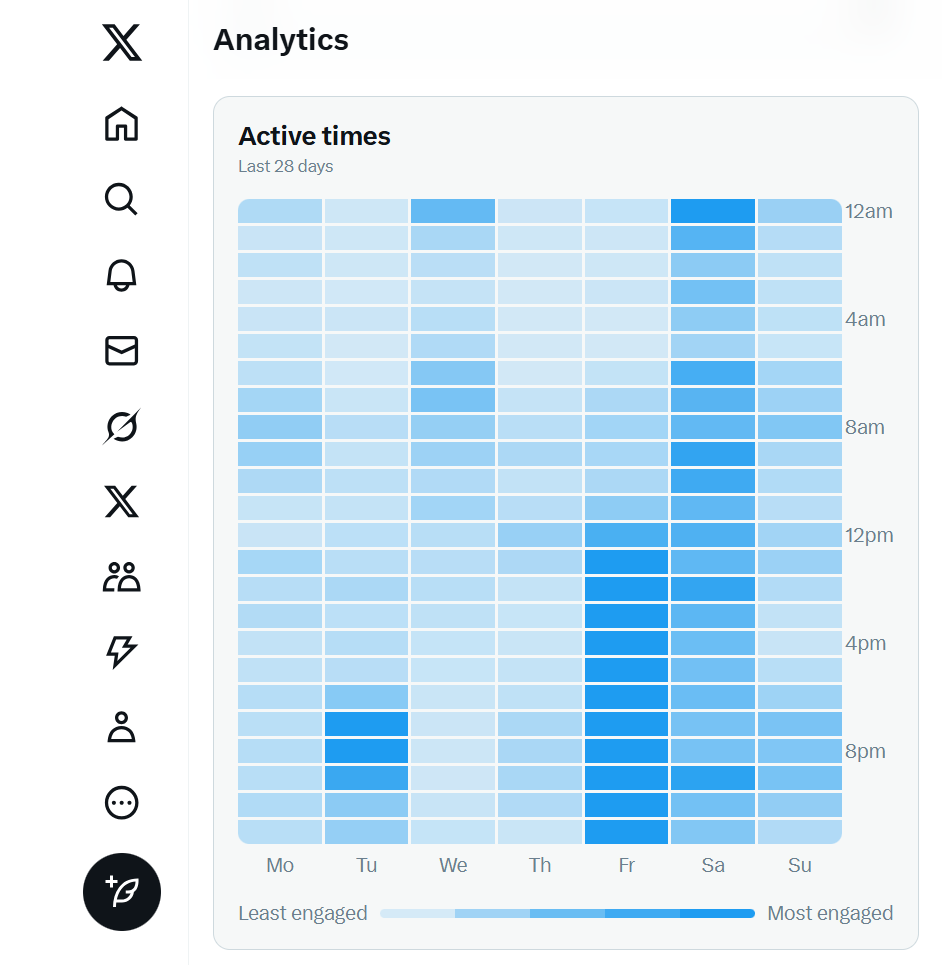
Use X analytics or tools like Hootsuite to identify peak engagement times and track performance. Nowadays, X analytics can show you when most of your audience are most active. Make use of this to know when best you can post content for maximum visibility and engagement. To add on, you need to conduct monthly audits to monitor follower growth and engagement rates, benchmarking against industry standards to refine your strategy.
7. Build an Email List for Control
X’s algorithm and ownership shifts can affect visibility. Besides that, an outage can appear and your audience will be in the dark. You need to build and email list and drive followers to your email list with compelling CTAs, like exclusive offers or newsletters, to maintain direct audience access.
8. Invest in Paid Promotion
Over time, the organic reach on social media platforms has declined, hence you need to boost your reach with paid ads. X leaning pay-to-play, consider ads or boosted posts to ensure reach. Target by interests or demographics for precision, and amplify high-performing organic content for better ROI. To start running your ads go to X ads manager. Alternatively, you can contact us at Samodigital to help you set up converting ads on X.
9. Collaborate for Growth
Another strategy that works like magic on X is partnering with influencers. Be strategic and Partner with micro-influencers or complementary brands to expand reach. Tag non-competing creators in posts to encourage reshares. Engage in X communities or niche discussions to build credibility and attract followers.
10. Stay Agile with Platform Changes
Just like any other social media platform, X keeps evolving with new features, tweaks in algorithms. X’s ad landscape and X continues to evolve its AI tools, with its Grok AI chatbot now able to generate images, including ad variations, based on text prompts. You also need to test new formats like X Money for monetization potential and see how they help you grow. and use tools like SocialBee to streamline scheduling and monitoring.
Adapt quickly to stay ahead.
Why X Matters in 2025
X’s real-time nature makes it ideal for customer service, PR, and thought leadership. Its audience (56.8% male, 43.2% female, mostly 25-34) is highly engaged, especially in the U.S. and Europe. Combine X with 2-3 platforms like LinkedIn or Instagram to maximize impact. For ad pricing or subscription details, visit X Premium.
Focusing on authenticity, engagement, and strategic testing, you can turn X into a growth engine for your brand in 2025.

X Premium Review: Is Paying To Be Verified On X Worth It?
X Premium Review: Is Paying To Be Verified Worth It?
15th October 2023, marked exactly a month since I subscribed to X Premium and I thought of giving a review based on my personal experience. Is it worth giving Elon Musk your $8 monthly? What are the features that come with X Premium formerly Twitter Blue?
What’s X Premium formerly Twitter Blue?
For starters, X Premium is a paid subscription introduced by X after Elon Musk #TwitterTakeOver that goes for $8 on the web and $11 on Android and iOS in a bid to counter bots on the platforms. X Premium comes with premium features that a normal user can’t access
Why Did I subscribe to X Premium
First, I subscribed to X premium because I wanted to explore the features offered by X. Secondly, my posts were receiving less impressions despite getting some engagement such as likes and retweets.
Thirdly, in line with that, I got Influencer gigs early September to live tweet events. This meant my posts needed to get more impressions for my posts for me to deliver.
What are X Premium Features?
Here are some of the features or benefits you get when you subscribe to X premium:
Edit Post: X doesn’t allow you to edit posts after sending out posts. However, with X premium, you can edit posts up to 1 hour after sending it out.
Undo Post: You can also undo posts before getting visible to your viewers. After undoing it, you can edit. I have used this option more than the edit feature
Highlight posts: On X premium you can highlight some of your best posts on your profile. See, the way you can pin a post, yes but now number of the to a dedicated highlight tab. I have used this alot since it makes it easier for a user to go through my profile and understand what I do and stand for on the platform
Post Longer posts: On the premium version, you can tweet beyond the usual 280 characters. X premium supports 25000 characters with 4 in line images. I find this feature useful, especially when I want to share weekly recap of social media updates. Not bad after all!
Get boosted in rankings in conversations and search: If you are on regular X version, you will notice you have view impressions despite getting interaction on posts. X premium boosts your ranking on X feed and also on search. Also, on replies sections your replies are prioritized.
Interestingly when starting in September I had about 9600 followers and a month later I hit 10.1k followers with more increase. Also, if I compare my X posts impressions between August 14th to September 14th, I had 262.3K impressions compared to 31 days of having a badge, I got 853.6K impressions
Use Text Formatting: On the web, you can bold and italicize text posts. This comes in handy when I want to emphasize a point or word.
Organize Bookmarks: Bookmarking posts on X is not just enough, you can also organize your bookmarks into folders. I prefer to organize folders to different topics for easier retrieval because it lacks the search feature.
Create Communities. On X premium you can create up to 10 communities and spotlight your communities on your profile. I have a growing community on X on Digital Trends and Insights. Join here
Monetize, Make money: When you subscribe you can earn as a creator through X Ads share revenue program once you achieve 5 Million Impressions in the last 3 months.Payouts are made out after every two weeks.. Another way you can make money X is through subscriptions, where you can lock your content behind a certain preferred fee.
Psst! Despite the growth in impressions and followers, I haven’t managed to monetize my account.
Get Access to X Pro: Remember the Free tweetdeck? Yes it’s now a premium feature behind 8 dollars renamed as X Pro. Still to explore more with its new interface. Thread Reader: When reading threads, you can use a new reading experience as one continuous post the way long posts look like. I love it!
Post longer high quality videos of up to 3 hours long.
Account analytics: You will get quick access to your account analytics in the last 7 days.
Account Protection: X Premium allows you to add an extra layer of your account protection with two-factor authentication via SMS.
These are some of the X Premium features. You can explore more benefits here
How Do You Get Verified On X?
The verification process on X is very easy. You can choose to get verified on the Web to save up those 3 dollars.
Here is how to get verified on X for Individual accounts
Step 1. Go to your Profile Menu and Click on “ X” on the Menu.
Step 2. A new window will pop up showing Individual and Verified Organizations
Step 3. Next, click on Individual followed and hit “Subscribe” button
Step 4. From there decide if you will go for monthly or annual subscription
Step 5. Next, Pay by providing your card details and subscribe.
Immediately X will grant you access to premium but you will have to wait for them to review your application before the badge appears on your username. Mine took about 4 days to reflect on my X account
Is it worth paying for the blue tick on X?
The answer lies if you find the features locked behind the $8 dollars valuable. For instance, if you want to grow your account, get prioritized and or are struggling with visibility on the platform, you may consider getting the badge.
NB:X is testing a new program known as Not A Bot that will require non- verified users to pay an annual fee of 1 US dollar to be able to post, retweet, reply, like repost or bookmark posts. Read more here Oct 23-2023: 10 Things That Happened in The Digital Space Last Week
7 Essential Qualities of a Successful Digital Marketing Consultant
What does digital marketing consultant do?
In todays’ ever changing world, you may need to work with a digital marketing consultant to elevate the growth of your business. What does a digital marketing consultant do? A digital marketing consultant is a professional who helps businesses and organizations develop and execute effective digital marketing strategies. They provide expert advice and guidance on various aspects of digital marketing. This will help you achieve their marketing goals and increase their online presence.
Here are some key responsibilities of a digital marketing consultant
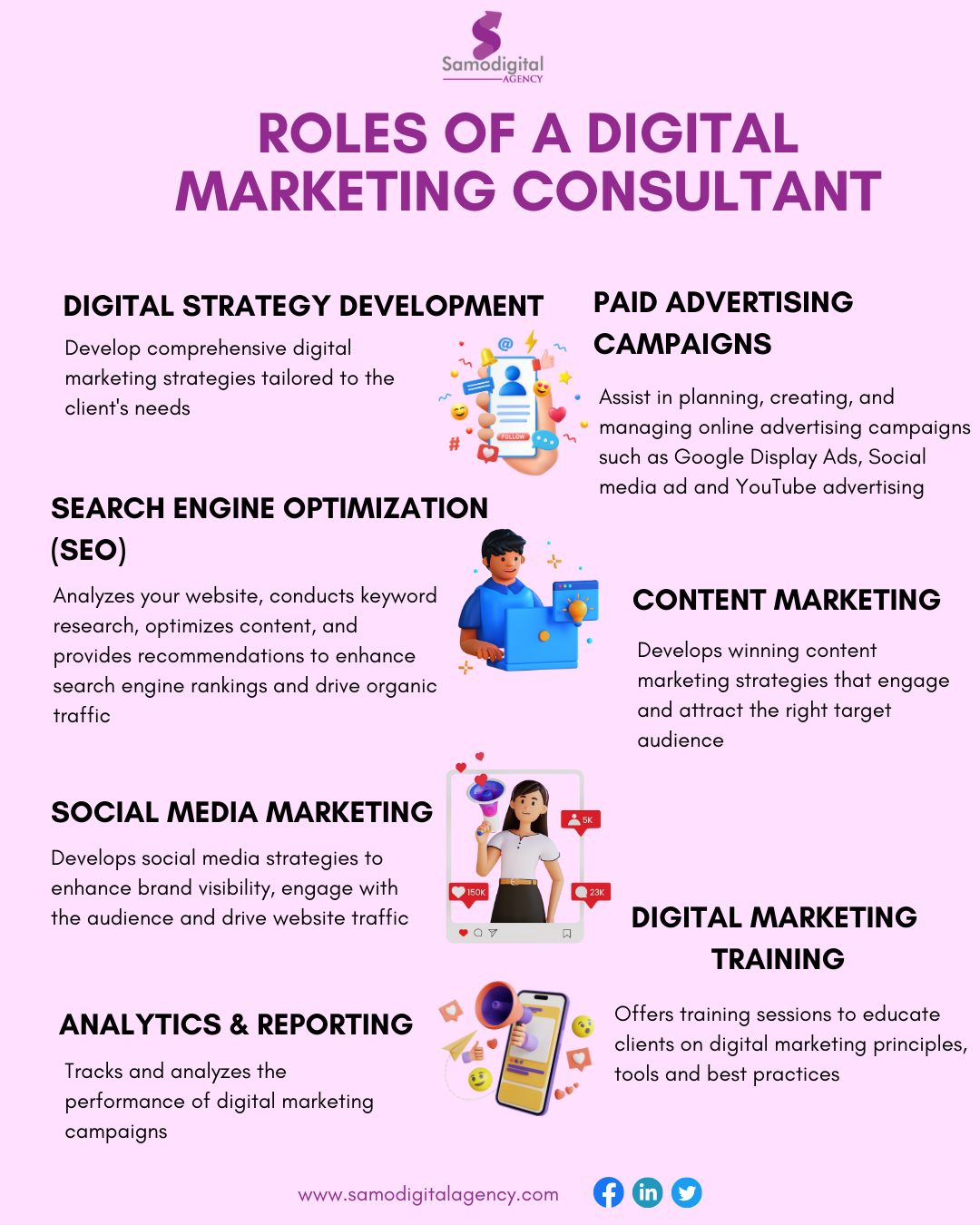
Roles of a digital marketing consultant Samodigital Agency
1. Digital Strategy Development
A consultant collaborates with clients to understand their business objectives and target audience and ideal social media platforms. They develop comprehensive digital marketing strategies tailored to the client’s needs. This involves identifying the most suitable digital channels and tactics to reach the target audience effectively.
2. Run Paid Advertising Campaigns
Hiring a digital marketing consultant will assist you in planning, creating, and managing online advertising campaigns across platforms such as Google Ads, social media platforms, and YouTube advertising. They will help you optimize campaigns to achieve maximum reach, engagement, and conversions within the allocated budget.
3. Search Engine Optimization (SEO)
As you know, SEO is crucial for improving a website’s visibility in search engine results. You will not be able to execute this alone if you don’t know how to do it. That’s why you will need an experienced digital marketing consultant. A digital marketing consultant will help you analyze websites, conduct keyword research, optimize content, and provide recommendations to enhance search engine rankings and drive organic traffic Share on X. Some will even be able to write engaging and informative content for your website.
4. Content Marketing
Content is King! It’s what drives engagement, leads and conversion for any business. A consultant will also help you develop winning content marketing strategies that engage and attract the right target audience. You can read this article to understand types of content and why it’s important to brands. Consultants often assess the performance of content and make suggestions for improvement.
5. Social Media Marketing
Moreover, consultants assist in developing social media strategies to enhance brand visibility, engage with the audience, and drive website traffic. Right now, we have top social media platforms and emerging platforms. Platforms like Threads, Lemon8, Bluesky and much more to come. Therefore a consultant will recommend platforms suitable for your business, create content calendars, and provide insights.
Also, they will optimize social media posts and advertising to ensure you gain the most from your marketing efforts and return investment.
6. Analytics and Reporting
With digital marketing you can easily track and measure your marketing efforts. To add on, working with a consultant will help you use various tools to track and analyze the performance of digital marketing campaigns. These could be web analytics tools like Google Analytics, In-app social media analytics or third party analytics tools like Semrush, Sprout Social among others.
Moreover, They will provide you with reports while highlighting key metrics, trends, and areas for improvement. Consultants use these insights to refine strategies and make data-driven decisions.
7. Digital Marketing Training
Finally, some consultants may offer training sessions to educate clients on digital marketing principles, tools, and best practices.If you are in Kenya and you would like to have in-house training for your team, you can hire a certified digital marketer like Egline Samoei Share on X. She will help you gain a better understanding of digital marketing and empowers them to execute strategies independently if desired. Yo can reach out via email at egline@samodigitalagency.com
In Conclusion
To conclude a digital marketing consultant helps businesses leverage digital channels effectively to achieve their marketing objectives, improve brand awareness, drive website traffic, and generate leads or sales. Lastly, they stay updated with the latest trends and technologies in the digital marketing landscape to provide valuable insights and guidance to their clients.
How To Create A Successful SEO Content Strategy in 2023
Google keeps updating its ranking algorithm; hence digital marketers and business websites must update their SEO content strategy. The competition to rank better in SEO and attract more visitors narrows to having a winning SEO content strategy.
This article guides you on how to create a successful SEO content strategy in 2023.
1. Understand your Target audience
Before creating any content, you must know your audience, interests, and search intent. Audiences visit your page not because they like it but because they need a solution. If you don’t offer a solution to their needs, you probably add no value to them, and they will visit other pages.
Understanding your audience can help you create relevant and engaging content that resonates with them, increasing traffic, engagement, and conversions.
There are many ways to understand your audience. You can conduct market research, carry out client interviews, create personas, use Google analytics, and analyze your competitors. With the evolving technological landscape, make sure you align your strategies with the industry trends.
2. Conduct Keyword Research
While the SEO algorithm uses several parameters to rank a website, keywords cannot be underestimated. Keywords are the backbone of any SEO content strategy.
Conducting keyword research is vital to identify what people are searching for and how to optimize your content for those queries. Simply put, keywords give you the user’s intention and subsequently attract an audience looking for your solution.
Finding relevant and high-volume keywords is a game-changer, and high-ranking sites can attest to it. Pull all your strings to obtain the right keywords for your content. While finding these keywords can be an uphill task, things become far much easier with keyword research tools.
Input suitable keyword phrases, long-tail, and funnel keywords to generate high-ranking keywords for your page. Finally, integrate the generated keywords into your page and see the magic traffic you will pull.
3. Create High-Quality Content
Creating high-quality content is a must-have ingredient in your SEO strategies. It never gets old, and there are no signs that quality content will drop its weight in the SERP algorithm. The beauty of quality content is that it provides value to your audience and gives them a reason to visit and stick around your page.
Creating quality content is not a rocket science task. Just make your content error-free, engaging, informative, authentic, factual, and relevant. Furthermore, add visual and multimedia elements to make your content eye-catchy and genuine. You can use charts, graphs, videos, audio, appealing images, and data tables. Well-crafted content enhances user experience and statistically generates high click-through rates (CTR).
4. Optimize Your Content
Optimizing your content for search engines and devices is an important SEO content strategy in 2023. You ought to make your content visible to search engines by optimizing your content, including keywords in title tags, meta descriptions, header tags, and throughout the body of the content. Make it organized and appealing to users.
Also, ensure that your content is mobile-friendly and loads quickly. Remember, millions of users use mobile phones to shop online, and this trend will continue. If your page is not mobile-friendly and takes too long to load, then be ready to lose more leads.
5. Align your SEO Strategies with Brand Goals
. Aligning your SEO strategies with brand goals is crucial for the success of your business. SEO strategies deviating from your brand goals can waste efforts, resources, and poor ROI. When your SEO strategies align with your brand goals, you create a consistent message across all channels and experience increased brand awareness and recognition.
Your brand goals communicate your identity and objectives. SEO efforts can help you reach your target audience, build trust and authority, and drive conversions. By aligning your SEO strategies with your brand goals, your efforts target achievable, measurable, and meaningful results. You create a strong brand identity, gain a competitive edge, and ultimately drive long-term growth and success.
Conclusion
Getting a successful SEO content strategy for 2023 can be tough, especially with the rapidly evolving SEO landscape. Nevertheless, you don’t necessarily need to be an expert to pull outstanding SEO strategies for your brand. Many SEO strategies fit your brand and have been well-elaborated in this article. Leverage these SEO strategies and attract massive traffic to your site.
8 Effective Ways To Use Twitter to Grow Your Business
How To Use Twitter to Grow Your Business
Twitter is one of the most powerful social media platforms that you can use to raise awareness about your business, engage with customers, and generate leads. Twitter boasts 229 million daily active users as of April 2022. So, if you are still wondering if you should use Twitter to grow your business, the answer is “Yes.”
All you need to know is how to set up your account and connect engagingly with people. Remember, people, go to Twitter to discover what is trending and not to be marketed to by brands. Therefore, when your business is on Twitter, you need to have conversations that matter to your community that will help your business grow and thrive.
This article looks at ways to use Twitter to grow your business. But first, let us look at what account you need.
Types of Accounts Available on Twitter
In the past, Twitter used to have one general type of account. However, in the recent past, Twitter introduced the following:
- Twitter for Professionals is meant to provide businesses, creators, publishers, and developers of all industries and sizes to showcase and highlight their content, products, and services directly on Twitter for free.
- Twitter Blue which is a monthly subscription that gives the most engaged people on Twitter exclusive access to premium features
Tip: Set your regular Twitter account and switch to Twitter Professional. This will help you specify the category and account type as a business. It will be easier to grow your business on Twitter.
Ways to Use Twitter to Grow Your Business
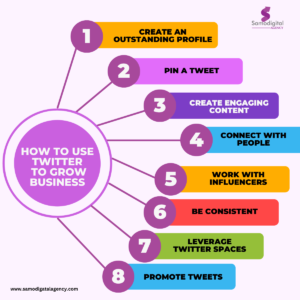
Infographic: How to Use Twitter To Grow Business
Create an Outstanding Profile
Begin by setting up your business account. Choose a display name that is easy to read. Also, use and handle that is consistent with your brand. You may not get the handle that matches your brand name because it’s been taken, but try to use something that still aligns with your brand name. For instance, @SamodigitalAgency was taken, we used @SamodigitaA
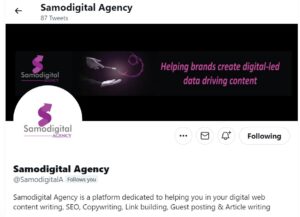
Samodigital Agency Twitter account
Next, you need a cover photo that compliments your brand colours and acts as an ever-changing billboard showcasing what’s new with your business. If you have offers or promotions or are celebrating a season, you can change it accordingly. Also, have a profile photo which preferably should be your company logo. The ideal dimension of a Twitter profile photo is 400x400px, whereas the cover photo dimension is 1500×500.
After that, you need to create a memorable bio that provides Information like your business mission statement, value proposition, location, branded hashtag, or operating hours.
Pin a Tweet
Once you have set up your profile, it’s time to send out Tweets. You will have to create different tweets daily or weekly. If you had created a tweet showcasing your brand, it would get overshadowed by the latest tweets. Therefore, it’s advisable to pin the tweet. A pinned tweet will appear on top of your Twitter profile, and you can change it anytime you have something new you want to inform your audience.
Here is an example of pinned Tweet
Why should you monitor social networks as a brand/ business?
Social media monitoring is the process of tracking hashtags, keywords, and brand mentions in order to stay informed about your audience and industry trends & topics
We can help you do social media monitoring in Kenya pic.twitter.com/20CHEc88XK— Brandmoran- Social Listening Tool (@BrandmoranKE) December 17, 2021
Create Engaging Content
You need to create engaging content to capture the attention of your followers and target audience. Try and express this through different supported formats like texts, videos, images, infographics, GIFs, and memes.
You can also combine all the formats, as Twitter now lets you post images, videos, and GIFs in a single tweet. Be creative in how you create your content. Ensure they are informative and educational and add value to your clients.
Also, add some humour to your content. Humour humanizes your brand. It’s also memorable and easily shareable. A brand like Mwango Capital uses memes to recap and share news about the business in Kenya.
????? ???? ????’? ??? ???????? ???? ?? ????? ?? ??????? ?? @CAK_Kenya:
1. KRA is set to come down hard on Kenyans as the President has set them a target of doubling double tax collections by the end of his first term.#MwangoMemes pic.twitter.com/7gtRjY04pr
— Mwango Capital (@MwangoCapital) October 29, 2022
Work with Influencers
Influencer marketing has proven to be one of the most effective marketing strategies. Influencers help create brand awareness, reach a new target audience, raise brand advocacy, and increase sales. Moreover, people trust consumer recommendations. You must work with the right influencers within your industry and niche, even when they have a small following. According to a blog post by Twitter, brands are now shifting to working with micro-influencers over mega-influencers since they offer trusted reviews and have built a strong following that can be valuable to brands.
Here is an example of how ShowmaxKenya worked with one of the top social media influencers, Janet Machuka to promote their shows
On my Twitter Spaces tonight sponsored by @ShowmaxKenya!
A chat on a documentary called “Love Crimes of Kabul.”
Joining link: https://t.co/KEVR2sj9qb #Showmaxing pic.twitter.com/BTjFOSZYEy
— Janet Machuka (@janetmachuka_) October 31, 2022
Be Consistent
Another way to grow your business effectively on Twitter is by being consistent on the platform. Tweet at a specific frequency, depending on what works for your brand. For some brands, tweeting three times a week works for them, while tweeting daily works for others. Choose what works for you and stick to that.
Connect with People
As a business, you are also free to follow other accounts. Follow the people within your industry, thought leaders, partners, stakeholders, brand advocates, customers, and fans. These groups of people will likely follow back and engage with your content and eventually help to create brand awareness.
Leverage Twitter Spaces
During the Covid-19 pandemic, social audio content emerged that helped people connect while keeping their distance. We saw the emergence of platforms like Clubhouse, Facebook audio rooms, and Spotify Greenroom among others. To keep up with this trend, Twitter introduced Spaces. Spaces are live audio conversations on Twitter.
As a business, you can host spaces to discuss industry topics, get feedback about your product or answer questions about your product. Twitter Spaces helps you get real-time engagements, build a community, connect with cultural moments and get instant feedback. Try to host spaces consistently or one of your team could participate in other spaces within your niche.
Below is an example of how Synnefa a Kenyan Agribusiness Startup is using Twitter Spaces
The future is calling, and it is here to stay. With the development of new innovative technologies, farmers are leading the way.
Join us tonight at 8PM as @taitangetich shares his journey with @FarmersStories!
Twitter Spaces Link: https://t.co/5ru8oPOqw7#Agri4Value pic.twitter.com/h35GU5ghli
— Synnefa (@synnefa_KE) March 16, 2022
Promoted Tweets
You can also promote your tweets through Twitter ads to reach a wider audience. Twitter ads campaigns allow you to achieve your marketing goal, like brand awareness, increasing followers, driving consideration, or delivering conversions. Twitter lets you quickly promote your posts, grow your followers, and increase your reach if you build brand awareness.
Conclusion
Twitter offers you immense ways to grow your business. Whether you are a solopreneur, a small business, or a large business, you can connect with fans, communities, audiences, and partners and grow your brand. Just understand the platform and use the above ideas to grow your business, get leads and make conversions.
If you need help with creating social media content or blogs, contact us at info@samodigitalagency.com.
Quote Tweet vs. Retweet? 5 Reasons Why You Need Retweet Posts
The engagement metrics on Twitter are retweets, quote retweets, likes, link clicks and impressions. However, retweeting is viewed as an important metric on Twitter, not just for a marketing campaign but even for Tweep(user). In this article we look at the difference between a retweet, a quote tweet and then look at the importance of retweeting a post.
Let us get started!
What is a retweet?
Twitter defines a retweet as a re-post of a Tweet. The Retweet feature helps you and others quickly share that Tweet with all of your followers. You can Retweet your own Tweets or Tweets from someone else.
Some users disagree with Retweeting your own Tweets and even made hilarious Tweets About Retweeting Your Own Tweets, but you have heard from the horse’s mouth; You can retweet your own tweet!
What is a Quote tweet?
On Twitter, you can retweet or quote a tweet. When you quote a tweet, you are retweeting a tweet and adding your comments. It could be a recent Tweet post that you want to add your perspective or an old post that is relevant again.
Twitter introduced Quote Tweets in 2020 as temporary tweet format ahead of the November 3rd US presidential election, to help prevent abuse and the spread of misinformation.
Tweets about a Tweet add more to the conversation, so we’ve made them even easier to find.
Retweets with comments are now called Quote Tweets and they’ve joined the Tweet detail view. Tap into a Tweet, then tap “Quote Tweets” to see them all in one place. pic.twitter.com/kMqea6AC80
— Twitter Support (@TwitterSupport) August 31, 2020
In both cases you just retweeting but quote retweet you can add your comment.
Why Do You Retweet on Twitter?
So why do we retweet? Now that we have distinguished between the two types of retweets available on Twitter, you need to know the importance of retweeting.
1. To quickly share information
Many will agree that they retweet as a quick way to share information while attributing it to the source. Assuming trusted source posts a piece of breaking news, you will likely retweet the post instead of creating a new one of the same content.
The news could be about a winner of an event, say the Tokyo Olympics, the death of a popular figure, natural calamities, court ruling or any other news. Below is a poll I conducted on the reasons why people retweet.
Hey Tweeps, why do you retweet a Tweet?
— Egline Samoei (@EguarEglin) July 9, 2021
2. To amplify information
People also retweet tweets so that they can amplify the information to their followers. Also, it is a means of sharing information, but this time, it reaches a new audience or your audience.
Assuming there is a post by Samodigital Agency on tips on content creation, I would retweet the post so that it can reach many people interested in the marketing tips.
3. To add your perspective
You may come across a post that you may want to add your sentiments different from the sources. In this case, you will quote a tweet with your sentiments. If an old tweet has become relevant again, you can retweet it and quote with the current context.
You can also quote a tweet poll to give the results or a finding of a poll. Here is a good scenario by social media marketing strategist and Founder of Africa Tweet Chat Janet Machuka
Wow! According to this poll, most people can comfortably quit Instagram.
Once crazy response was, “I don’t have clothes for Instagram.” Well, please wear that one dress all the time. https://t.co/cpHqagVVdV pic.twitter.com/NfKiTsonSu
— Janet Machuka (@janetmachuka_) September 7, 2021
4. To make one’s presence as a listener visible
You can also show support to a person on Twitter by retweeting their post and making them visible. Mark Trammell, a design researcher at Twitter, says, “People also retweet to introduce their followers to someone new or to shine a spotlight on someone deserving…The retweeter becomes the person who brings the new cool kid in town to the party.”
5. Build relationships
When you retweet a person’s tweet, you are not only sharing information or amplifying their tweet but also building relationships. Yes, that is how online relationships are built and nurtured.
You may have come across a situation where a person retweets your tweet, and you go ahead and check their profile and even follow them. With time you get to build meaningful connections.
Wrapping Up
Engagements on Twitter vary but retweeting a tweet is seen to be more powerful. It is an easier way to share and amplify information. It also gives you a chance to gain followers and attract relevant personalities. Keep tweeting, keep retweeting. Eventually, build and grow your network!
Follow Egline Samoei Twitter and LinkedIn as well as Samodigital Agency on LinkedIn and Twitter for more engagements.

Facebook Page vs Profile: Is it Better to Have a Facebook Page or Profile?
Facebook Page vs Profile: Is it Better to Have a Facebook Page or Profile?
Facebook allows anyone to create a Facebook page or personal profile. So, which one is better to have? If you have a business, it is always advisable to separate your personal profile from a Facebook page.
When scrolling through a Facebook feed you will see posts from personal profiles who are friends, pages you have liked and even groups you have joined. A few weeks ago, a friend was venturing into photography and I received a friend request from a name that looked familiar. Looking through the profile, it was the brand name of his photography. This never sounded well for me and urged them to create a Facebook business page instead. Remember he already has a Facebook personal profile and is now creating another Facebook profile under his photography name. So, why have a Facebook page not a Facebook profile for business?
First, we need to distinguish between a Facebook profile Facebook page
Facebook Profile
A Facebook Profile is your personal account on Facebook, where you tell people about yourself, add friends and share personal updates. A profile is what you first create when you sign up on Facebook by providing personal information and creating a password. With a Facebook profile, you can connect with friends, family, colleagues, and follow brands and organizations that are of interest.
Importance of a Facebook Profile
- You will be able to create posts, share videos, photos
- You can share information and stories with your friends and family
- Like, follow and get updates on businesses and organisations that interest you
Facebook Page
A Facebook Page is your business’s digital presence on Facebook that you create using your personal profile. A Page has tools to help you grow your business, connect with customers and see how people interact with it. With a Facebook business page, you add details of your website like contacts, website, services and get analytics.
Facebook page is ideal for businesses, organisations, charities, public figures
Previous Post: What is Doomscrolling and How To Avoid Doomscrolling?
Why You Should Have a Facebook Business Page for your Brand or As A Brand
Imagine a brand like Nike sending you a friend request, or you sending a friend request to a company like Coca-Cola? You find it odd, right? Now, imagine how many friend requests those companies could be receiving if they created a Facebook profile instead of a Facebook page where their fans could just like and follow within a click!
Tip👇
A facebook business page should be part of your social media strategy, not a replacement for your website
Build your authority in Industry
Own a website #websiteisimportant #websitedesign pic.twitter.com/ztqxeLh7D4— Av (@GameSpells) April 24, 2021
That is exactly why brands need a business page no matter how small your business is. Try and look at the future. Your fanbase, community or customers will grow over time.
Here are other benefits of having a business page over a profile
Get A Wider Reach
With a Facebook page, you get an advantage of a wider reach on your posts. Page’s content is often public and Facebook users can search and view your content. When your followers share or comment on your page, their friends will get to see your posts. Some will be prompted to follow you back.
Tip: When posting content on your page, add relevant trending hashtags within your industry so that you can get a wider reach. In 2020, Facebook Promoted the Use of Hashtags on Posts with a promise of Wider Reach
Unlimited Follows/Likes
Unlike a Facebook profile that limits you to 5000 confirmed friends and 1000 friend requests in the queue, pages allow millions of people to follow your brand. You can invite friends to like your page and grow your community. Moreover, you can also manage your followers by banning disrespectful followers or muting insensitive words on your page.
Target Your Market
The beauty of having a page is that you can market your page to a specific targeted audience. Also, you can boost posts to the targeted audience or lookalike audience. A lookalike audience is customers who are similar to your current audience. Moreover, with a targeted audience you can target people:
- According to their interests, gender, age, location, behaviours and demographics
- That like your page
- Who like your page and their friends
- In your local area
Tip Facebook Page Posts: The Rise of Memes and Why You Need to Start Using Meme Marketing
A Cheap Way to Market and Advertise Your Brand
Facebook pages offer you an affordable way to advertise and market to your target market. Within less than $2 you can reach about 443-1.3k people per day with 68-195 engagements! Facebook promotions are affordable and allow you to target the right audience.
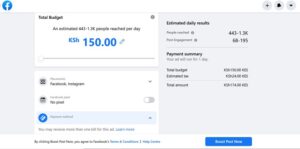
facebook page ad daily budget
NB: My Ad Center settings are in Kenya currencies for the pages I manage.
Get Free Analytics
With a Facebook page, you will get free overview analytics and detailed insights into your posts. You will get insights on total page followers, organic followers, paid followers, daily page views, organic vs paid reach, page likes among others.

Another free detailed page insight you get on the Facebook page is the People insights. You can know your fans, followers, people engaged, people reached by age, gender, location and language. What a free useful insight!
facebook page people insights
You Can Schedule Posts
Sometimes you may have a busy schedule but you still want to engage your customers on Facebook. At times, you want to have your post published when most of your page followers are online but you will not be online then. Here is where the Facebook Schedule post feature comes in. You can schedule posts to any day and time, unlike a Facebook profile.
You can allow other People to Manage your Page
Teamwork is paramount! A Facebook page allows you to add other people to manage your page such as comments, create ads and delete comments. You can assign your friends or your team with roles like editor, moderator, analyst, advertiser or a custom role.
Conclusion
If you are a personal brand or have a brand, consider creating a Facebook page over a Facebook profile. Although you must have a Facebook profile to create a Facebook page, you have a Facebook and grow it. With a business page, you will enjoy a pool of privileges in marketing, get data insights and manage your community easily.
For more tips on digital marketing, follow Egline Samoei on Twitter and LinkedIn

