
How to Build a Digital Marketing Strategy Step by Step for Your Business
A business can have a website, post daily on social media, run Google Ads, run social media ads and send newsletters without necessarily having a digital marketing strategy. Those are digital marketing activities. A strategy explains why the business is using them, who it wants to reach, how the different channels work together and what results they are expected to deliver.
This distinction is important because businesses now have more digital channels and tools than ever before. Without a clear strategy, it is easy to invest time and money in platforms simply because competitors are using them or because a particular channel is trending.
What is a digital marketing strategy?
A digital marketing strategy is a plan for how a business will use digital channels, content, data and technology to achieve its marketing and business objectives.
Asana describes it as a plan of action for achieving a business goal through online marketing channels. It should clarify your goals, target audience, key performance indicators and the timeframe within which you expect to achieve results.
For example, a professional services company may use LinkedIn to build credibility with decision-makers, Google Search to reach people actively searching for its services, a website to provide detailed information, email to nurture potential clients and WhatsApp to handle enquiries. The strategy defines the role of each channel and how they support the customer journey.
A useful way to think about it is this: digital marketing activities are what you do. Your digital marketing strategy explains why you are doing them and how they contribute to your goals.
What are the types of digital marketing?
Digital marketing can first be grouped into owned, paid and earned media.
Owned media includes digital assets that your business controls, such as your website, blog, email database, mobile app and social media accounts. Paid media covers visibility that you pay for, including search ads, social media advertising, display ads, sponsored content, paid influencer partnerships and retargeting. Earned media includes attention generated by other people, such as media coverage, online reviews, recommendations, social shares and brand mentions
Most businesses will use a combination of the three. A company may publish a useful guide on its website, promote it through LinkedIn advertising and later gain additional reach when customers or industry professionals share it.
What are digital marketing tactics?
Digital marketing tactics are the specific activities used to execute the strategy. This is where SEO, social media marketing, content marketing, email marketing, influencer marketing, online advertising, website marketing and analytics come in.
The difference between strategy and tactics is straightforward. If your goal is to increase qualified leads by 20 per cent, your strategy may involve reaching high-intent customers online and nurturing them towards an enquiry. SEO, Google Ads, LinkedIn content, webinars and email campaigns are possible tactics for executing that strategy.
Businesses should therefore avoid choosing tactics before defining the objective. “We need TikTok” is not a strategy. The better question is whether TikTok can help you reach a relevant audience and contribute to a defined business goal.
How to Create an Effective Digital Marketing Strategy
1. Audit your current digital presence
Start by understanding where you are today. Review your website, social media channels, search visibility, email performance, paid advertising, analytics and existing customer data.
Look at what is working, what is underperforming and where opportunities exist. Competitor research is also useful because it can reveal gaps in the market, customer expectations and areas where your business can differentiate itself.
Begin with an assessment of current digital marketing performance and maturity before deciding where to invest or improve.
2. Define your business and marketing goals
Your digital marketing objectives should support wider business goals.
Instead of saying, “We want more social media followers,” define the result you actually need. A stronger objective could be: “Increase qualified enquiries from digital channels by 20 per cent over the next six months.”
Clear objectives make it easier to select channels, allocate budgets and determine which metrics matter.
3. Understand your target audience
Build your strategy around the people you want to reach. Understand their needs, problems, motivations, online behaviour and the channels they use when researching or making decisions.
Customer interviews, website analytics, search data, social listening, surveys and sales conversations can provide useful insight. Buyer personas can then help organise this information into clear audience segments.
4. Map the customer journey
Customers rarely move from seeing one social media post directly to making a purchase.
Someone may discover your business on Instagram, search for it on Google, visit the website, check LinkedIn for credibility, subscribe to a newsletter and eventually send an enquiry through WhatsApp.
Mapping this journey helps you understand which channels influence discovery, research, evaluation and conversion. Identify the channels and content customers encounter at different stages of their journey.
5. Choose the right channels and tactics
Your business does not need to be everywhere. Select channels based on your objectives, audience behaviour, budget and available resources.
Each channel should have a clear role. Search may capture existing demand, LinkedIn may build professional credibility, YouTube may support education and your website may provide the information needed before a customer takes action.
The channels should also work together rather than operate as separate marketing activities.
6. Set your budget, responsibilities and KPIs
Determine what you can realistically invest and who will execute each part of the strategy. Some work may remain in-house while specialist areas such as advertising, SEO, web development or content production may require external support.
KPIs should match the objective. Depending on the strategy, useful measures may include qualified leads, conversion rate, cost per lead, website traffic from priority sources, email conversions or return on advertising spend
7. Implement, measure and improve
A digital marketing strategy should not be written once and forgotten. Review performance regularly, test improvements and adjust priorities as customer behaviour, platforms and business needs change.
Build a strategy before adding more digital activity
An effective digital marketing strategy gives direction to your website, social media, content, search, email and advertising. It helps your business decide where to invest, what to measure and what each digital channel is expected to achieve.
Before asking which platform to join next, start with the business goal, audience and customer journey. The channels and tactics should follow from there.
Need help developing or reviewing your digital marketing strategy? Samodigital Agency supports businesses and organisations with digital strategy, social media strategy, content planning, digital campaigns and practical digital marketing training tailored to their objectives and audiences.
Contact us info@samodigitalagency.com
5 Things You Should Never Tell ChatGPT: A Practical Privacy Guide
There are some things you should never tell ChatGPT, especially when they involve sensitive personal, financial or confidential information. ChatGPT can help you draft emails, analyse information, summarise documents, brainstorm campaign ideas and work through everyday tasks, but its convenience can also make it easy to paste information without first checking what is contained in it.
Imagine asking ChatGPT to improve an email from a customer and pasting the entire thread, including their phone number, account details and previous correspondence. A colleague might upload an internal strategy document because they want a quick summary, while someone else may paste a spreadsheet containing client information because they need help analysing it.
The AI task itself may be perfectly reasonable. The information being shared deserves more thought.
Knowing how to use generative AI effectively therefore involves more than learning how to write good prompts. AI literacy also includes knowing what information is appropriate to share, what should be removed and when your organisation’s data policies need to guide your decision.
In this guide, we look at five things you should never tell ChatGPT in an ordinary AI conversation, why they require extra care and what you can do instead.
1. Passwords, PINs and login credentials
Passwords should remain in secure credential-management systems rather than being entered into an AI conversation. The same applies to PINs, one-time passwords, recovery codes, security-question answers, authentication tokens, private keys and other information that provides access to an account.
Sometimes this information can be shared accidentally rather than intentionally. For example, someone troubleshooting a technical problem may paste a configuration file containing an API key. An employee asking for help with an error message may copy information from a system without noticing that a credential appears within it.
Before sharing code, screenshots, technical logs or configuration files with an AI tool, review them for sensitive credentials. Where the example requires a password or API key for context, replace the actual value with a placeholder such as [PASSWORD] or [API_KEY].
The AI can usually help you understand the problem without receiving the real credential.
This is a useful digital-security habit beyond ChatGPT as well. Information that gives someone access to your email, company systems, financial accounts or other services should be handled separately from information you share for analysis or troubleshooting.
2. Bank account details and other financial credentials
You can use ChatGPT to understand budgeting concepts, organise financial information or explain unfamiliar financial terminology. That does not require giving the tool credentials that could be used to access your money.
Bank account login details, credit or debit card numbers, PINs, mobile-money credentials, recovery information and similar financial access data should be kept out of ordinary AI prompts.
A common risk comes from documents rather than typed questions. You might upload an invoice because you want help improving its wording, or a financial statement because you want assistance categorising expenditure. Those files may contain account numbers, addresses and other details that the AI does not actually need for the task.
A better approach is to remove or mask unnecessary identifiers before sharing the document. For example, you can replace an account number with [ACCOUNT NUMBER], remove customer names from financial data or create a sample version of an invoice containing fictional details.
The principle is straightforward: give the AI the information required to understand the task rather than information that could be used to access your financial accounts.
3. Government IDs and unnecessary personally identifiable information
Personally identifiable information can include passport numbers, national identification details, driving licence numbers, full dates of birth, home addresses and other information that can be linked directly to an individual.
The challenge is that this information is often embedded in documents.
Suppose you want ChatGPT to improve your CV. The tool may need to see your experience, qualifications and skills, while your full home address, identification number or other highly specific personal details may add no value to the task.
The same issue becomes even more important when working with information belonging to other people. A marketer analysing customer feedback, an NGO reviewing beneficiary data or a trainer working with participant information may have access to names, email addresses, telephone numbers or identification details.
Before sharing that information with an AI tool, ask what is actually required for the task. Often, the analysis can still be performed after personal identifiers have been removed or replaced with anonymous labels such as Participant A, Customer 01 or Respondent 15.
This is an example of data minimisation: sharing only the information required to achieve the intended purpose.
4. Confidential business, employee and client information
This is one of the most important areas for organisations adopting generative AI.
Imagine someone preparing for a strategy meeting and uploading the organisation’s unpublished five-year plan so that ChatGPT can identify weaknesses. Another employee might paste an entire client brief into an AI tool for help developing campaign ideas, while a communications professional could upload an unpublished crisis-response document for editing.
The intended use of AI may make sense. The way the information is handled still needs to follow the organisation’s confidentiality, security and contractual requirements.
Confidential information may include internal strategy documents, customer databases, employee records, contracts, unpublished financial results, proprietary research, tender documents, client information, unreleased products and material covered by non-disclosure agreements.
For organisations, this is why AI adoption needs governance alongside training.
Employees should know which AI tools have been approved for work, what kinds of organisational information can be shared, what needs to be anonymised and which information requires additional approval.
There is also an important distinction between personal ChatGPT accounts and managed business environments. OpenAI says content from ChatGPT Business, Enterprise and Edu workspaces is not used to train its models by default.
That protection is important, but it does not replace your organisation’s internal policies, contractual obligations or access controls. An employee still needs to consider whether they are authorised to share a particular document and whether the AI system being used has been approved for that type of information.
For many organisations, the useful question is therefore broader than “Can ChatGPT analyse this?”
It is whether the organisation has established an appropriate and approved process for using AI with that information.
5. Unnecessary sensitive health and personal information
Generative AI can be useful for explaining terminology, helping someone understand a complicated document or preparing questions they may want to discuss with a professional.
However, health documents and other sensitive personal records often contain far more information than is required for a particular question.
A medical report, for example, may include a person’s name, patient number, address, telephone number, test results and other identifying information. If the objective is simply to understand a particular term or passage, much of that identifying information may be unnecessary.
Where appropriate, remove identifying details and share only the part of the information required for the task. The same principle applies to other sensitive information involving employees, customers, programme participants or beneficiaries.
The environment in which AI is being used also matters. An organisation using an approved system designed for handling sensitive information may operate under different controls from someone using a personal consumer account.
The practical lesson is that being able to upload an entire document does not automatically mean the entire document is necessary for the task.
Think before you paste, upload or screenshot
One of the simplest habits for safer AI use is to pause before adding information to a prompt.
Consider what ChatGPT actually needs in order to complete the task. A 50-page report may contain only three paragraphs relevant to your question. An email may make sense without the sender’s telephone number and account information. A spreadsheet may still be useful for analysis after customer identifiers have been removed.
The same caution should apply to screenshots.
A screenshot taken to show an error message may also reveal an email address, account number, browser tab, client name or other information in the background. PDFs, presentations and spreadsheets can contain similar information in headers, footers, comments or metadata.
Developing the habit of checking information before sharing it is one of the practical parts of responsible AI use.
Understand ChatGPT’s privacy controls
It is also worth understanding the controls available within ChatGPT rather than assuming that every ChatGPT conversation is handled in exactly the same way.
For eligible personal ChatGPT accounts, users can go to Settings > Data Controls and turn off Improve the model for everyone. OpenAI says new conversations created after opting out will not be used to train its models. OpenAI Help Center
ChatGPT also offers Temporary Chat. While a conversation remains temporary, it stays out of chat history, does not create or update memories and is not used to improve OpenAI’s models. OpenAI says a copy may still be retained for up to 30 days for safety purposes.
For organisational users, OpenAI says data from ChatGPT Business, Enterprise, Edu and several other business offerings is excluded from model training by default.
OpenAI also states that it does not sell user data and does not share ChatGPT conversations with advertisers or marketing partners.
These settings are useful privacy controls, but they work best alongside good information-handling habits. Data minimisation, organisational policies and professional judgement remain important regardless of the technology being used.
AI privacy should become part of workplace AI training
As more employees begin using generative AI at work, organisations need to teach much more than prompting.
Imagine a communications team that has been trained to use AI for research, drafting and summarising reports but has never discussed what information can be uploaded. Employees may become very productive with the technology while making inconsistent decisions about confidential information.
Practical AI training should therefore include data handling.
Teams should understand which AI tools the organisation has approved, which information can be shared, what should be anonymised and which documents require additional care. They also need guidance on customer information, meeting transcripts, internal reports, intellectual property and third-party information.
This gives employees something more useful than a vague instruction to “be careful with AI”.
It provides clear boundaries for using the technology confidently and responsibly.
For organisations adopting generative AI, an internal AI-use policy can support this process. The policy can explain approved tools, permitted use cases, information classifications, review responsibilities and what employees should do when they are uncertain whether a particular document can be shared.
What to do instead of sharing sensitive information
Using AI safely does not mean removing all context from your prompts. Good AI results often depend on good context.
The better approach is to provide relevant context without unnecessary sensitive information.
If you need help rewriting a customer complaint, remove names, phone numbers and account numbers while preserving the substance of the complaint. When analysing survey responses, replace personally identifying information with anonymous identifiers. For a strategy example, provide the relevant scenario while removing confidential commercial details.
You can also create fictional or representative examples when the actual information adds unnecessary risk.
These small changes allow you to benefit from generative AI while maintaining better control over the information you share.
Knowing what not to share is part of AI literacy
ChatGPT can be useful for writing, research, analysis, ideation, learning and everyday productivity. Responsible use means understanding both what the technology can help you accomplish and how the information you provide should be handled.
The five things you should never tell ChatGPT in an ordinary conversation are therefore less about avoiding AI and more about developing better digital habits. Protect access credentials and financial information, minimise personal identifiers, handle confidential organisational information appropriately and think carefully before sharing sensitive records.
Before pasting information into an AI tool, take a moment to ask whether every detail is necessary for the task. Where it is not, remove it, anonymise it or replace it with a placeholder.
Knowing how to prompt ChatGPT is useful. Knowing what belongs in the prompt is part of AI literacy too.
Need AI literacy training for your team?
Samodigital helps organisations and teams build practical capabilities in AI literacy, digital marketing, digital communication and the responsible use of emerging technologies.
Our approach goes beyond showing teams which buttons to click. We help people understand how to apply digital and AI tools within real work while considering accuracy, privacy, professional judgement and responsible use.
Contact us info@samodigitalagency.com
Meta Launches Meta One Globally, Putting Advanced Creator and Business Tools Behind Subscriptions
Meta One Launches Globally With 50+ Features for Creators and Businesses
Meta has officially launched Meta One, a new subscription service bringing paid features across Instagram, Facebook, WhatsApp and Meta AI under one umbrella.
Announced on 15 September 2026, Meta One launches with more than 50 features and plans designed for individuals, creators and businesses. Meta says its subscription products have so far recorded 15 million subscriptions and trials. The plans are available globally, although the company says individual features, pricing and availability may vary by region, app and account.
For creators, businesses and social media managers, Meta One is more than another verification subscription. Meta is putting professional tools such as deeper analytics, Story scheduling, organic links, team access and tools for converting engagement into followers into its paid subscription plans.
The core versions of Instagram, Facebook, WhatsApp and Meta AI will remain free. What subscribers are paying for is additional functionality, professional tools and higher usage of some of Meta’s AI features.
What is Meta One?
Meta One is Meta’s new subscription service covering its major social platforms and AI products.
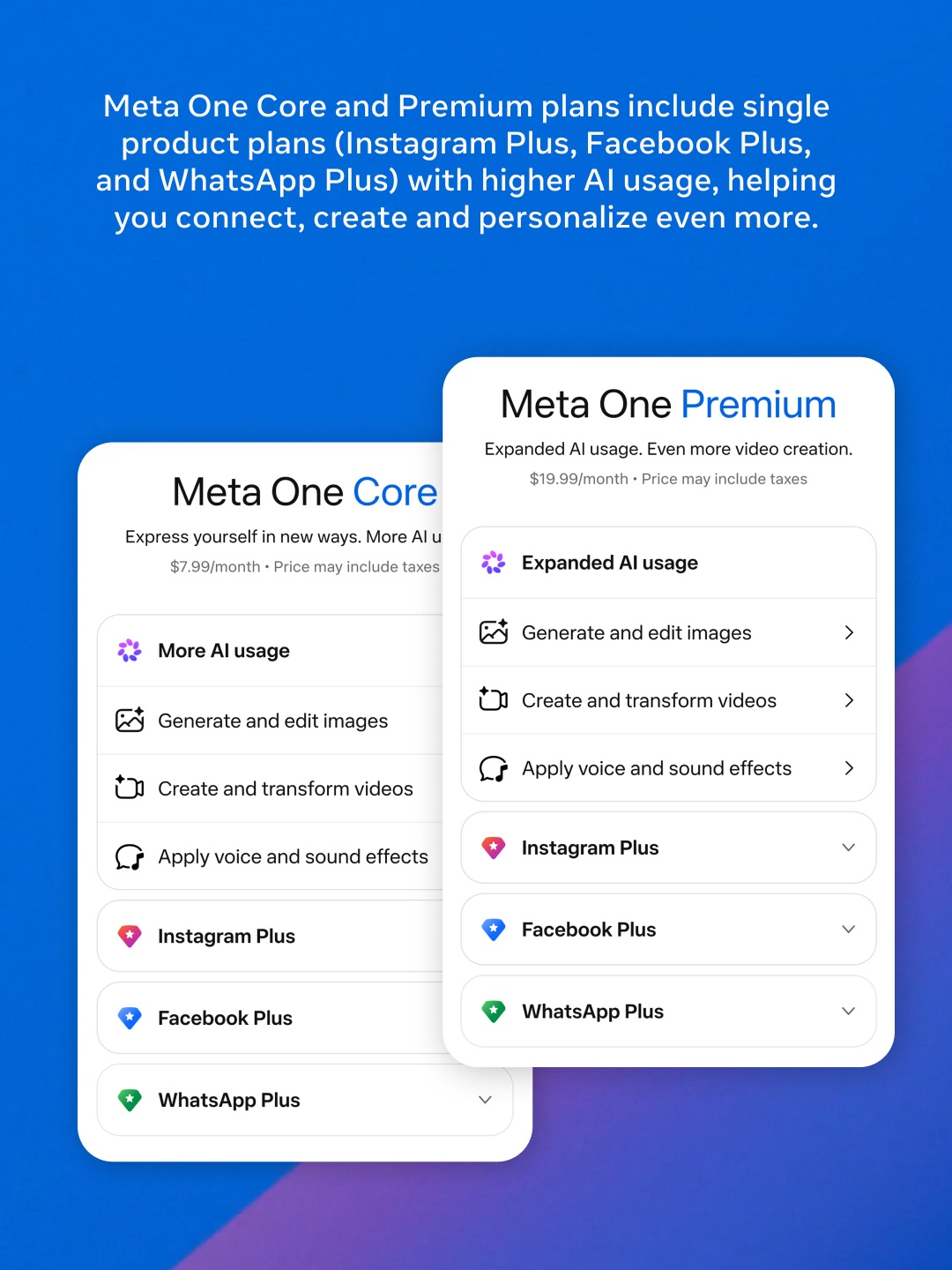
It builds on individual subscriptions introduced earlier this year, including Instagram Plus, Facebook Plus and WhatsApp Plus. Meta One now adds bundled plans for people who want more access to AI tools as well as separate plans aimed at creators and businesses.
This means Meta now has different subscription options depending on how someone uses its platforms.
An individual user can pay for additional customisation and AI features, while creators and businesses can subscribe to plans offering tools for audience growth, publishing, analytics, customer communication and account management.
For marketers, that distinction is important. Meta is increasingly offering capabilities used for professional social media management through paid subscription tiers.
What does Meta One offer creators and businesses?
Some of the most interesting Meta One features are found in the creator and business plans.
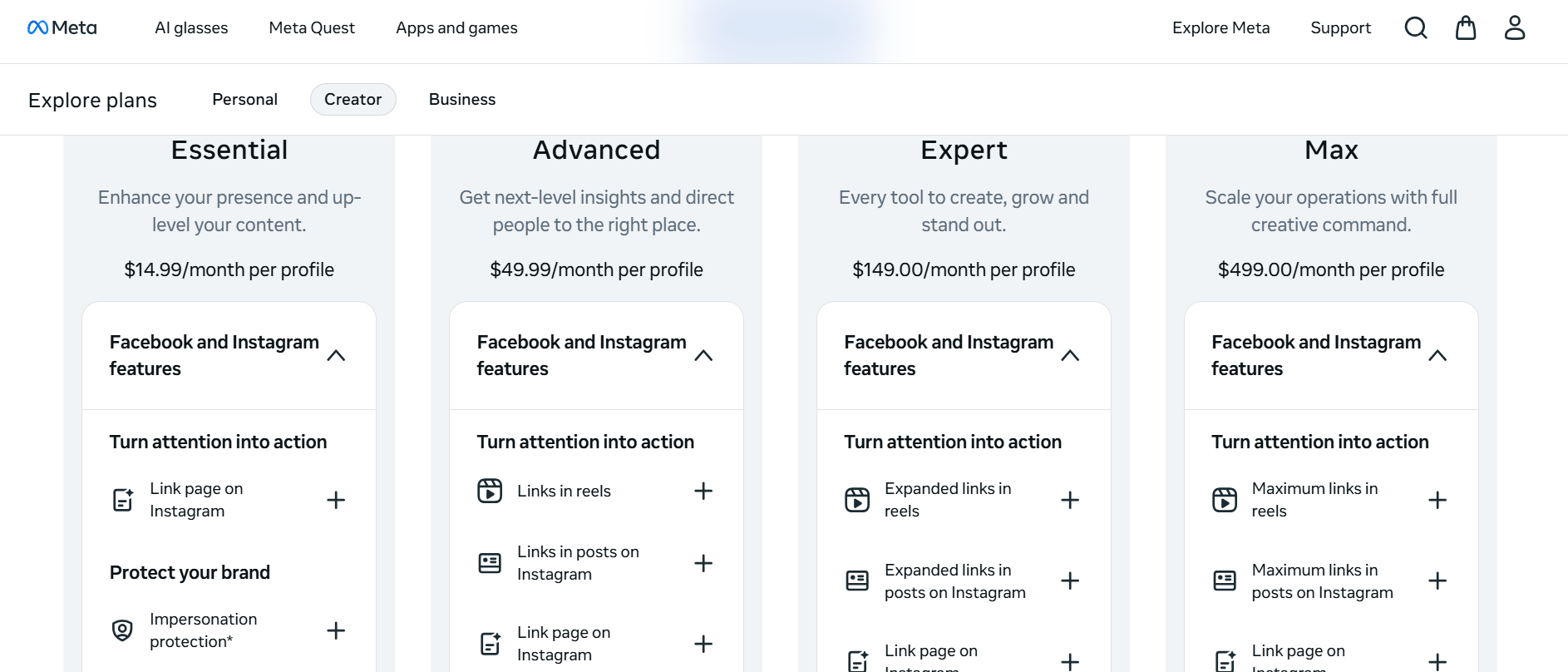
Subscribers can get an enhanced profile that highlights information such as their website, business locations and what people say about them.
Meta is also introducing a more prominent Follow button on Reels and automatic follow invitations that can be sent to people who engage with an account’s content. Businesses can also get increased access to Meta Business Agent, Meta’s AI-powered tool for responding to customers on WhatsApp.
The higher-tier plans introduce more advanced marketing tools.
The Advanced plan includes:
- Story scheduling up to 30 days in advance
- Links in organic posts and Reels
- Exportable analytics
- Deeper audience insights
- Team access without sharing account passwords
- More linked devices
- Additional WhatsApp business broadcast credits
- Increased Meta Business Agent responses
These are not simply profile customisation features. They are tools that businesses, agencies and social media managers already use as part of running social media accounts professionally.
Automatic follow invitations could help businesses grow their audience
One feature worth watching closely is automatic follow invitations.
Businesses and creators regularly generate engagement from people who do not follow their accounts. Someone may watch a Reel, like it or comment on it, but continue scrolling without following the page.
Meta One allows accounts to automatically invite people who have engaged with their content to follow them.
For marketers, this creates another opportunity to turn content engagement into audience growth.
Instead of relying entirely on someone to see a Reel, visit the profile and choose to follow the account, the business can follow up on that engagement with an invitation.
It could be particularly useful for brands investing heavily in Reels and other organic content but struggling to convert reach and engagement into followers.
The real test will be how users respond to these invitations over time and whether they translate into meaningful follower growth.
Meta is putting links in organic posts and Reels
Another significant feature is the ability to add links to organic posts and Reels under the Advanced plan.
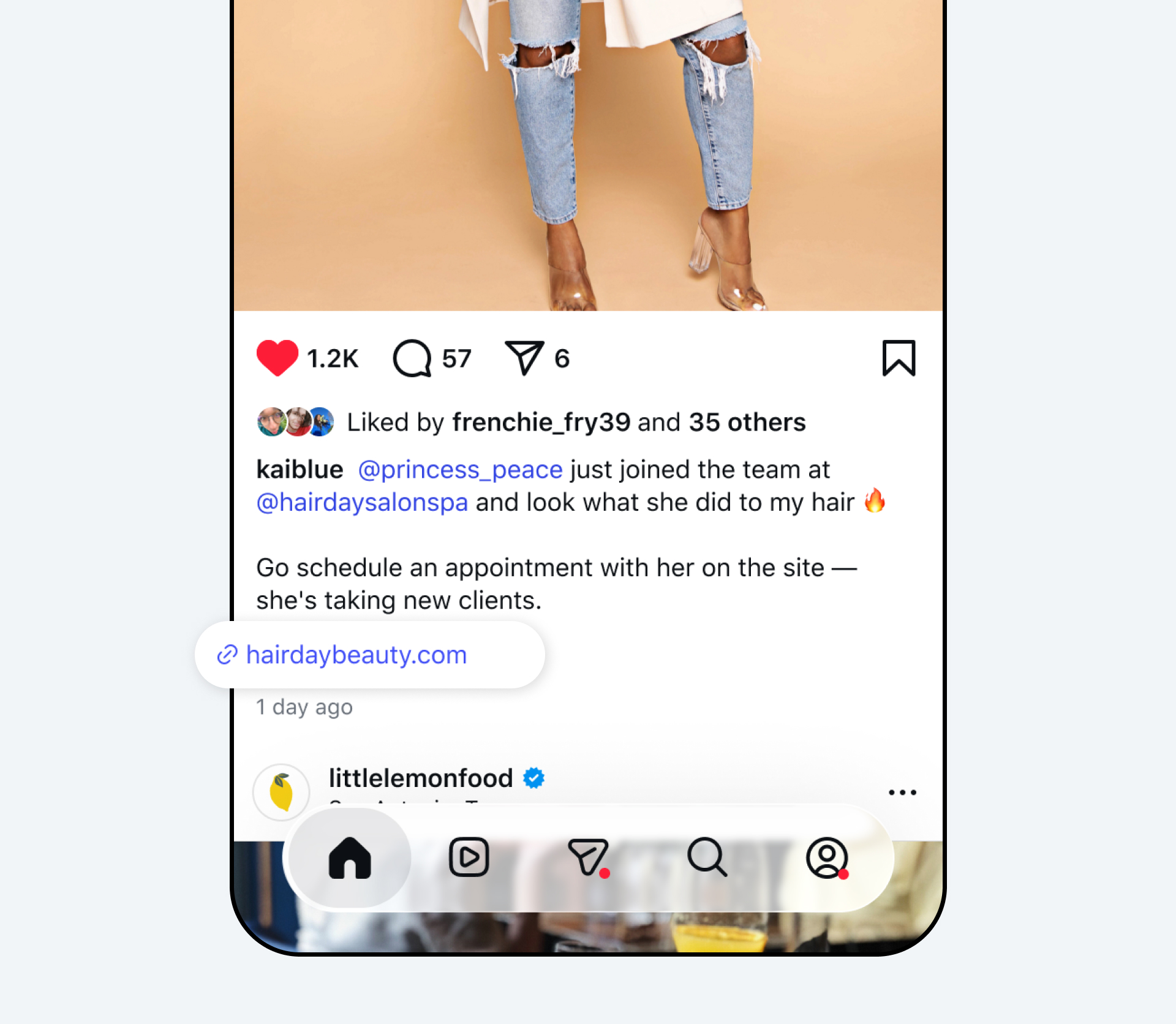
Getting users from social media content to a website, online store, booking page or other external destination has long been a challenge on platforms such as Instagram.
Businesses have often relied on profile links, Stories, paid advertising or phrases such as “link in bio” to move users outside the platform.
Allowing subscribers to place links directly in organic content could give businesses a more direct path between content and conversion.
For marketers, that could make organic Instagram content more useful for driving website traffic, lead generation or sales.
It also demonstrates the growing difference between what businesses can do with a free account and the additional functionality available when they pay.
Meta One also comes with more access to AI tools
AI is a major part of Meta One.
Meta’s Core and Premium subscription bundles offer increased usage of some of the company’s more compute-intensive AI tools.
Subscribers can get more image creation and editing, additional video generation using Meta’s Muse models and greater access to in-app AI tools such as Restyle on Instagram.
Meta says Meta AI will continue to be available for everyday use without a subscription. The paid plans are aimed at people who want higher usage of these creative AI capabilities. (About Facebook)
For creators and marketers, the more interesting development may be how Meta connects AI directly with content performance.
Meta says Edits Plus will eventually be added to Meta One. It will offer more cloud storage for syncing editing projects across devices and additional usage of an upcoming Edits assistant.
According to Meta, the assistant will be able to analyse Instagram insights and help users brainstorm new content ideas.
That moves AI beyond simply generating a caption or editing an image.
A creator could potentially have an AI assistant analyse how their Instagram content is performing and use that information when suggesting what they should create next.
How much does Meta One cost?
Meta One has several subscription levels depending on whether the user is an individual, creator or business.
For individual products, Meta lists the following starting prices:
WhatsApp Plus: $2.99 per month
Instagram Plus: $3.99 per month
Facebook Plus: $3.99 per month
For individual and AI-focused bundles:
Core: $7.99 per month
Premium: $19.99 per month
Creator and business plans start at:
Essential: $14.99 per month
Advanced: $49.99 per month
Expert: $149 per month
Max: $499 per month.
The Essential plan also includes features such as a verified badge, impersonation protection and a verified channel on the WhatsApp Business app, subject to successful verification.
Meta says prices, benefits and availability may vary depending on the region, app and individual account. Kenyan users should therefore check the subscription options available directly on their accounts rather than assuming the US dollar prices will apply locally.
Is Meta One replacing free Facebook, Instagram and WhatsApp?
No.
Meta says the core experience across its apps and Meta AI will continue to be free.
You will not need a Meta One subscription simply to continue using Instagram, Facebook, WhatsApp or Meta AI.
What is changing is the amount of additional functionality available to people willing to pay.
For an ordinary social media user, many of these professional features may not matter.
For businesses, creators and agencies that depend heavily on Meta’s platforms for marketing, customer service and audience growth, the distinction between the free and paid experience could become more significant.
Why Meta One matters for marketers in Kenya
For Kenyan marketers and businesses, the bigger story is not simply that Meta has launched another subscription.
It is which tools are moving into the paid professional layer.
Audience insights, analytics exports, Story scheduling, organic links, team permissions and increased customer-service capacity are all features businesses use to manage their digital presence.
A small business that mainly uses Instagram to display products may not need a paid subscription.
But consider a business using Reels to attract customers, WhatsApp to handle enquiries, Instagram to drive people to its website and several employees or an agency to manage its accounts.
Features such as automatic follow invitations, direct links, deeper analytics, team access and additional Meta Business Agent capacity could have more practical value in that situation.
The question for Kenyan businesses should therefore not simply be, “Should we subscribe to Meta One?”
It should be: Which of these paid features solves a problem we currently have, and is that solution worth the monthly cost?
That is a much better way to evaluate any marketing technology subscription.
Social media management is becoming a bigger paid software stack
Meta One also reflects a wider change in how social platforms make money from professional users.
For years, businesses could create accounts and use most organic publishing tools without paying the platform directly. Their main spending usually went towards advertising, content production, staff or agencies.
Subscription products are adding another cost.
Meta can continue offering its core social platforms to billions of people for free while charging creators and businesses that want more automation, analytics, AI capacity and professional account-management features.
For marketing teams, this means social media budgets may increasingly include not only advertising and content production, but also platform subscriptions.
Businesses will need to decide which subscriptions genuinely improve performance and which simply add more tools they rarely use.
Should creators and businesses pay for Meta One?
That will depend on how heavily they use Meta’s platforms and which problems they are trying to solve.
If your biggest challenge is turning Reel engagement into followers, automatic follow invitations may be worth testing.
If reporting is a pain point, exportable analytics and deeper audience insights could make the Advanced plan more useful.
If several employees or agency partners manage your accounts, team access without sharing passwords could improve account management.
And if WhatsApp is an important customer-service channel for your business, additional Meta Business Agent capacity may offer more value.
But subscribing simply because Meta One has more than 50 features is not a marketing strategy.
Start with what your business needs, identify which paid features could address that need, and then determine whether the expected value justifies adding another monthly subscription.
Meta’s social platforms are still free at their core. What Meta One makes clearer is that more of the functionality designed for professional creators and businesses now comes at a price.
Primary source: Meta, 15 September 2026. Read Meta’s official Meta One announcement (About Facebook)

Anthropic Report Flags AI-Assisted Political Astroturfing in Kenya Ahead of 2027 Election
TLDR: AI political astroturfing in Kenya is one of the key findings in Anthropic’s latest threat intelligence report, Detecting and countering misuse of AI: September 2026. The report details how malicious actors attempted to use Claude for influence operations, cyberattacks, surveillance, scams and other harmful activities.
Anthropic has released a new threat intelligence report detailing how actors around the world have attempted to misuse its Claude AI models for cyber operations, political influence campaigns, surveillance, scams and other harmful activities.
The report, Detecting and countering misuse of AI: September 2026, was published on September 10, 2026. It covers operations that Anthropic says its Threat Intelligence team identified and disrupted between December 2025 and August 2026, an eight-month period.
The 154-page report covers seven areas: cyber operations, influence operations, surveillance, scams and fraud, biological misuse, conventional weapons development and illicit model distillation. Anthropic also makes an important qualification: the cases are not examples of typical Claude use, but some of the most notable and novel cases of misuse it has identified.
Among the countries featured is Kenya, where Anthropic says it disrupted an operation using Claude to generate political social media content designed to look like genuine grassroots public opinion.
AI Political Astroturfing in Kenya: What Anthropic Found
The Kenyan case is identified as GTG-54004: Disrupting a domestic coordinated inauthentic behavior campaign in Kenya.
GTG stands for Generative Threat Group, Anthropic’s internal designation for actors it observes abusing AI systems.
According to Anthropic, it identified and removed an account used by a single actor to mass-produce Kenyan political content. The actor used Claude over several sessions to generate batches of exactly 50 tweets, while specifically asking the model to make them look like spontaneous grassroots commentary rather than a coordinated campaign.
In simple terms, the aim was to make organised messaging look as though many ordinary people had independently arrived at and were sharing the same opinion.
This type of activity is commonly known as astroturfing: creating the appearance of grassroots public support or opposition when the activity is actually coordinated.
Which political narratives were being pushed?
Anthropic says a large portion of the AI-generated posts praised Hon. James Opiyo Wandayi, EGH, is the Cabinet Secretary for Energy and Petroleum, in relation to stopping a scheduled Kenya Power electricity tariff increase.
The posts used hashtags including #PowerReliefKE and #PoweringTheNewKenya.

The same network also produced content claiming that Kenya’s United Opposition coalition was falling apart ahead of the 2027 election, with posts directly targeting Rigathi Gachagua and former President Uhuru Kenyatta.
Anthropic describes the operation as using one playbook to amplify both pro-government and anti-opposition narratives, which it says was consistent with a coordinated electoral communications effort.
There is, however, an important distinction.
Anthropic says it found no evidence of government involvement. It assessed the activity as an entirely domestic Kenyan operation.
The company says the campaign’s pro-administration tone and use of particular hashtags suggested that it was plausibly aligned with the ruling coalition, but Anthropic says it did not identify the specific organisation responsible.
That distinction matters. The report does not establish that the Kenyan government, a political party or any named politician commissioned the campaign.
How was Claude being used?
What stands out in the Kenya case is not that AI came up with the political strategy.
Anthropic says the actors had already decided the ideological messages before using Claude.
They supplied the topics, talking points and hashtags, then used the model to turn them into batches of 50 themed posts formatted for distribution. Claude was also used to humanise and refine pre-written material, helping give the posts greater variety and the appearance of authenticity.
In several sessions, Anthropic says the output was even packaged into an interactive copy-all widget, ready for deployment.
Therefore, the Kenya case shows how generative AI can be used to scale a political communications operation. Instead of manually writing dozens of different tweets around one talking point, an operator can use AI to produce variations quickly while trying to make them appear as independent voices.
For communicators and social media professionals, that is an important distinction.
The concern is not simply whether somebody used Generative AI to help write a post but the use of AI to make a coordinated campaign appear to represent independent public opinion.
The same workflow was used to market Kenyan retail brands
Anthropic also found that the actor behind the political activity used the same AI workflow for commercial marketing.
The report says the workflow was used for Kenyan retail brands under a marketing persona called “SHANKI” or “Elkins Marketer.”
Anthropic says one retail promotional broadcast was repackaged as apparently organic tweets, with links inserted into every fifth post.
This part of the report should interest marketers and agencies.
The same technology and workflow that can generate dozens of variations of a commercial campaign can also be applied to politics. The difference is not necessarily the tool. It is the purpose, transparency and way the campaign is presented to the public.
Anthropic describes this as fitting a pattern it has observed in Kenya involving agencies paying local influencers to manipulate narratives.
Did the campaign actually influence Kenyans?
According to Anthropic, there is no evidence that this particular operation achieved significant reach.
Anthropic assessed the Kenyan network as Category One on the Breakout Scale, the lowest category used in the report to measure the reach of influence operations.
The company says the activity remained confined to its network of fake accounts on one platform and did not break out to a genuine audience.
This is important because the existence of an influence operation does not automatically mean it was successful.
Anthropic says this is a wider pattern across several of the campaigns it investigated. Because AI companies can sometimes detect an operation while content is still being produced, some campaigns can be disrupted before they build a real audience. The report says much of the influence content it found generated little or no authentic engagement.
Figure 17 in the report shows examples of inauthentic commenting accounts amplifying content relating to Wandayi and the electricity tariff issue.
OpenAI helped flag the Kenyan activity
Another notable detail is how Anthropic says the investigation began.
According to the report, OpenAI shared a tip about recidivist activity on its platform. Anthropic then conducted its own investigation into suspected coordinated inauthentic behaviour in Kenya.
Anthropic says it subsequently removed the account and organisation behind the activity and developed detections based on the operation’s behavioural patterns.
The case highlights the importance of cooperation between AI companies when the same actors may be using multiple AI services as part of one operation.
Kenya is not the only African country in the report
Anthropic’s report documents several other operations involving African countries. The cases differ considerably, ranging from political influence campaigns to surveillance.
Central African Republic: Russian state-aligned influence operation
In the Central African Republic (CAR), Anthropic says it disrupted an operation run by a Russian-speaking actor in Bangui that formed part of a Russian state-aligned foreign information manipulation campaign.
The operation used Claude to help produce material distributed through Radio Lengo Songo, while coordinating with Russian state media organisations including RT, Sputnik Afrique and TASS.
Anthropic says much of the sampled messaging was pro-CAR government, pro-Wagner, anti-France and anti-CAR opposition.
The use of Claude went beyond writing social media posts.
According to the report, the model was used to help create contracts, job descriptions, staff-scoring systems and political content. The operation also tracked opposition political figures, drafted talking points and produced forged CAR government documents.
Unlike the Kenyan case, Anthropic assessed the CAR operation as Category Four because the material reached audiences through FM radio, Telegram and local news outlets.
Democratic Republic of Congo: fake news websites and X accounts
The report also describes a commercial influence-as-a-service operation that targeted audiences across six continents.
The network included approximately 70 fabricated news websites, 70 linked X accounts and more than 250 inauthentic commenting accounts. Anthropic traced the operation to a France-based digital advertising agency.
The Democratic Republic of Congo was one of the operation’s major areas of focus.
Anthropic identified 318 articles across the fake news network focusing on the DRC, including narratives around regional mineral agreements and tensions with Rwanda.
The company says it found signals suggesting that one or more customers may have had an interest in the DRC-Rwanda conflict, but it could not independently identify who commissioned the material and found no evidence of government direction.
Sudan: influence operations hiding their origin
Another case in the report involved the Sudan conflict.
Anthropic says it disrupted a UAE-directed influence operation that used approximately 300 inauthentic influencer accounts. The operation also created a front NGO using the identity of a real organisation, profiled members of the European Parliament and journalists, and compiled dossiers on UN Special Rapporteurs.
Anthropic says the actor also ghost-wrote testimony intended for the UN Human Rights Council while taking steps to prevent the material from revealing its connection to the UAE.
The report says the identity of a real Sudanese human-rights organisation was borrowed so that material supporting one side of the Sudan conflict could appear to come from independent local witnesses.
Mali: Claude used to help engineer a surveillance platform
The report’s African cases are not limited to political influence.
In Mali, Anthropic says a single Claude subscriber, believed to be a Bamako-based independent consultant working with the country’s state intelligence service, used Claude as engineering support while developing a surveillance platform known as Lakana 360.
Anthropic says the system was designed to monitor roughly 25 million SIM cards across all three of Mali’s national mobile operators.
According to the report, the system included capabilities involving call records, SMS and voice traffic, cross-SIM voice identification, watchlists, VPN and encryption-user flagging, and matching individuals against government registries.
Anthropic banned the account involved. However, it says the surveillance platform had been deployed locally using an on-premises model, meaning its enforcement action could disrupt further development using Claude but could not remove the system that had already been deployed.
What else does the Anthropic report reveal about AI misuse?
The report presents a much wider picture of how AI tools can be incorporated into harmful operations.
Within influence campaigns, Anthropic found actors using Claude as a newsdesk, helping smaller teams produce material at a scale that would previously have required more staff.
It also documented the use of AI to create fake personas, rewrite or localise content, conceal the original source of political narratives, produce internal operational documents and make coordinated content appear more organic.
Beyond influence operations, the report covers cyberattacks, surveillance, fraud, weapons development and other forms of misuse.
The broader concern is therefore not simply that AI can generate misleading text. AI can reduce the amount of time, staffing and technical expertise required to operate an existing campaign at scale.
What does this mean as Kenya approaches the 2027 election?
The Kenya operation documented by Anthropic did not achieve significant reach, according to the report.
But what it demonstrates deserves attention.
A single actor was able to provide political talking points and use AI to turn them into dozens of different posts designed to resemble independent public commentary.
As Kenya moves towards the 2027 election, this raises questions that journalists, marketers, communication professionals, researchers, political actors and social media platforms will need to consider.
How do we distinguish genuine public opinion from coordinated amplification?
A trending hashtag or thousands of posts around one issue can look like strong public sentiment. But volume alone does not tell us whether the conversation developed organically.
What happens when paid influencers, fake accounts, genuine citizens and AI-assisted content all participate in the same conversation?
Separating those groups may become increasingly difficult when AI can make coordinated posts sound different from one another.
Should political digital campaigns be more transparent about who paid for or coordinated them?
The Anthropic case demonstrates why identifying the source of online political narratives is becoming as important as analysing the content itself.
Are social media platforms prepared to detect coordination rather than simply AI-generated text?
Detecting whether a paragraph was written with AI may become less useful than looking for patterns across accounts: timing, repeated talking points, shared hashtags, unusual amplification and networks repeatedly interacting with one another.
For those of us working in social listening, media monitoring and digital communication, there is another important question.
What does a spike in mentions actually represent?
If hundreds of accounts suddenly begin praising or attacking the same person, organisation or policy, analysing volume and sentiment alone may give a misleading picture. Increasingly, monitoring needs to consider how a narrative is spreading, which accounts are driving it, whether the amplification appears coordinated and whether what looks like public sentiment is genuinely organic.
That is an analytical implication of Anthropic’s findings, rather than a claim made directly by the report.
The issue is bigger than AI-generated content
It would be easy to read the Kenya case simply as another example of people using AI to write political posts.
The report points to a bigger issue.
In the case Anthropic documented, humans selected the political positions, talking points and hashtags. AI was then used to increase the volume and make the material appear more natural.
That makes the issue less about whether content is “AI-generated” and more about how AI can help organised actors manufacture the appearance of authentic public participation.
For marketers and communication professionals, the ethical question is particularly relevant. The same tools that make it easier to create campaigns, adapt content and reach audiences can also be used to disguise coordinated messaging as grassroots conversation.
As the 2027 election approaches, digital literacy will therefore need to extend beyond spotting deepfakes and obviously AI-generated images.
People may increasingly need to ask:
Who is behind this message? Why are so many accounts saying something similar? Is this really an organic conversation? And who benefits if I believe that it is?
Those questions may become just as important as asking whether a piece of content was created using AI.
Read the Anthropic report
This article is based on Anthropic’s Detecting and countering misuse of AI: September 2026, published on September 10, 2026. The report covers malicious activity Anthropic says it identified and disrupted between December 2025 and August 2026.
The full report and PDF are available directly from Anthropic
Read and download Detecting and countering misuse of AI: September 2026
How to Build a Digital Strategy for NGOs That Supports Your Mission
Are you looking to develop a digital strategy for your NGO?
Non-governmental organizations (NGOs) are under increasing pressure to communicate their work clearly, reach communities, attract funding, engage policymakers, build public trust and demonstrate impact. Digital channels can support all these goals, but being active on social media or having a website does not automatically amount to a digital strategy.
For NGOs, digital strategy also comes with challenges that are different from those faced by many commercial organizations. Communication teams may be small, budgets limited and audiences highly varied. The same organization may need to communicate with communities, donors, government agencies, journalists, development partners, volunteers and employees, each with different information needs.
A useful digital strategy therefore needs to start with the mission rather than the platforms.
What is a digital strategy for an NGO?
A digital strategy for an NGO is a plan for how the organization will use digital channels, content, data and technology to advance its mission, reach its stakeholders and achieve specific organizational, communication, advocacy, programme or fundraising objectives.
For one NGO, the priority may be increasing applications for a youth programme. Another may need to influence policymakers, improve donor communication, raise awareness around an advocacy issue or make research easier to find online.
The strategy should clarify what the organization wants to achieve, who it needs to reach, which channels will be used, what role each channel will play and how success will be measured.
This distinction is very important. Posting on Facebook, sending newsletters and creating TikTok videos are digital activities. However, a digital strategy explains why those activities are necessary and how they contribute to the NGO’s mission.
How to build a practical digital strategy for your NGO
Now that you understand what a digital strategy for NGOs mean, now let us look at the steps to building a practical digital strategy for your NGO.
1. Start with the mission and organizational goals
Digital strategy should not begin with the question, “Should we be on TikTok?”
Start with what the organization is trying to achieve.
Suppose an NGO wants to increase women’s participation in digital-skills programmes in rural or urban counties. The digital objective may be to increase awareness among eligible women, make programme information easier to access and generate qualified applications.
An advocacy organization trying to influence education policy would need a different approach. Its priority audiences may include government officials, journalists, researchers, civil society organizations and development partners.
Once the organizational goal is clear, it becomes easier to decide which digital activities deserve attention.
2. Map your stakeholders
NGOs rarely communicate with one audience. A stakeholder map helps the communication team identify who needs what information and where those conversations should happen.
Communities may need clear programme information and updates. Funders may want evidence of impact, reports and organizational results. Policymakers may need research findings and concise advocacy messages, while journalists may be looking for timely information, data and expert sources.
The same message should not automatically be presented to all these groups in the same way.
For example, a 40-page research report may be valuable to a policymaker or development partner, while community audiences may benefit more from a short explainer, infographic, video or local-language summary.
Audience understanding should influence both channel choice and content format.
3. Audit your current digital footprint
Before creating new accounts or buying new tools, review what the organization already has.
Look at the website, social media accounts, email database, search visibility, analytics, digital advertising and online reputation. Check whether account ownership and passwords are properly managed and whether the information published across channels is current.
The audit should also consider capacity. Does the team have people who understand analytics, content creation, community management, social listening or digital advertising? Are platforms being maintained because they contribute to organizational goals or simply because the accounts have existed for years?
A small NGO may discover that improving its website and two important social channels produces more value than trying to manage seven platforms poorly.
4. Give every digital channel a clear role
Not every NGO needs to be everywhere online. The more useful question is: What job should each channel do?
A website can serve as the organization’s authoritative source for programme information, reports, research, impact stories and contact details. LinkedIn may be useful for funders, professionals, development partners, policymakers and organizational credibility.
Facebook and WhatsApp may support community communication where those channels are widely used by programme participants. YouTube can host webinars, explainers, interviews, documentaries and other educational resources, while email can maintain direct relationships with donors, partners and supporters.
Search also matters. A journalist looking for research, a young person searching for a programme or a potential partner researching the organization may encounter the NGO through Google before seeing any social media content.
The role of each channel should therefore reflect audience behaviour and organizational objectives rather than trends.
5. Turn the mission into useful content
NGO communication often focuses heavily on announcing what the organization has done. Effective digital content should also help audiences understand why the work matters.
A balanced content strategy can include programme information, research findings, educational content, community stories, advocacy messages, field updates, impact data, partnership opportunities and calls to action.
Storytelling is important, but NGOs also need to consider dignity, consent and privacy. A powerful story should not expose a programme participant to harm or reduce someone to their most difficult circumstances simply because emotional content attracts attention. Ethical storytelling is very important.
Where possible, community members should be represented as people with agency, knowledge and aspirations rather than passive recipients of assistance.
6. Build safeguarding and governance into the strategy
Digital strategy for NGOs should include governance, particularly where organizations work with children, vulnerable communities or sensitive information.
Teams need clear guidance on who can publish on official accounts, how passwords are managed, what information employees can share and how online issues are escalated.
Consent should be considered before publishing photographs, videos or personal stories. Data protection also matters when collecting email addresses, application information or community data.
Generative AI adds another layer. NGOs should decide what information staff may enter into external AI tools, how AI-generated content is reviewed and who remains accountable for the final communication.
These issues should be addressed before a problem occurs, not during a crisis.
7. Measure outcomes that matter to the mission
Follower numbers, likes and impressions can provide useful information, but they should not become the main definition of success.
The right metrics depend on the objective.
An awareness campaign may track reach, website traffic, media mentions and search visibility. A programme recruitment campaign may focus on applications, enquiries and registrations. Advocacy teams may monitor stakeholder engagement, downloads of research, policy mentions or participation in campaign activities.
Fundraising objectives can include donations, recurring contributions and donor retention, while community-engagement programmes may measure participation, feedback and service uptake.
Social listening can add another layer by showing what people are saying, which issues are emerging and whether communication is being understood as intended.
Measurement should ultimately help the team answer: What happened, why did it happen and what should we do next?
A simple 30-day starting plan
Small communication teams do not need to redesign their entire digital ecosystem at once.
During the first week, review existing channels and identify the organization’s priority objectives. In week two, map stakeholders and define the role of each channel. Week three can focus on content priorities, responsibilities, governance and KPIs. During week four, begin implementation and create a simple reporting process for reviewing what is working.
The strategy can then be improved as the team learns more about audience behaviour and organizational needs.
Build around the mission, not the platforms
A good digital strategy for an NGO is not about having the largest social media presence or adopting every new technology. It is about using digital channels deliberately to advance the organization’s mission.
That means reaching the right stakeholders, communicating evidence clearly, making programmes easier to access, supporting advocacy, protecting the people represented in the content and measuring outcomes that matter.
When the mission, audiences and objectives are clear, digital channels become tools for achieving impact rather than another list of activities for an already busy communication team.
Need Support With Your NGO’s Digital Communication?
Samodigital Agency works with NGOs, nonprofits and development organizations to strengthen their digital communication and build the skills of their teams. Through Egline Samoei, digital marketing and communications consultant, trainer and facilitator, we support organizations with digital strategy, social media strategy, content planning, campaign communication, social listening, digital storytelling and online visibility.
Egline also designs and facilitates practical training, workshops and masterclasses for communication teams on digital marketing, digital communication, social media, AI for communication, content creation, digital literacy and emerging digital trends.
If your organization is reviewing its digital strategy, strengthening its communications function or equipping staff with practical digital skills, get in touch with egline@samodigitalagency.com to discuss how Egline can support your team.
How to Write a Good Prompt for Generative AI: A Practical Guide for Marketers and Communication Professionals
How to write a good prompt for generative AI is becoming an essential skill for digital marketers and communication professionals. A vague request such as “write a campaign post” often produces generic copy because the AI has not been given the campaign goal, audience, platform, message or brand voice.
A strong prompt gives the tool enough direction to produce a useful first draft. Google Cloud defines prompt engineering as designing and optimizing instructions to guide an AI model towards a desired response, while OpenAI recommends clarity, specificity, context and iterative refinement.
What Is a Generative AI Prompt?
A prompt is the instruction or input given to a generative AI system. It can be a question, command, document, image, audio file or combination of inputs, depending on the tool and task.
Examples include ChatGPT, Google Gemini, Claude, Microsoft Copilot, Adobe Firefly and Canva AI. They support writing, analysis, brainstorming and visual creation.
Why Good Prompts Matter
Marketing and communication work depends on context. The same announcement may require a professional LinkedIn post, a concise X update, an Instagram caption, an internal email or a media statement.
Without clear instructions, AI may select the wrong tone or produce content that does not suit the audience. A good prompt explains the intended outcome and what the final output should contain.
How to Write a Good Prompt for Generative AI
A useful prompt does not need complicated language. It needs a clear task, relevant background and specific requirements.
1. Define the Task
Begin with an action verb that tells the AI what to do. Useful verbs include write, analyse, compare, summarize, develop, rewrite, classify, recommend and evaluate.
A weak prompt says:
Write about our new service.
A clearer prompt says:
Write a LinkedIn post announcing our new social media monitoring service.
The improved version identifies the task and format, but still needs an audience, objective and context.
2. Identify the Audience
State who should read or use the output. Audience information guides the vocabulary, examples, depth and tone.
For example:
Write a LinkedIn post for public relations managers in Kenyan state corporations.
Content for senior decision-makers may need a strategic tone, while consumer content may require simpler language and a direct benefit.
3. Explain the Objective
Tell the AI what the content should achieve. A post designed to educate will be structured differently from one intended to generate leads, manage a reputational issue or encourage event registration.
For example:
The objective is to show public relations managers how monitoring online complaints can support early issue detection and reputation management.
This instruction prevents the response from becoming a general description of social media monitoring.
4. Provide Relevant Context
Context is the background information the AI cannot safely assume, including the organization, product, campaign, key facts and geographic setting.
A marketer could provide product benefits, customer pain points and the call to action. A communication professional drafting a media response could provide confirmed facts, affected stakeholders and action already taken.
MIT Sloan recommends providing context, being specific and building on the conversation. Google Cloud also advises users to include relevant facts, documents and examples.
5. Specify the Output Format
Do not make the AI guess how the answer should be presented. State whether you need a blog article, press release, table, content calendar, video script, carousel outline or executive summary.
For example:
Create a seven-slide LinkedIn carousel. Give each slide a self-explanatory heading, two short explanatory sentences and one practical takeaway.
This defines the number of slides, amount of copy and purpose of each section.
6. Set the Tone and Style
Describe how the output should sound. OpenAI recommends terms such as professional, friendly, formal, serious or humorous to guide tone.
A communications prompt could state:
Use a professional but conversational tone. Use British English, short paragraphs and clear transitions. Avoid jargon, exaggerated claims and sales-heavy language.
Tone must match the situation. A crisis statement should not sound playful, while an Instagram campaign should not read like a board report.
7. Add Constraints
Constraints may include word count, character limits, required points, prohibited phrases, sources or factual safeguards.
For example:
Keep the post below 250 words. Include three benefits and end with a question. Do not invent statistics, customer quotes or product features.
This improves control, especially in regulated sectors or crisis communication.
8. Provide Examples and Sources
AI can follow a pattern more accurately when it receives an example. You can provide a previous post, brand guideline, campaign brief, report or sample of the preferred structure.
This is known as few-shot prompting. Giving examples can clarify structure, tone and the expected level of detail.
Avoid asking AI to copy a competitor or imitate a writer. Describe the qualities you need, such as a strong hook, evidence-based analysis, short sentences and a clear call to action.
A Reusable Prompt Formula
Use this formula as you learn how to write a good prompt for generative AI:
Role + Task + Audience + Objective + Context + Format + Tone + Constraints + Sources
A complete prompt could read:
Act as a digital communication strategist. Write an 800-word article for communication managers in Kenyan public institutions. Explain how social listening can identify emerging complaints before they become reputational crises. Use examples involving service delays, policy announcements and public complaints. Structure the article with an introduction, four benefits, implementation steps and a conclusion. Use a professional and conversational tone, British English and short paragraphs. Do not invent statistics. Use the attached report and official sources.
The prompt defines the role, audience, purpose, context and quality expectations. It gives the AI a clear brief without guaranteeing a perfect response.
Break Complex Tasks Into Stages
Do not ask one prompt to complete research, strategy, writing, editing and distribution at once. For a campaign, first ask AI to analyse the brief, then develop the audience and messages, create platform drafts and review them for consistency.
A practical Reddit prompt-engineering discussion similarly recommends giving AI a framework, reviewing its response and changing one element at a time. This supports OpenAI’s guidance that effective prompting is iterative.
Review, Verify and Refine
A good prompt does not replace professional judgement. Review every output for accuracy, relevance, brand alignment, stakeholder sensitivity and platform suitability.
Useful follow-up prompts include:
- Identify unsupported or exaggerated claims.
- Adapt this announcement for LinkedIn, X and Instagram.
- Check whether the response addresses the communication objective.
- Remove repetition and make each paragraph more specific.
- List the facts that require independent verification.
AI tools can produce inaccurate or invented information even when the writing sounds confident. MIT Sloan advises users to examine outputs critically and remain aware of hallucinations and bias.
Protect Confidential Information
Do not paste confidential client data, unreleased results or personally identifiable information into an AI tool without authorization. Follow your organization’s data protection and AI-use policies.
For sensitive internal or crisis matters, anonymize information where possible. Relevant legal, compliance, leadership or subject-matter teams should review the final content before publication.
Conclusion
Learning how to write a good prompt for generative AI helps digital marketers and communication professionals turn AI from a generic content generator into a more useful work assistant. The strongest prompts define the task, audience, objective, context, format, tone, constraints and sources.
Before submitting a prompt, ask whether the AI has enough information to understand what success looks like. Improve the brief when the answer is no, then review and refine the response instead of publishing the first draft.
GPT-5 Explained: What Business Owners and Marketers Need to Know
OpenAI has just unveiled GPT-5, the latest and most advanced version of its AI model, and it’s already transforming the way we work, create, and communicate. Whether you are running a business, leading a marketing team, creating content, or simply trying to keep up with digital trends, GPT-5 promises faster, smarter, and more accurate results compared to previous models.
What Exactly is ChatGPT-5?
Think of GPT-5 as your new AI partner that’s sharper, more reliable, and more flexible than previous versions. According to OpenAI, GPT-5 is designed to handle complex tasks from drafting high-quality content and brainstorming creative campaigns, to analysing data and even interpreting images or charts.
Compared to GPT-4, GPT-5 has a stronger “long-memory,” meaning it can follow your train of thought over longer conversations, remember key details, and adapt its tone to match your style. It also does a much better job of reasoning through tricky problems, making it a powerful tool for marketers, business owners, and digital creators who want smart support on demand.
GPT-5 Access and Pricing Plans
OpenAI offers ChatGPT through different subscription plans tailored to your usage needs:
- Free Plan: Provides limited access to GPT-5 with daily usage caps. Ideal if you want to try out the model casually. Once you hit your limit, you might get downgraded to a smaller, lighter version like GPT-5 Mini.
- ChatGPT Plus: This paid plan gives you higher usage limits and priority access to GPT-5. It’s perfect for marketers and creators who need reliable, faster responses throughout their day.
- ChatGPT Pro: Designed for power users and businesses, Pro users get the highest usage limits and access to GPT-5 Pro — a more capable variant built for handling complex, resource-intensive tasks with ease.

ChatGPT pricing plans 2025
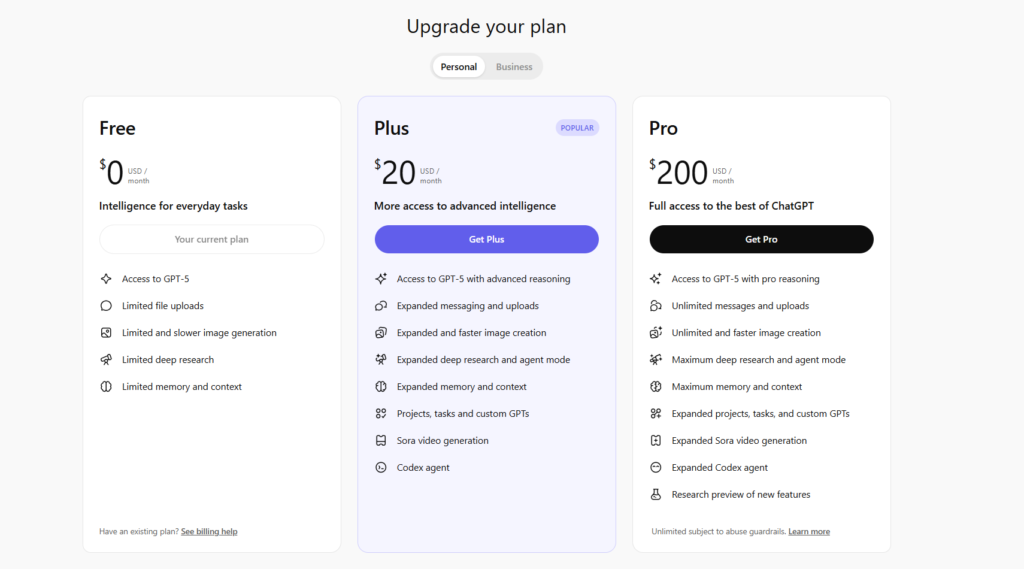
If you are a small business owner or a content team, these flexible plans let you pick the right balance of performance and cost for your needs. You can also explore the ChatGPT business plans
Key Features That Make GPT-5 Stand Out
Now let us look at some of the key features of ChatGPT-5:
- Sharper Reasoning
GPT-5 excels at multi-step thinking, breaking down complex questions and delivering more accurate answers. - Longer Context
It can follow your conversation or project for much longer without “forgetting” earlier points, perfect for ongoing campaigns or content strategies. - Multimodal Power
Beyond text, GPT-5 can understand and work with images, charts, and diagrams, giving you richer insights. - Smarter Adaptability
It adjusts its style and tone automatically — whether you need professional copy for a client pitch or a playful caption for social media. - Better Accuracy
Hallucinations (AI-generated wrong facts) are significantly reduced, making responses more trustworthy. - Custom Controls
You can fine-tune how detailed or concise it should be, or how much “thinking” it puts into an answer.
The Limitations to Keep in Mind
While GPT-5 is impressive, it’s not perfect. It’s still not “true AI” that understands the world the way humans do and it can make occasional mistakes, especially with niche or tricky questions. This is evident with what some of the earlier users on Reddit are saying about ChatGPT-5.
Moreover, Free-tier users will also face daily limits, and while it’s much more accurate than GPT-4, it’s not immune to errors.
GPT-4 vs GPT-5: The Big Differences
Here’s how the new version stacks up side by side:
| Feature | GPT-4 | GPT-5 |
| Reasoning Ability | Strong, but can struggle with complex multi-step problems | Much better at multi-step, complex reasoning |
| Accuracy | Good, but prone to occasional errors and hallucinations | Fewer errors, more factually reliable |
| Context Memory | Handles shorter conversations, limited long-term recall | Maintains context over much longer exchanges |
| Content Length | Up to ~100,000 tokens | Supports up to ~400,000 tokens or more |
| Pricing | Higher token costs, less cost-efficient | More cost-effective with flexible pricing plans |
| Adaptability | Can switch styles but may need prompts | Smooth and natural tone/style adaptation |
| Multimodal Support | Basic image and text handling (GPT-4o) | Advanced multimodal inputs (text, images, charts, audio, video) |
| Safety & Honesty | Occasional sycophancy and overconfident answers | More honest, transparent, and safer responses |
Why This Matters for You
If you run a business, create content, or work in digital marketing, GPT-5 can save you time, sharpen your campaigns, and even spark ideas you might not have considered. At Samodigital Agency, we are already exploring ways to use GPT-5 for smarter automation, content creation, customer engagement, and market analysis.
The bottom line? GPT-5 is not just another tech upgrade. It is a productivity boost, a creativity partner, and a competitive edge rolled into one.

How to Get More Plastic Surgery Clients Without Compromising Ethics
You might be a skilled plastic surgeon or clinic but that might not be enough to attract clients! Let’s face it; this is one of those niches that is quite competitive. In other words, you need to stand out if you are to convert more clients. The good news is that you don’t need to compromise your ethics to grow your practice. You can still attract new clients whilst respecting the personal, vulnerable nature of cosmetic procedures. Here’s a guide on how to get more plastic surgery clients without crossing ethical lines.
Lead with Customer Education, Avoid Enticement!
The best place to start when it comes to getting more clients is to build your authority in the market. This is what using tailored ethical marketing in plastic surgery comes in. You are better off starting by offering value-first content.
Remember this is a space where there are tons of aggressive marketing tactics used by competitor medical clinics looking to also get more plastic surgery clients. This means that most prospective patients tend to be often overwhelmed or misinformed.
You can thus stand a cut above the rest if you can position yourself as the educator, not the salesperson.
For example, you can tap into FAQ-style posts and video explainers like say honest procedure breakdowns. Make sure you avoid flashy language in your communication approach.
Tip: If you’re already working with a plastic surgery marketing agency, make sure they focus on educational content strategy instead of the hard-sell tactics approach.
Use Transparent Messaging To Craft Trust
There is literally no ethics in your plastic surgery practice marketing without transparency! Yes, your prospective patients will love honest information.
Sure you want to get more plastic surgery clients but don’t give them any sugar-coated guarantees or unrealistic promises. In this regard, you should be upfront with everything. We are talking about things like costs, risks, recovery times, and outcomes in your marketing copy and content. Well, you have got the duty of care thus you should be medically accurate. This is why you ought to make sure you explain what the client should truly expect
Tip: You can partner with a good great marketing agency to help you refine messaging. This way you’ll be compliant, honest, and still persuasive as a medical service provider
Avoid Fear-Based or Shame-Oriented Advertising
Now, unethical marketing will tend to gear more towards insecurities. On the other hand, long-term patient relationships are more of growing respect and empathy. You should therefore avoid using language or imagery that suggests patients are “flawed” or “not enough” without your cosmetic surgery services.
You are better off focusing more on empowerment messaging: For example, something like a message that tells the client a procedure will enhance their natural features is a better approach. It also helps if you feature diverse models and real patients in your photos rather than just filtering to showcase warped “perfection”
Tip: Ethical marketing in healthcare isn’t about closing fast. It’s more of building patient confidence over time.
Practice Informed Marketing, Just Like Informed Consent
Ethical marketing in healthcare draws parallels with informed consent. Again, patients should feel educated and autonomous. That mindset should show up in all of your content written or videos-including social posts and consultation emails.
Case example; you could create some downloadable guides like: “How to Choose the Right Cosmetic Procedure for You” or something like “10 Questions to Ask Your Plastic Surgeon First.”
You could also share behind-the-scenes videos, surgeon Q&As, and staff spotlights.
After all, people out there love to connect with people, not corporate jargon. So, go for a more conversational language that aligns with your in-person demeanor.
A good plastic surgery marketing agency will help you create these kinds of assets that build long-term trust, not quick conversions.
Share Social Proofs, But Do This Responsibly!
You should also use before-and-after images and testimonials to convey your expertise albeit they must be handled ethically and legally. As a rule of thumb, always get written patient consent (not just verbal). You should also contextualize them like say you share patient stories including goals, concerns, and outcomes.
It’s also wise to use disclaimers like “Individual results may vary”. Again, avoid overpromising to your prospective clients.
It is wise to work with a plastic surgery marketing agency that specializes in crafting HIPAA-compliant content workflows. A good marketing partner should understand how to present patient success stories responsibly.
Wrapping up
In a nutshell, you can get more plastic surgery clients whilst operating within ethical frameworks of medicine. The key is to convey empathy, transparency, and expertise. This way you won’t just avoid ethical missteps but you’ll also stand out.
If you need expert support, partnering with a specialized global plastic surgery marketing agency like Samodigital Agency.
We are a specialized global plastic surgery marketing agency proudly serving clients across the US, UK, and Africa. Our mission is simple: to help your practice attract more patients, build a trusted online presence, and dominate your local market.
Our comprehensive services include:
- Advanced SEO for plastic surgery clinics, including fully managed link building to boost your Google rankings
- Strategic Social Media Management to engage your audience and drive leads
- Custom content creation, paid social and google ad campaigns, website optimization, and more
It doesn’t matter if you’re looking to expand locally or scale globally. We have the experience and expertise to get you there!
So, are you ready to elevate your cosmetic surgery practice?
Just contact us today via info@samodigitalagency.com to schedule a free consultation and discover how we can take your plastic surgery brand to the next level.
Looking for a Google Ads Expert? Here’s What to Look For (Agency vs. Freelancer)
Are you looking to ramp up your online visibility? You might be thinking of running Google Ads as a way to create more awareness and lead generation for your products/services. In this case you might want to look for a Google Ads Specialist to help you with everything from the campaign setup, audits and the ads management. You are probably wondering if you should go for a Google Ads Agency or simply find a Google Ads Freelancer? Well, there isn’t really a one-size fits all solution.
It all boils down to factors like your budget, goals, and the likes. Here’s a guide on what to look for when hiring a Google Ads Specialist be it a full-service agency or a freelancer.
Assess Your Individual/Business Goals
For starters, you’ll need to clarify what you want to gain from your Google Ads campaigns.
For example, do you want to grow your website traffic? Are you maybe looking to drive leads, or boost your business sales? You’ll need to define the KPIs you’ll be looking for. This will make it easier to determine if you need a versatile Google Ads Consultant, a dedicated Google Ads Freelancer, or the full service Google Ads Agency.
When To Hire a Google Ads Freelancer
Google Ads Freelancers are often solo digital marketing professionals. They are skilled at managing campaigns for multiple clients. They can be a great fit if you are a small to mid-sized business with a limited budget.
Pros:
- Cost-effective: This will give you lower overhead costs
- Personal attention: You work directly with the person running your campaigns.
- Flexible: A freelancer tends to be more adaptable in communication and strategy adjustments.
When to Hire a Good Google Ads Agency
A Google Ads Agency on the other hand offers a team of specialists. This will often include strategists, copywriters, designers, and analysts. This can be beneficial if you have a project that’s relatively complex
Pros:
- Full-service: Top agencies can give you end-to-end services. They can handle everything from keyword research to landing page designs and optimization.
- Team of experts: You’ll get access to multiple specialists e.g., a Google Ads Consultants, analysts, designers and more in under one house.
- Scalable solutions: This is often ideal for a growing business or large accounts.
What to Look for in Any Google Ads Expert
Regardless of if you’re hiring a freelancer, agency, or an independent Google Ads Consultant, you definitely want to find the right fit.
Now, there are universal qualities and credentials to watch for:
- Google Ads certification: You should verify their credentials to ensure that they have the right skill sets to get the job done. You should vet that they know their way around platforms like Search, Display, Shopping, and YouTube ads, not just the basics.
- Proven track record: You should also ask for case studies or references showing measurable results.
- Transparent communication: Look for a provider that will make communication and collaboration easier.
Common Pitfalls to to Avoid When Working With Google Ads Freelancers & Agencies
- Promises of instant results: You should keep in mind that Google Ads tends to be data-driven. In other words, performance optimization takes time.
- No access to your account: Avoid an agency or a freelancer that will want to have full admin access to your ad accounts.
Which Should You Choose?
Again, it’s all about taking your pick depending on your project. If you’re on a tight budget and need hands-on attention, a Google Ads Freelancer might be your best option. If you have more complex needs or plan to scale quickly, then you need the right Google Ads Agency.
Ready to Grow with Google Ads?
Whether you’re looking for a dedicated Google Ads Freelancer on a retainer or a full-service Google Ads Agency experience, we’ve got you covered!
Our services cover:
- Google Ads Campaign Setup
- Google Ads Optimization
- Google Ads Audits
- Google Ads Scripting
- Google Shopping Feed Setup
- Conversion Tracking (GA4)
- Google Ads Account Review
- Google Ads Suspension Help
- PMAX (Performance Max) Scripting
- DSA (Dynamic Search Ads) Setup
You can email us via info@samodigialagency.com to book a free strategy call today and discover the smarter way to scale with a trusted Google Ads Expert by your side.
10 Proven Strategies to Boost Your Business on X in 2025
X formerly Twitter remains a powerhouse for real-time engagement, thought leadership, and customer connection in 2025. For marketers, brands, social media managers, businesses, solopreneurs, and creators, mastering X can drive visibility and conversions. In this article we share 10 actionable strategies to elevate your presence on X platform.
1. Optimize Your Profile for Maximum Impact
The first thing you need to do on X is to optimize your profile. Craft a profile that stands out. Use a clear logo or headshot, a professional header. Also have a bio that nails your brand’s value proposition. As you craft your bio, include niche-specific keywords and a link to your website to boost discoverability and conversions.
You can also add location and link to your other platforms or website.
2. Post Consistently with Diverse Content
Having an account on X without posting won’t bear you fruit. You need to post content consistently.Aim for 1-2 daily posts to stay visible without spamming followers. Mix text updates, images, short videos, and polls to keep your feed engaging. Data shows visuals and emojis can lift engagement by 30%. Keep posts concise (under 280 characters) for X’s fast-moving feed.
If you need to post content beyond 280 characters, you need to subscribe to X Premium. Understand the different features offered and go for the one that you can afford. X Premium also promises to boost your visibility on X.
3. Prioritize Real-Time Engagement
On X users expect quick responses 59% use the platform for news and updates. Therefore, you need to reply to comments, mentions, and DMs promptly to build trust. Moreover, you also need to join trending conversations in your industry to establish authority and use relevant hashtags to expand reach. This enhances visibility on the platform and helps you grow your brand and build an engaging community.
4. Embrace Video and Audio Features
X is doubling down on video and audio in 2025. Over time, they have made enhancements on video features such as introducing the ability to upload longer and 4K high quality videos. With that in mind, you need to create short-form videos (e.g., product demos or behind-the-scenes clips) to capture attention. Besides posting videos, you can also host Spaces for live audio discussions on industry topics to connect authentically with your audience. You can have thematic areas and recurring days when you are hosting Spaces.
Our Corporate Banking clients are at the heart of our success. With a customer-first approach and a comprehensive suite of solutions, I&M Bank is your partner for sustainable business growth.#IMBank #OnYourSide pic.twitter.com/Jo5MxJVgD6
— I&M Bank Kenya (@imbankke) May 26, 2025
5. Tell Stories That Resonate
Trends come and go, but storytelling drives conversions. There are different approaches to story telling. You can share customer success stories, company updates, or relatable insights. Repurpose high-performing content from Instagram or TikTok, but tweak it for X’s conversational vibe.
While on a routine wildlife health assessment in Meru National Park, the Meru Mobile Veterinary Unit encountered a solitary plains zebra stallion that had distanced itself from its herd. The zebra showed signs of severe pain, lack of appetite, and difficulty walking—prompting an… pic.twitter.com/aM3rGhhH5x
— Kenya Wildlife Service (@KWSKenya) April 24, 2025
6. Leverage Analytics for Smarter Posting
Use X analytics or tools like Hootsuite to identify peak engagement times and track performance. Nowadays, X analytics can show you when most of your audience are most active. Make use of this to know when best you can post content for maximum visibility and engagement. To add on, you need to conduct monthly audits to monitor follower growth and engagement rates, benchmarking against industry standards to refine your strategy.
7. Build an Email List for Control
X’s algorithm and ownership shifts can affect visibility. Besides that, an outage can appear and your audience will be in the dark. You need to build and email list and drive followers to your email list with compelling CTAs, like exclusive offers or newsletters, to maintain direct audience access.
8. Invest in Paid Promotion
Over time, the organic reach on social media platforms has declined, hence you need to boost your reach with paid ads. X leaning pay-to-play, consider ads or boosted posts to ensure reach. Target by interests or demographics for precision, and amplify high-performing organic content for better ROI. To start running your ads go to X ads manager. Alternatively, you can contact us at Samodigital to help you set up converting ads on X.
9. Collaborate for Growth
Another strategy that works like magic on X is partnering with influencers. Be strategic and Partner with micro-influencers or complementary brands to expand reach. Tag non-competing creators in posts to encourage reshares. Engage in X communities or niche discussions to build credibility and attract followers.
10. Stay Agile with Platform Changes
Just like any other social media platform, X keeps evolving with new features, tweaks in algorithms. X’s ad landscape and X continues to evolve its AI tools, with its Grok AI chatbot now able to generate images, including ad variations, based on text prompts. You also need to test new formats like X Money for monetization potential and see how they help you grow. and use tools like SocialBee to streamline scheduling and monitoring.
Adapt quickly to stay ahead.
Why X Matters in 2025
X’s real-time nature makes it ideal for customer service, PR, and thought leadership. Its audience (56.8% male, 43.2% female, mostly 25-34) is highly engaged, especially in the U.S. and Europe. Combine X with 2-3 platforms like LinkedIn or Instagram to maximize impact. For ad pricing or subscription details, visit X Premium.
Focusing on authenticity, engagement, and strategic testing, you can turn X into a growth engine for your brand in 2025.

