
Is SEO Dead or Evolving in 2026? How AI, AEO and GEO Are Changing Search
Is SEO Dead or Evolving in 2026?
Every few years, someone declares SEO dead. This happened when social media grew. It happened when voice search became popular. It happened when Google introduced featured snippets. Again, it is happening because of AI Overviews, ChatGPT, Gemini, Perplexity and other answer engines.
But SEO is not dead. What is dying is the narrow version of SEO that depended on keyword stuffing, thin blog posts, weak backlinks and chasing page-one rankings without understanding user intent.
SEO in 2026 is no longer just about appearing in blue links. It is about being discoverable, trusted, cited and chosen across search engines, AI answers, social search, voice search, local search and generative discovery.
The real question is not whether SEO is dead. The better question is whether your SEO strategy has evolved enough to match how people now search.
Search Behaviour Has Changed
SEO in the age of AI has changed. People are no longer searching only with short phrases such as “SEO agency Nairobi” or “best PR firm Kampala”. They are asking full questions, comparing options, using voice, searching on TikTok and YouTube, and expecting summarized answers.
For instance, a user might ask, “Which digital agency is best for SMEs in Kenya and why?” or “How can a PR team measure online reputation after a crisis?” These are no longer simple keyword searches. They are intent-rich questions.
Search systems are now trying to understand context, meaning, credibility and usefulness. This is why the old SEO playbook is not enough. Ranking for a keyword still matters, but it is no longer the full game.
Your content must answer real questions, show expertise, prove authority and be structured well enough for search engines and AI systems to understand it.
Why SEO Is Still Important in the Age of AI
Google itself has been clear that SEO best practices remain relevant for AI features such as AI Overviews and AI Mode. Google says its generative AI features are rooted in its core Search ranking and quality systems.
In simple terms, if your website cannot be crawled, indexed, understood and trusted by Google, it is unlikely to perform well in AI-driven search experiences.
That is an important correction to the noise around “AI SEO hacks”. You do not need to abandon SEO. You need to strengthen it.
-
Technical SEO Still Matters
Your website must be fast, mobile-friendly, secure and crawlable. A slow, broken or poorly structured website will struggle to rank, even when the content is useful.
Search engines need to access your pages, understand your structure and index your content correctly. Without that foundation, your visibility is already weak.
-
On-Page SEO Still Matters
Your titles, headings, internal links, images, schema, meta descriptions and page structure still help search engines understand your content.
Good on-page SEO is no longer about forcing keywords into every paragraph. It is about helping both humans and search engines understand what the page is about, who it serves and why it is useful.
-
Off-Page SEO Still Matters
Credible backlinks, media mentions, reviews, social references and brand mentions still shape authority. In the AI era, reputation across the open web matters even more because AI systems rely on trusted signals when deciding what to retrieve, summarize or cite.
The Evolution: From SEO to AEO and GEO
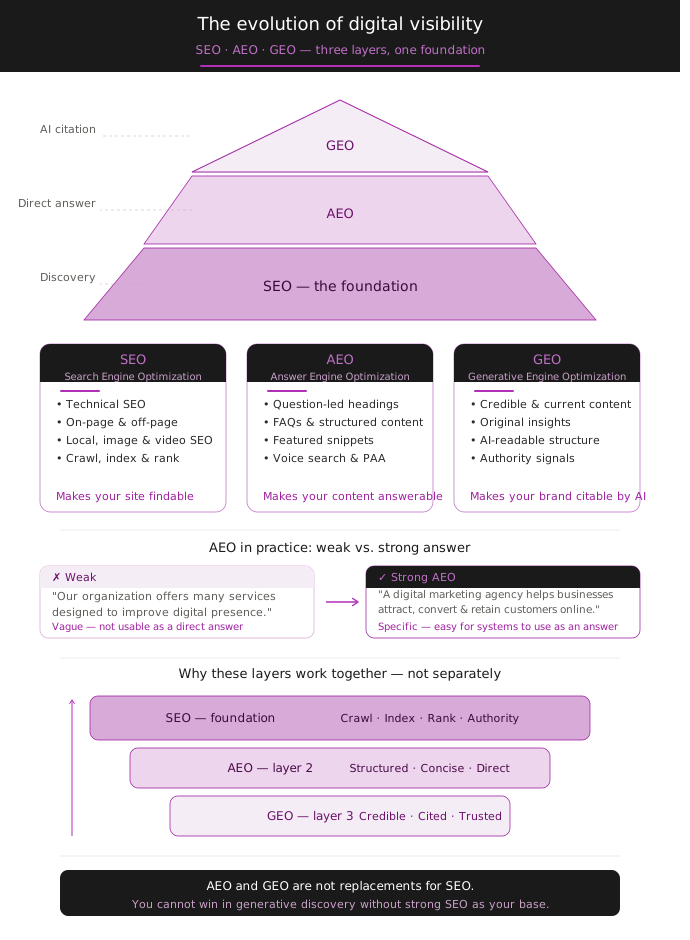
Modern visibility now has three connected layers: SEO, AEO and GEO. These three are not competing ideas. They work together.
SEO: Getting Discovered in Search Results
SEO, or Search Engine Optimization, is the foundation. It helps search engines discover, crawl, index and rank your website.
It includes technical SEO, on-page SEO, off-page SEO, local SEO, image SEO and video SEO. Without SEO, your website is harder to find and harder for search engines to understand.
AEO: Getting Selected as the Direct Answer
AEO, or Answer Engine Optimization, is about making your content easy to select as a direct answer.
This matters because users increasingly get answers without clicking through several websites. AEO focuses on question-led headings, concise explanations, FAQs, structured content, featured snippets, voice search and People Also Ask results.
For example, a weak paragraph might say:
“Our organization offers many services designed to improve digital presence.”
A stronger AEO-style answer would say:
“A digital marketing agency helps businesses attract, convert and retain customers online through SEO, paid ads, social media, content marketing, analytics and conversion optimization.”
The second version is clearer, more specific and easier for a search system to use as an answer.
What is GEO: Getting Cited by AI Answer Systems
GEO, or Generative Engine Optimization, is about making your brand, expertise or content more likely to be retrieved, trusted, synthesized and cited by AI answer systems. GEO matters because AI tools do not always show users a traditional list of links. They summarize information and cite selected sources. To be cited, your content needs to be credible, current, original and easy to interpret.
Why AEO and GEO Do Not Replace SEO
The mistake many brands are making is treating AEO and GEO as replacements for SEO. They are not replacements. They are layers on top of SEO.
You cannot win in generative discovery if your basic website structure, content quality and authority signals are weak.
SEO in the Age of AI: What Has Changed?
AI has changed search in several important ways. These shifts explain why marketers, communicators, PR professionals and organizations need to rethink how they approach search visibility.
-
Users Are Asking Longer and More Complex Questions
Instead of searching “media monitoring tools”, a user may now ask, “What is the best media monitoring tool for PR teams in Kenya tracking brand sentiment across social media and news?”
That kind of query needs more than a keyword-matched page. It needs a useful, contextual and credible answer.
-
Zero-Click Search Is Growing
Many users now get answers directly on the search results page. They may see a featured snippet, People Also Ask result, knowledge panel or AI-generated summary before clicking any website.
This means brands must measure visibility differently. A click is still valuable, but visibility, mentions, snippets and citations also matter.
-
Search Is Becoming Multimodal
People now search using text, images, video, screenshots and voice. This makes image SEO, video SEO and structured visual content more important.
A brand that only optimizes written articles is missing part of the search opportunity.
-
Authority Is Becoming Harder to Fake
AI systems and search engines need trusted sources. Clear authorship, expert credentials, original data, case studies, reviews, reputable mentions and consistent brand information now matter more.
Generic content is easy to produce. Trusted content is harder to build. That is where serious brands can win.
-
AI Search Uses Query Fan-Out
AI search can break one user question into several related searches before generating an answer. This means your content must cover topics deeply, not just target one narrow keyword.
If your website has one shallow blog post on a topic, that is not enough. You need depth, related pages, evidence, examples and a clear point of view.
How to Do SEO in the Age of AI
SEO in 2026 needs a stronger operating rhythm. It is not a one-off website task. It sits at the intersection of content, communications, product, analytics and leadership.
1. Start With the SEO Basics
Many brands want to jump into GEO before fixing the foundation. That is a mistake.
Check whether your website is indexed. Use Google Search Console. Fix crawl errors. Improve page speed. Make sure your site works well on mobile. Use HTTPS. Remove broken links. Update old pages.
A technically weak website loses visibility even when the content is good.
2. Build Content Around Intent, Not Just Keywords
Keywords still matter, but they should guide your understanding of what people want.
For every important topic, ask:
- What does the user want to know?
- What decision are they trying to make?
- What fear, confusion or problem are they bringing to search?
- What answer would actually help them?
A page that answers intent will outperform a page that simply repeats keywords.
3. Create Answer-Ready Content for AEO
Use question-based H2 and H3 headings. Give a direct answer immediately after the heading before expanding. Add FAQs to service pages. Use tables where comparison is needed. Use numbered steps for how-to content.
Write in a natural style that can be read aloud for voice search. This is how you build for Answer Engine Optimization.
4. Create Original, Expert-Led Content for GEO
AI can summarize generic content easily. It cannot replace your real experience, data, local insight, client work, industry observations or case studies.
In East Africa especially, there is still a major gap in credible local content. This is an opportunity for consultants, agencies, universities, public sector organizations, NGOs and brands to own their niche through original explainers, research reports, local examples and expert commentary.
If you want AI systems to cite you, publish content worth citing.
5. Strengthen Your Entity Signals
Search engines and AI systems need to understand who you are, what you do, where you operate and why you should be trusted.
Keep your organization name, address, phone number, service descriptions and profiles consistent across your website, Google Business Profile, LinkedIn, media mentions, directories and partner pages.
Add author bios. Show credentials. Link to credible sources. Publish an About page that actually explains your expertise.
6. Use Structured Data, But Do Not Obsess Over It
Schema can help search engines understand your content and qualify your pages for rich results.
Use the FAQ schema, Article schema, LocalBusiness schema, Product schema or HowTo schema where relevant. But schema is not a shortcut for weak content. It supports clarity; it does not create authority by itself.
7. Build Topic Clusters
One blog post is rarely enough to prove authority.
If you want to rank and be cited for digital marketing, PR measurement, media monitoring, social listening or AI search, build a cluster of related pages.
Create pillar guides, practical how-to articles, FAQs, case studies, glossary pages, comparison pages and industry insights. Search engines and AI systems reward depth, consistency and topical authority.
8. Do Not Ignore Local SEO
For businesses in Kenya and East Africa, local visibility is still powerful.
Claim and optimize your Google Business Profile. Keep your name, address, and Phone number consistent. Encourage reviews. Respond to reviews. Add local service pages. Use natural location references such as Nairobi, Kenya, Kampala, Dar es Salaam or Mombasa where relevant.
Local SEO is especially important for agencies, consultants, training institutions, restaurants, health facilities, public services, real estate firms and professional service businesses.
9. Optimize for Images, Video and Social Search
Search is no longer limited to Google’s traditional results page. Users search on YouTube, TikTok, Instagram, LinkedIn, Pinterest and AI tools.
Use descriptive file names, alt text, captions, transcripts and clear titles for images and videos. Repurpose strong articles into carousels, short videos, explainers and LinkedIn posts. This improves discoverability across platforms where audiences are already searching.
10. Measure Beyond Rankings
In 2026, SEO reporting should not stop at keyword rankings.
Track organic traffic, impressions, click-through rate, indexed pages, Core Web Vitals, backlinks, featured snippet ownership, People Also Ask visibility, local pack appearances, branded search growth, AI Overview appearances, AI citations and conversions.
The master metric is visibility share: how often your brand appears across traditional search, answer engines and AI-generated responses for the conversations that matter in your sector.
What This Means for Brands and Organizations
The brands that will win search in 2026 are not the ones producing the most content. They are the ones producing the most useful, credible and findable content.
Organizations need to stop treating SEO as a technical task left to one person after the website is built. SEO now affects brand reputation, thought leadership, customer acquisition, public communication and digital trust.
- A public institution should ask: are citizens finding accurate answers from us or from third-party summaries?
- A PR team should ask: when people search our brand during a crisis, what do they find first?
- A university should ask: are prospective students finding clear programme pages, credible faculty profiles and useful application information?
- A business should ask: when AI tools recommend service providers in our sector, are we visible or invisible?
- These are no longer small questions. They are visibility, reputation and revenue questions.
So, Is SEO Dead?
To conclude, No. SEO is not dead. It is becoming more strategic, more technical, more content-led and more reputation-driven.
What is dead is lazy SEO. Publishing generic articles, adding keywords mechanically, buying weak backlinks and hoping Google will reward you is no longer a serious strategy. The brands that will win in 2026 are the ones that understand how people search, how AI systems retrieve information, and how trust is built across the open web.
SEO has evolved from ranking pages to earning visibility. AEO helps you become the answer. GEO helps you become the cited source. But SEO remains the foundation that makes both possible.
If Google, ChatGPT or Gemini introduced your organization to a stranger today, would you be proud, worried, shocked or invisible?
That is the real SEO audit for 2026.
Contact us for SEO and Website Optimization services at info@samodigitalagency.com

SEO in the Gemini Era: How Google’s AI Updates Impact Search Optimization
At the just concluded Google I/O 2024, Google announced expanded AI features for Google Search. How will this impact search engine optimization? Google has been making changes to Google search to improve how users find information in the search results.
The generative AI has even accelerated the improvement since the introduction of Gemini and the search lab’s search generative experience.
Here are some of the updates coming to Google Search in the Gemini Era
Google Search is introducing a new feature called AI Overviews.
AI overviews are summaries of search results that are designed to give users a quick overview of a topic without them having to click on multiple links. The feature has been tested in Search Labs, and users liked that they could get a quick summary and then links to learn more if they wanted. Google is rolling out AI Overviews to everyone in the US this week and expects to bring them to over a billion people by the end of the year.
Ability to Customize AI Overviews
Google Search will soon let you customize AI Overviews. You’ll be able to choose to simplify the language for easier understanding or get a more detailed breakdown of the topic
Search is getting smarter!
You can now ask complex questions in one go, thanks to a new AI model called Gemini. This means you can include all the details you want in your search, like location, criteria, and comparisons.
Google gives an example “For example, maybe you’re looking for a new yoga or pilates studio, and you want one that’s popular with locals, conveniently located for your commute, and also offers a discount for new members. Soon, with just one search, you’ll be able to ask something like “find the best yoga or pilates studios in Boston and show me details on their intro offers, and walking time from Beacon Hill.”
Plan Ahead!
Search can now help you create meal plans and trip itineraries. You can search for things like “easy 5-day meal plan for a group” and get recipe suggestions. Google says you can even customize the plan by asking for vegetarian options. You can then export the plan to Docs or Gmail. This feature is currently in testing but will be expanded to include other planning categories like parties and workouts.
Get AI-organized Results Pages
They’re introducing AI-organized results pages to help you brainstorm ideas. These pages will use AI to categorize different websites under unique headings, giving you a broader perspective on your search topic. This will be available first for searches related to dining and recipes, with plans to expand to movies, music, and more.
Google Search is getting a video search upgrade!
You’ll soon be able to search using videos. This means you can record a problem, like a malfunctioning record player, and Search will use AI to understand the video and provide solutions with steps and resources. No more struggling to describe the issue with text!
What does this mean for SEO?
The SEO Impact of Generative AI in Google Search
In my view, the question of how generative AI in Google searches will affect search engine optimization (SEO) has been a major concern. Is SEO dead? While the impact is undeniable, I believe SEO will adapt rather than become obsolete.
Firstly, website traffic might be affected. Users may get some answers directly from search results, reducing clicks to websites for basic information.
Secondly, content creators like bloggers and writers will face a challenge in crafting high-quality, relevant content that stands out for AI algorithms. However, Google’s inclusion of recommended articles within the search generative experience suggests that valuable content will still be crucial.
In essence, generative AI offers easier information access for users but presents a challenge for content creation.
What are your thoughts?
7 Essential Qualities of a Successful Digital Marketing Consultant
What does digital marketing consultant do?
In todays’ ever changing world, you may need to work with a digital marketing consultant to elevate the growth of your business. What does a digital marketing consultant do? A digital marketing consultant is a professional who helps businesses and organizations develop and execute effective digital marketing strategies. They provide expert advice and guidance on various aspects of digital marketing. This will help you achieve their marketing goals and increase their online presence.
Here are some key responsibilities of a digital marketing consultant
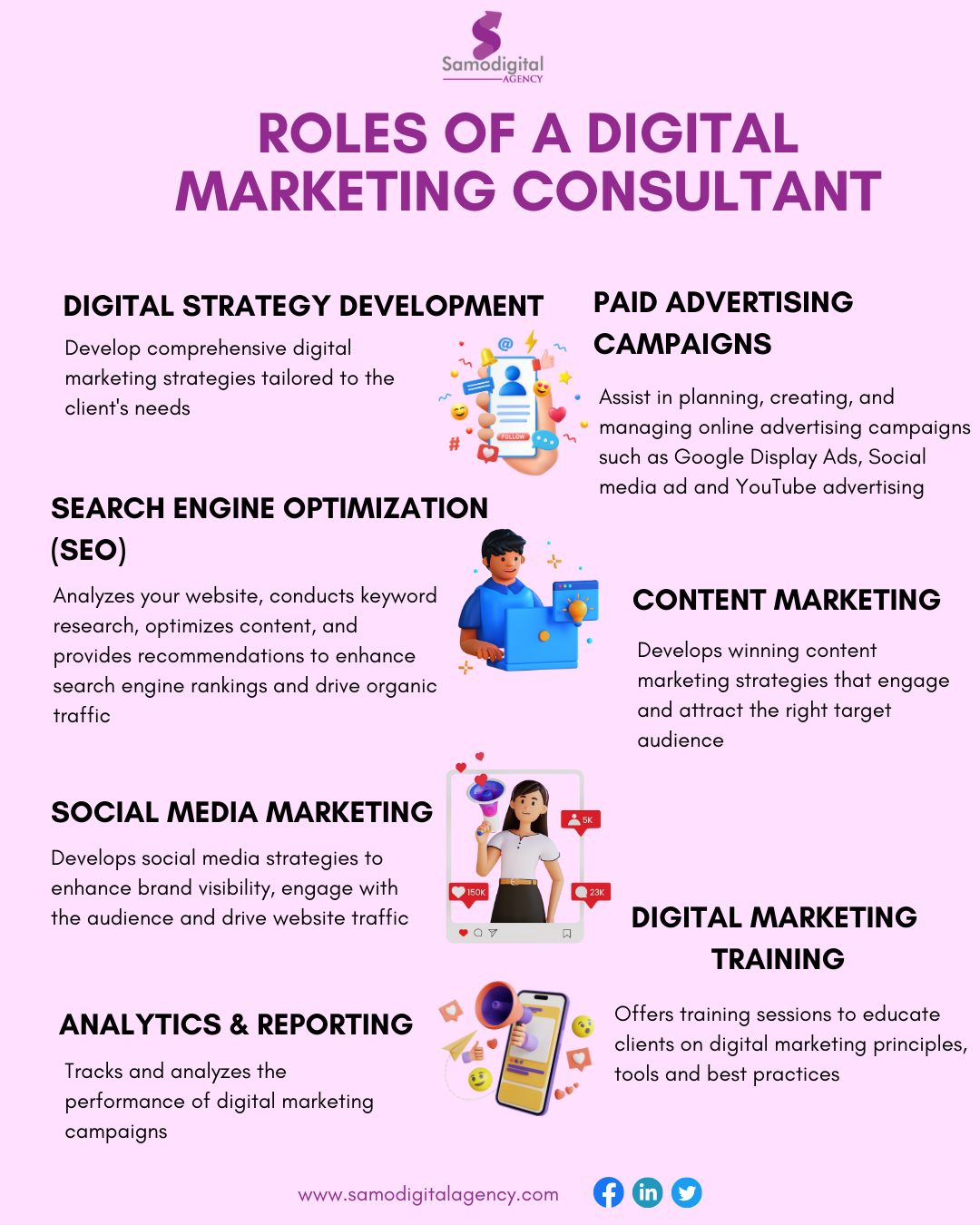
Roles of a digital marketing consultant Samodigital Agency
1. Digital Strategy Development
A consultant collaborates with clients to understand their business objectives and target audience and ideal social media platforms. They develop comprehensive digital marketing strategies tailored to the client’s needs. This involves identifying the most suitable digital channels and tactics to reach the target audience effectively.
2. Run Paid Advertising Campaigns
Hiring a digital marketing consultant will assist you in planning, creating, and managing online advertising campaigns across platforms such as Google Ads, social media platforms, and YouTube advertising. They will help you optimize campaigns to achieve maximum reach, engagement, and conversions within the allocated budget.
3. Search Engine Optimization (SEO)
As you know, SEO is crucial for improving a website’s visibility in search engine results. You will not be able to execute this alone if you don’t know how to do it. That’s why you will need an experienced digital marketing consultant. A digital marketing consultant will help you analyze websites, conduct keyword research, optimize content, and provide recommendations to enhance search engine rankings and drive organic traffic Share on X. Some will even be able to write engaging and informative content for your website.
4. Content Marketing
Content is King! It’s what drives engagement, leads and conversion for any business. A consultant will also help you develop winning content marketing strategies that engage and attract the right target audience. You can read this article to understand types of content and why it’s important to brands. Consultants often assess the performance of content and make suggestions for improvement.
5. Social Media Marketing
Moreover, consultants assist in developing social media strategies to enhance brand visibility, engage with the audience, and drive website traffic. Right now, we have top social media platforms and emerging platforms. Platforms like Threads, Lemon8, Bluesky and much more to come. Therefore a consultant will recommend platforms suitable for your business, create content calendars, and provide insights.
Also, they will optimize social media posts and advertising to ensure you gain the most from your marketing efforts and return investment.
6. Analytics and Reporting
With digital marketing you can easily track and measure your marketing efforts. To add on, working with a consultant will help you use various tools to track and analyze the performance of digital marketing campaigns. These could be web analytics tools like Google Analytics, In-app social media analytics or third party analytics tools like Semrush, Sprout Social among others.
Moreover, They will provide you with reports while highlighting key metrics, trends, and areas for improvement. Consultants use these insights to refine strategies and make data-driven decisions.
7. Digital Marketing Training
Finally, some consultants may offer training sessions to educate clients on digital marketing principles, tools, and best practices.If you are in Kenya and you would like to have in-house training for your team, you can hire a certified digital marketer like Egline Samoei Share on X. She will help you gain a better understanding of digital marketing and empowers them to execute strategies independently if desired. Yo can reach out via email at egline@samodigitalagency.com
In Conclusion
To conclude a digital marketing consultant helps businesses leverage digital channels effectively to achieve their marketing objectives, improve brand awareness, drive website traffic, and generate leads or sales. Lastly, they stay updated with the latest trends and technologies in the digital marketing landscape to provide valuable insights and guidance to their clients.

