

5 Things You Should Never Tell ChatGPT: A Practical Privacy Guide
There are some things you should never tell ChatGPT, especially when they involve sensitive personal, financial or confidential information. ChatGPT can help you draft emails, analyse information, summarise documents, brainstorm campaign ideas and work through everyday tasks, but its convenience can also make it easy to paste information without first checking what is contained in it.
Imagine asking ChatGPT to improve an email from a customer and pasting the entire thread, including their phone number, account details and previous correspondence. A colleague might upload an internal strategy document because they want a quick summary, while someone else may paste a spreadsheet containing client information because they need help analysing it.
The AI task itself may be perfectly reasonable. The information being shared deserves more thought.
Knowing how to use generative AI effectively therefore involves more than learning how to write good prompts. AI literacy also includes knowing what information is appropriate to share, what should be removed and when your organisation’s data policies need to guide your decision.
In this guide, we look at five things you should never tell ChatGPT in an ordinary AI conversation, why they require extra care and what you can do instead.
1. Passwords, PINs and login credentials
Passwords should remain in secure credential-management systems rather than being entered into an AI conversation. The same applies to PINs, one-time passwords, recovery codes, security-question answers, authentication tokens, private keys and other information that provides access to an account.
Sometimes this information can be shared accidentally rather than intentionally. For example, someone troubleshooting a technical problem may paste a configuration file containing an API key. An employee asking for help with an error message may copy information from a system without noticing that a credential appears within it.
Before sharing code, screenshots, technical logs or configuration files with an AI tool, review them for sensitive credentials. Where the example requires a password or API key for context, replace the actual value with a placeholder such as [PASSWORD] or [API_KEY].
The AI can usually help you understand the problem without receiving the real credential.
This is a useful digital-security habit beyond ChatGPT as well. Information that gives someone access to your email, company systems, financial accounts or other services should be handled separately from information you share for analysis or troubleshooting.
2. Bank account details and other financial credentials
You can use ChatGPT to understand budgeting concepts, organise financial information or explain unfamiliar financial terminology. That does not require giving the tool credentials that could be used to access your money.
Bank account login details, credit or debit card numbers, PINs, mobile-money credentials, recovery information and similar financial access data should be kept out of ordinary AI prompts.
A common risk comes from documents rather than typed questions. You might upload an invoice because you want help improving its wording, or a financial statement because you want assistance categorising expenditure. Those files may contain account numbers, addresses and other details that the AI does not actually need for the task.
A better approach is to remove or mask unnecessary identifiers before sharing the document. For example, you can replace an account number with [ACCOUNT NUMBER], remove customer names from financial data or create a sample version of an invoice containing fictional details.
The principle is straightforward: give the AI the information required to understand the task rather than information that could be used to access your financial accounts.
3. Government IDs and unnecessary personally identifiable information
Personally identifiable information can include passport numbers, national identification details, driving licence numbers, full dates of birth, home addresses and other information that can be linked directly to an individual.
The challenge is that this information is often embedded in documents.
Suppose you want ChatGPT to improve your CV. The tool may need to see your experience, qualifications and skills, while your full home address, identification number or other highly specific personal details may add no value to the task.
The same issue becomes even more important when working with information belonging to other people. A marketer analysing customer feedback, an NGO reviewing beneficiary data or a trainer working with participant information may have access to names, email addresses, telephone numbers or identification details.
Before sharing that information with an AI tool, ask what is actually required for the task. Often, the analysis can still be performed after personal identifiers have been removed or replaced with anonymous labels such as Participant A, Customer 01 or Respondent 15.
This is an example of data minimisation: sharing only the information required to achieve the intended purpose.
4. Confidential business, employee and client information
This is one of the most important areas for organisations adopting generative AI.
Imagine someone preparing for a strategy meeting and uploading the organisation’s unpublished five-year plan so that ChatGPT can identify weaknesses. Another employee might paste an entire client brief into an AI tool for help developing campaign ideas, while a communications professional could upload an unpublished crisis-response document for editing.
The intended use of AI may make sense. The way the information is handled still needs to follow the organisation’s confidentiality, security and contractual requirements.
Confidential information may include internal strategy documents, customer databases, employee records, contracts, unpublished financial results, proprietary research, tender documents, client information, unreleased products and material covered by non-disclosure agreements.
For organisations, this is why AI adoption needs governance alongside training.
Employees should know which AI tools have been approved for work, what kinds of organisational information can be shared, what needs to be anonymised and which information requires additional approval.
There is also an important distinction between personal ChatGPT accounts and managed business environments. OpenAI says content from ChatGPT Business, Enterprise and Edu workspaces is not used to train its models by default.
That protection is important, but it does not replace your organisation’s internal policies, contractual obligations or access controls. An employee still needs to consider whether they are authorised to share a particular document and whether the AI system being used has been approved for that type of information.
For many organisations, the useful question is therefore broader than “Can ChatGPT analyse this?”
It is whether the organisation has established an appropriate and approved process for using AI with that information.
5. Unnecessary sensitive health and personal information
Generative AI can be useful for explaining terminology, helping someone understand a complicated document or preparing questions they may want to discuss with a professional.
However, health documents and other sensitive personal records often contain far more information than is required for a particular question.
A medical report, for example, may include a person’s name, patient number, address, telephone number, test results and other identifying information. If the objective is simply to understand a particular term or passage, much of that identifying information may be unnecessary.
Where appropriate, remove identifying details and share only the part of the information required for the task. The same principle applies to other sensitive information involving employees, customers, programme participants or beneficiaries.
The environment in which AI is being used also matters. An organisation using an approved system designed for handling sensitive information may operate under different controls from someone using a personal consumer account.
The practical lesson is that being able to upload an entire document does not automatically mean the entire document is necessary for the task.
Think before you paste, upload or screenshot
One of the simplest habits for safer AI use is to pause before adding information to a prompt.
Consider what ChatGPT actually needs in order to complete the task. A 50-page report may contain only three paragraphs relevant to your question. An email may make sense without the sender’s telephone number and account information. A spreadsheet may still be useful for analysis after customer identifiers have been removed.
The same caution should apply to screenshots.
A screenshot taken to show an error message may also reveal an email address, account number, browser tab, client name or other information in the background. PDFs, presentations and spreadsheets can contain similar information in headers, footers, comments or metadata.
Developing the habit of checking information before sharing it is one of the practical parts of responsible AI use.
Understand ChatGPT’s privacy controls
It is also worth understanding the controls available within ChatGPT rather than assuming that every ChatGPT conversation is handled in exactly the same way.
For eligible personal ChatGPT accounts, users can go to Settings > Data Controls and turn off Improve the model for everyone. OpenAI says new conversations created after opting out will not be used to train its models. OpenAI Help Center
ChatGPT also offers Temporary Chat. While a conversation remains temporary, it stays out of chat history, does not create or update memories and is not used to improve OpenAI’s models. OpenAI says a copy may still be retained for up to 30 days for safety purposes.
For organisational users, OpenAI says data from ChatGPT Business, Enterprise, Edu and several other business offerings is excluded from model training by default.
OpenAI also states that it does not sell user data and does not share ChatGPT conversations with advertisers or marketing partners.
These settings are useful privacy controls, but they work best alongside good information-handling habits. Data minimisation, organisational policies and professional judgement remain important regardless of the technology being used.
AI privacy should become part of workplace AI training
As more employees begin using generative AI at work, organisations need to teach much more than prompting.
Imagine a communications team that has been trained to use AI for research, drafting and summarising reports but has never discussed what information can be uploaded. Employees may become very productive with the technology while making inconsistent decisions about confidential information.
Practical AI training should therefore include data handling.
Teams should understand which AI tools the organisation has approved, which information can be shared, what should be anonymised and which documents require additional care. They also need guidance on customer information, meeting transcripts, internal reports, intellectual property and third-party information.
This gives employees something more useful than a vague instruction to “be careful with AI”.
It provides clear boundaries for using the technology confidently and responsibly.
For organisations adopting generative AI, an internal AI-use policy can support this process. The policy can explain approved tools, permitted use cases, information classifications, review responsibilities and what employees should do when they are uncertain whether a particular document can be shared.
What to do instead of sharing sensitive information
Using AI safely does not mean removing all context from your prompts. Good AI results often depend on good context.
The better approach is to provide relevant context without unnecessary sensitive information.
If you need help rewriting a customer complaint, remove names, phone numbers and account numbers while preserving the substance of the complaint. When analysing survey responses, replace personally identifying information with anonymous identifiers. For a strategy example, provide the relevant scenario while removing confidential commercial details.
You can also create fictional or representative examples when the actual information adds unnecessary risk.
These small changes allow you to benefit from generative AI while maintaining better control over the information you share.
Knowing what not to share is part of AI literacy
ChatGPT can be useful for writing, research, analysis, ideation, learning and everyday productivity. Responsible use means understanding both what the technology can help you accomplish and how the information you provide should be handled.
The five things you should never tell ChatGPT in an ordinary conversation are therefore less about avoiding AI and more about developing better digital habits. Protect access credentials and financial information, minimise personal identifiers, handle confidential organisational information appropriately and think carefully before sharing sensitive records.
Before pasting information into an AI tool, take a moment to ask whether every detail is necessary for the task. Where it is not, remove it, anonymise it or replace it with a placeholder.
Knowing how to prompt ChatGPT is useful. Knowing what belongs in the prompt is part of AI literacy too.
Need AI literacy training for your team?
Samodigital helps organisations and teams build practical capabilities in AI literacy, digital marketing, digital communication and the responsible use of emerging technologies.
Our approach goes beyond showing teams which buttons to click. We help people understand how to apply digital and AI tools within real work while considering accuracy, privacy, professional judgement and responsible use.
Contact us info@samodigitalagency.com
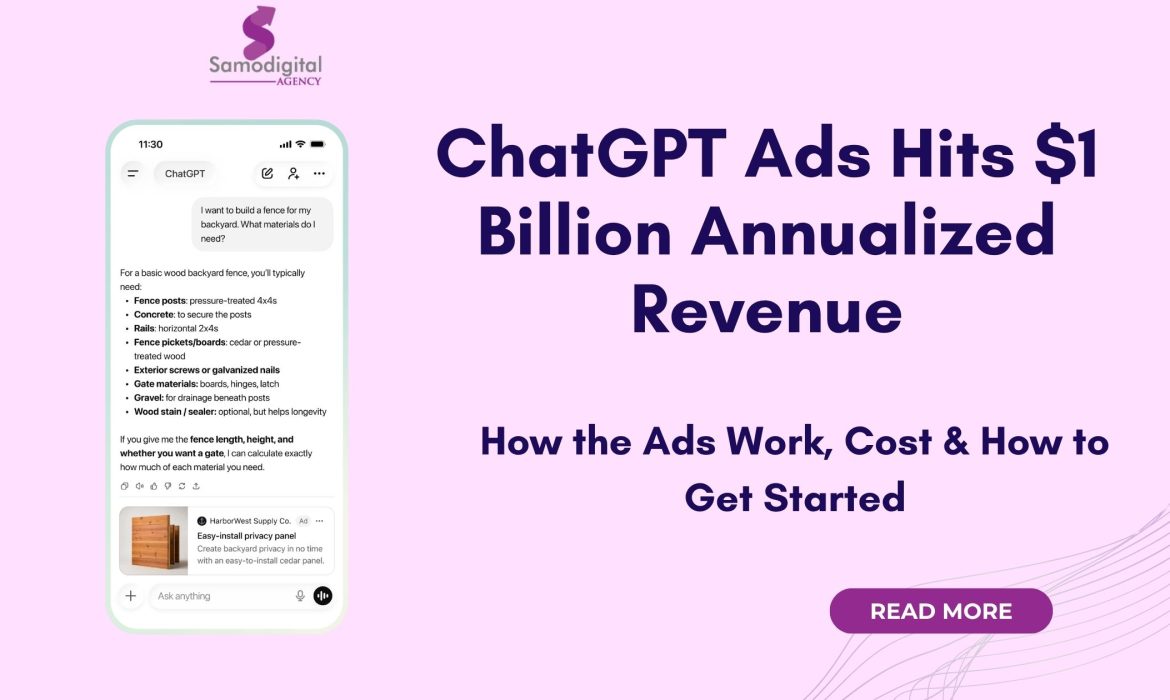
ChatGPT Ads Reaches $1 Billion in Annualized Revenue Run Rate: How It Works, What It Costs and How to Get Started
ChatGPT Ads has reached $1 billion in annualized revenue run rate less than 200 days after launch, giving OpenAI’s advertising business a significant milestone while the company continues expanding access to advertisers around the world.
OpenAI announced on August 31, 2026 that tens of thousands of advertisers are now using ChatGPT Ads. The company has also expanded self-service buying through Ads Manager across India, Europe, the Middle East and North Africa. ChatGPT Ads is now available in more than 40 countries through OpenAI’s advertising team, agencies and technology partners.
The $1 billion figure does not mean OpenAI has already collected $1 billion in advertising revenue in less than 200 days. Annualized revenue run rate takes the current pace of revenue and estimates what that would amount to over a full year if the same rate continued.
Even so, the speed at which ChatGPT Ads has grown is worth paying attention to. OpenAI says ChatGPT serves more than 1 billion weekly active users, while advertising is becoming another part of its business alongside subscriptions, enterprise products and API usage.
For marketers, advertisers and businesses, this raises more practical questions: How do ChatGPT Ads work? What do they look like? How much do ChatGPT Ads cost? And how can a business start advertising on ChatGPT?
Does ChatGPT Have Ads?
Yes. ChatGPT now shows advertising to some users on its Free and Go plans in markets where ads are available.
Ads are not shown to users on Plus, Pro, Business, Enterprise or Edu plans. OpenAI also says it does not show ads to accounts identified as belonging to people under 18, and Temporary Chats do not show ads.
The ads appear below ChatGPT responses and are clearly marked as sponsored. They are separate from the answer generated by ChatGPT.
This is an important distinction. Advertisers are paying for an ad placement, not for ChatGPT to recommend their product inside an answer. OpenAI says advertisers cannot pay to shape, rank or alter ChatGPT responses, and seeing an ad does not mean OpenAI endorses that advertiser or product.
How Do ChatGPT Ads Work?
ChatGPT Ads uses the context and intent of a conversation to help determine whether an advertisement may be relevant.
That makes the advertising experience different from traditional keyword-based search advertising.
Someone using a search engine might type best accounting software for a small business. In ChatGPT, the same person could explain that they run a five-person company, need software that integrates with their bank, want simple invoicing and cannot afford an expensive enterprise system.
The conversation gives the system much more context about what the person is trying to achieve.
OpenAI says its advertising system considers several signals when deciding which ads may be relevant. These include the context and intent of the current conversation, the advertiser’s landing page, headline, ad copy, targeting selections and advertiser-provided context hints. When ad personalization is enabled, selected signals from a user’s wider ChatGPT experience may also contribute to ad relevance.
For marketers, this means advertising on ChatGPT cannot simply be treated as another place to upload a long list of keywords.
What Are Context Hints in ChatGPT Ads?
Context hints help advertisers describe the kinds of needs, conversations or situations where their product or service may be useful.
For example, an advertiser selling running shoes could provide a broad description such as running shoes. But OpenAI recommends giving more useful context, such as cushioned everyday running shoes for beginners training for their first 5K.
The idea is to help the advertising system understand the customer situation behind the product.
Context hints are not exact-match keywords. Someone does not need to type the exact phrase provided by the advertiser before the ad becomes eligible to appear, and adding a context hint does not guarantee that an advertisement will be shown.
This is one of the areas marketers will need to learn. Instead of thinking only about what keyword would someone search?, it may become equally important to ask what problem is this person trying to solve, and when would our product genuinely be useful?
What Do ChatGPT Ads Look Like?
ChatGPT Ads appear below ChatGPT’s response.
A standard ad can include the advertiser’s name, brand favicon or logo, headline, description, landing page and an image. OpenAI may show one or more sponsored items when there is a relevant match to the conversation

That placement puts advertising close to the moment when someone may already be researching something, comparing alternatives or deciding what to do next.
This could be particularly useful for businesses selling products and services that customers normally research before making a decision. The challenge for advertisers will be making sure the ad is genuinely helpful within the context of that conversation instead of simply interrupting it.
OpenAI’s own guidance encourages advertisers to use clear, useful copy that explains what a product offers, who it is for and when it may help. It advises against relying too heavily on generic slogans and broad marketing language.
What Does ChatGPT Ads Manager Do?
OpenAI Ads Manager Beta is the self-service platform advertisers use to create, launch and manage ChatGPT advertising campaigns.
Businesses can use Ads Manager to set up campaigns, create ad groups and ads, control budgets and targeting, manage billing and account access, and monitor performance. Campaigns can be built individually through the guided workflow or created at scale using bulk uploads.
Advertisers can currently monitor metrics including impressions, clicks, spend, click-through rate, average CPC, average CPM and conversions where conversion tracking has been configured. Reporting is available through tables, charts and CSV exports.
Ads Manager also supports conversion measurement, while OpenAI has introduced tools including its Pixel and Conversions API to help advertisers understand what people do after clicking an ad.
ChatGPT ad Campaigns can currently be optimized for reach, clicks or conversions. OpenAI supports CPM, where advertisers pay per 1,000 impressions; CPC, where advertisers pay for valid clicks; and oCPC, which optimizes delivery towards a selected conversion action while the advertiser is still billed for valid clicks.
How Much Do ChatGPT Ads Cost?
There is no single fixed cost for advertising on ChatGPT.
ChatGPT Ads uses an auction-based advertising system, so the amount an advertiser pays can depend on the campaign objective, bid, competition and relevance.
For CPC campaigns, OpenAI currently recommends starting with a maximum CPC bid of US$3 to US$5 per click. That does not mean every click will cost between $3 and $5. It is a recommended starting maximum bid, with the actual amount determined through the advertising auction.
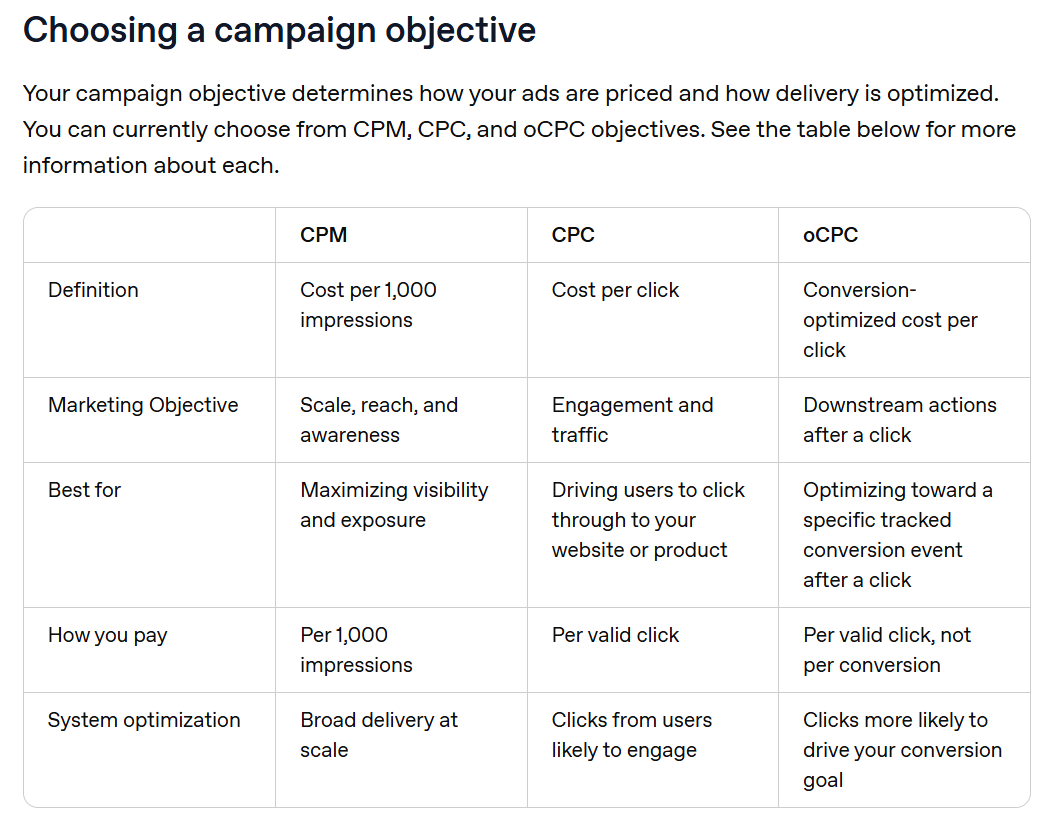
OpenAI says it uses a relevance-weighted second-price auction. This means having the highest bid alone is not enough. The system also considers how relevant an advertisement is expected to be to the user and conversation.
There are also minimum campaign budgets.
For example, the current daily minimum is US$25 for advertisers billed in the United States, £15 in the UK, ₹725 in India, A$25 in Australia, C$25 in Canada and ¥2,500 in Japan. Minimums vary by country and billing currency. (OpenAI Help Center)
Advertisers should therefore think about ChatGPT Ads pricing in much the same way they would approach other auction-based platforms: set a test budget, measure results and optimize based on actual performance rather than assuming one universal cost per click.
OpenAI also says ChatGPT Ads is still an early platform and does not yet have established performance benchmarks covering all advertisers, industries and campaign types.
How to Start Advertising With ChatGPT
Businesses in supported countries can buy ads directly through OpenAI Ads Manager. Open ChatGPT Ads Manager
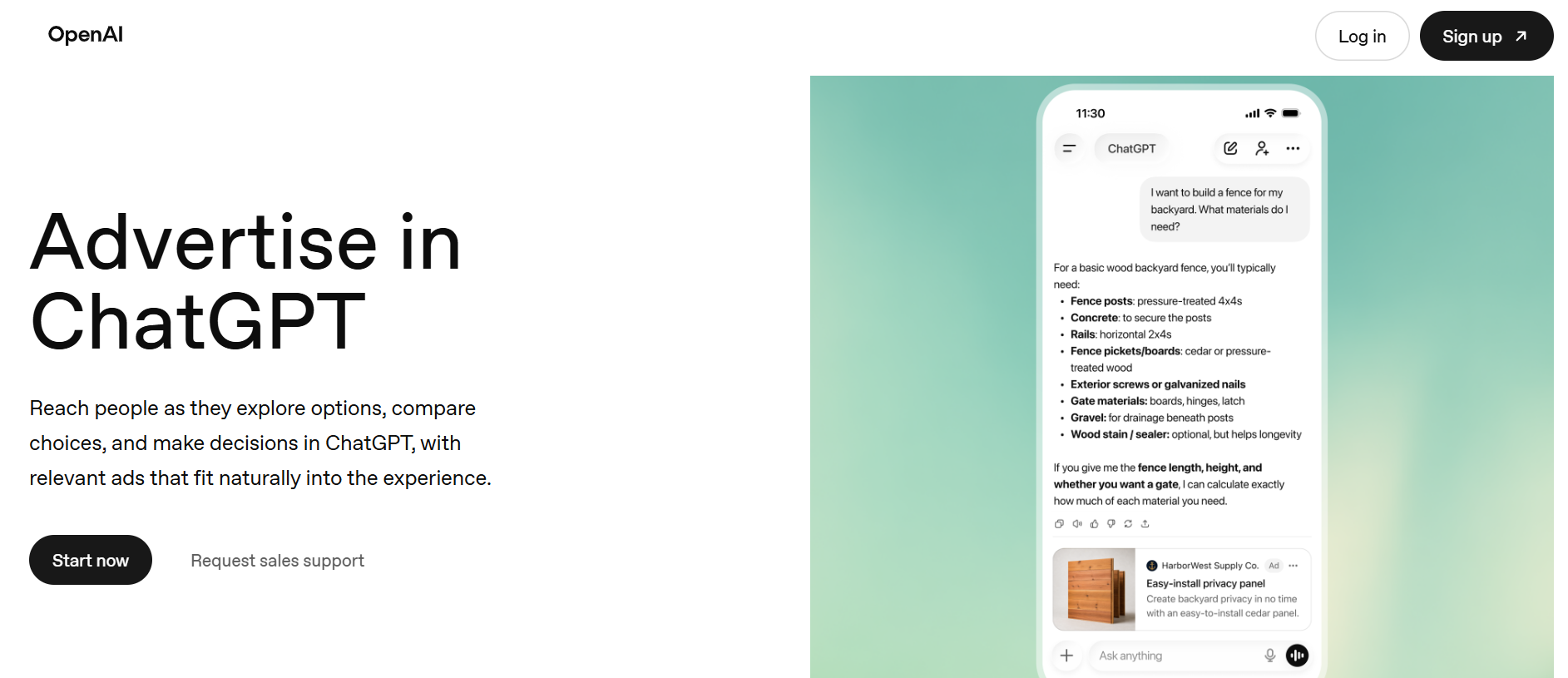
The process works as follows:
- Create your Ads Manager account. Sign in using an existing OpenAI account connected to your work email or create a new account.

- Set up your advertiser profile. Add your business information and brand logo, then complete the required advertiser verification.
- Add billing information. Set up your billing profile and payment method before your campaigns can begin running.
- Create your campaign. Choose your advertising objective, campaign budget, dates, locations and supported platforms.
- Create your ad groups. Organize ads around a particular product, customer need, theme or intent and add context hints to explain where the offer could be useful.
- Create your ads. Add your headline, description, image and landing page. Your landing page should clearly match what the ad promises.
- Submit the campaign for review. OpenAI reviews campaigns and ads before they are eligible to serve.
- Monitor the campaign. Once approved, track impressions, clicks, CTR, average CPC, average CPM, spend and conversions where measurement has been configured.
- Optimize based on results. Test different messages, context hints, bids, landing pages and creatives as you collect more performance data.
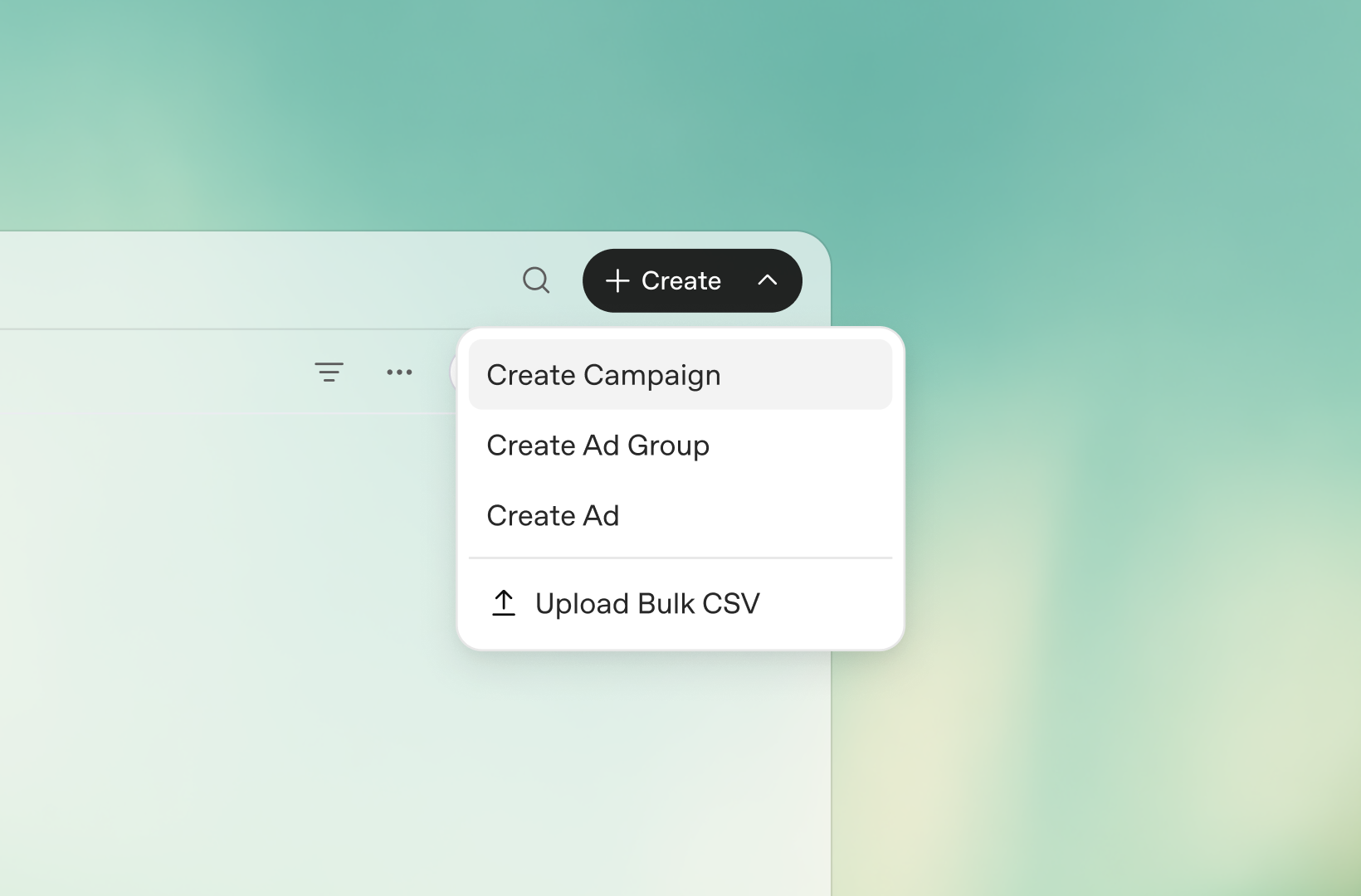
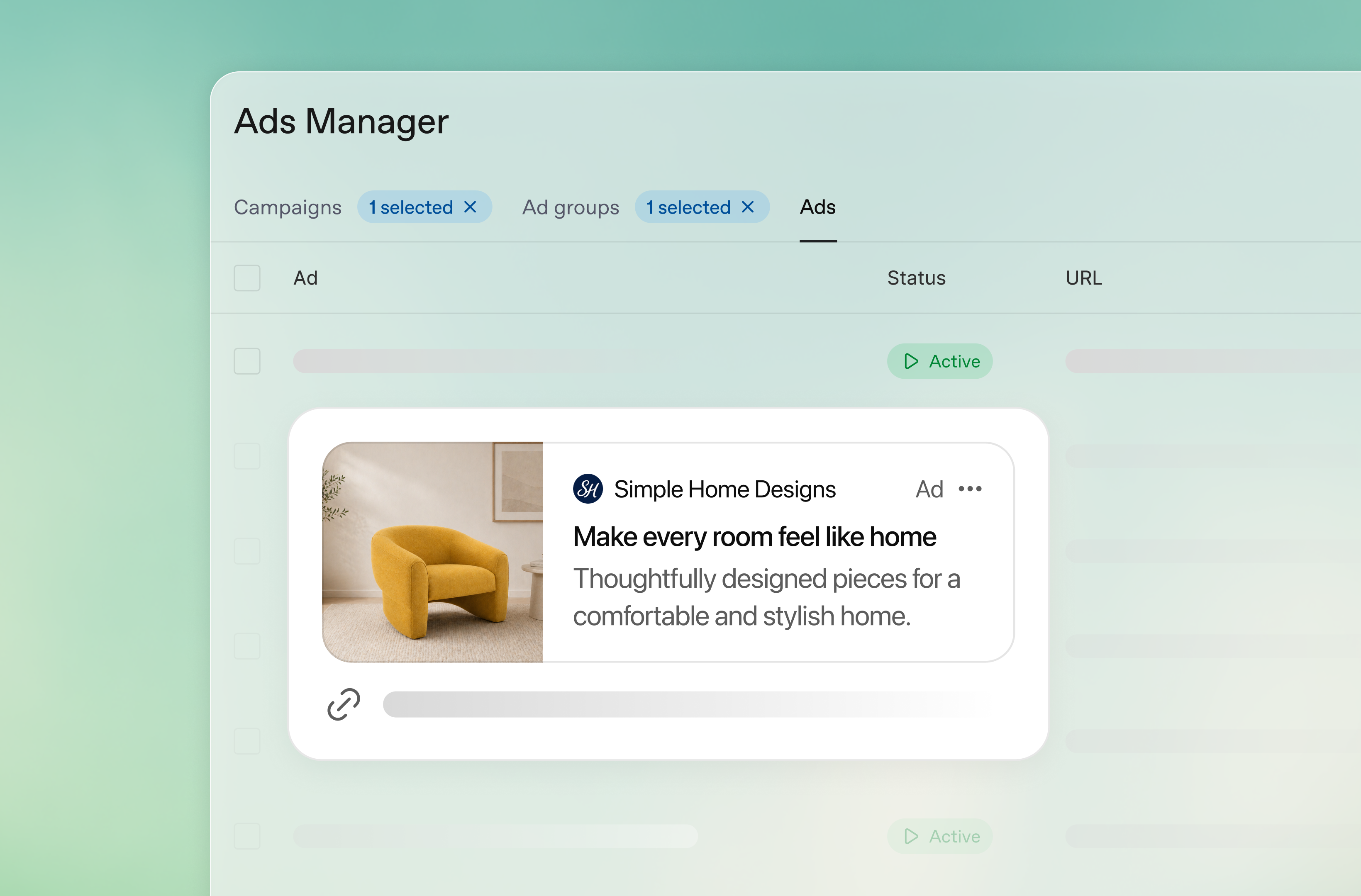
For businesses managing large numbers of ads, Ads Manager also supports bulk campaign creation and editing.
Can I Run Ads on ChatGPT?
Yes, if advertiser access is available in your market.
OpenAI has been expanding ChatGPT Ads internationally, and self-service Ads Manager access is now available across a growing number of countries in Europe, the Middle East, North Africa, Asia and other markets.
For businesses in Kenya, there is one important point to note.
Kenya is not currently listed among the countries with self-service ChatGPT Ads Manager access as of September 2026. Businesses can still create an Ads Manager account and OpenAI says it will notify advertisers when self-service becomes available in their country. Larger advertisers with more complex requirements can also contact the OpenAI Ads team about sales support.
For Kenyan marketers, this makes the current expansion worth following. Several North African and Middle Eastern markets are now supported, which shows that availability is moving beyond the initial group of countries.
Do Advertisers See Your ChatGPT Conversations?
No.
OpenAI says advertisers do not receive access to users’ ChatGPT conversations, chat histories, memories or personal information. Advertisers receive aggregated performance information such as the total number of views or clicks generated by their campaigns.
This is particularly important because conversational advertising can easily create the impression that the advertiser is somehow reading what an individual user has told ChatGPT.
According to OpenAI, that is not how the system works.
Information from the conversation can stay within ChatGPT and be used to determine whether an advertisement may be relevant, but the conversation itself is not passed to the advertiser. OpenAI also says it does not sell user data to advertisers.
Users can turn off ad personalization. When personalization is disabled, ads can still be selected based on the current conversation, but other chat threads, ad history and broader signals are not used in the same way.
Is AI Advertising Illegal?
No. Advertising through an AI platform such as ChatGPT is not inherently illegal.
Advertisers are still responsible for following the advertising, consumer protection, privacy and sector-specific laws that apply in the markets where they operate. They must also comply with OpenAI’s own advertising policies.
OpenAI prohibits or restricts several advertising categories and also controls the types of conversations beside which ads can appear. Its policies are designed to prevent advertising from appearing around sensitive or brand-unsafe conversations.
Political advertising is currently prohibited on ChatGPT, while some regulated sectors such as health, financial and legal services have additional requirements or restrictions depending on the market.
So using AI to deliver an advertisement does not remove the normal responsibilities around truthful claims, privacy, consumer protection and responsible targeting.
Why ChatGPT Ads Matter for Marketers
The most interesting part of ChatGPT advertising is not simply that OpenAI has created another place to display ads.
It is where those ads can appear in the customer decision process.
People come to ChatGPT to explain problems, research products, understand unfamiliar topics, compare alternatives and ask follow-up questions. A conversation can therefore reveal much more about what someone is trying to achieve than a single search term or social media interaction.
OpenAI describes ChatGPT as a place where discovery, consideration and decision-making can happen within one experience. The company says its advertiser base is becoming increasingly global and advertisers outside the United States now represent a growing share of revenue.
For marketers, this will require a slightly different mindset.
A ChatGPT Ads strategy should not simply copy a Google Search campaign or take a Meta ad and place it somewhere else. Advertisers will need to understand the questions customers ask, the situations that lead them towards a product, the language customers use to explain their problems and what information is useful at that point in the journey.
Landing-page experience will matter too. If an ad appears beside a detailed conversation and sends someone to a generic page that does not answer the need that brought them there, the opportunity may be wasted.
ChatGPT Ads Is Still Developing
The $1 billion annualized revenue run rate is a significant milestone, but ChatGPT Ads and Ads Manager are still developing.
OpenAI describes Ads Manager as a beta product and says additional capabilities will be introduced over time. The company is continuing to develop its advertising formats, measurement systems, buying options and tools for advertisers.
That is another reason advertisers should treat the platform as a place to test rather than assuming the rules, prices and formats available today will remain unchanged.
The more useful question for marketers now is how advertising performs when it sits alongside a conversation where somebody is actively researching, comparing or trying to make a decision.
Reaching $1 billion in annualized revenue run rate in less than 200 days, while attracting tens of thousands of advertisers, suggests businesses are already willing to test that opportunity.
For advertisers with self-service access, ChatGPT Ads is becoming another digital advertising channel worth testing alongside search and social media.
For Kenyan marketers, Ads Manager is not yet available for direct self-service buying, but now is a good time to understand how conversational advertising works. When access expands, the marketers who already understand context, intent, campaign structure and measurement will have a much easier place to start.
Want to explore ChatGPT advertising for your business or understand how AI is changing digital marketing? Samodigital helps businesses and marketing teams understand emerging digital platforms and turn them into practical marketing opportunities.
How to Write a Good Prompt for Generative AI: A Practical Guide for Marketers and Communication Professionals
How to write a good prompt for generative AI is becoming an essential skill for digital marketers and communication professionals. A vague request such as “write a campaign post” often produces generic copy because the AI has not been given the campaign goal, audience, platform, message or brand voice.
A strong prompt gives the tool enough direction to produce a useful first draft. Google Cloud defines prompt engineering as designing and optimizing instructions to guide an AI model towards a desired response, while OpenAI recommends clarity, specificity, context and iterative refinement.
What Is a Generative AI Prompt?
A prompt is the instruction or input given to a generative AI system. It can be a question, command, document, image, audio file or combination of inputs, depending on the tool and task.
Examples include ChatGPT, Google Gemini, Claude, Microsoft Copilot, Adobe Firefly and Canva AI. They support writing, analysis, brainstorming and visual creation.
Why Good Prompts Matter
Marketing and communication work depends on context. The same announcement may require a professional LinkedIn post, a concise X update, an Instagram caption, an internal email or a media statement.
Without clear instructions, AI may select the wrong tone or produce content that does not suit the audience. A good prompt explains the intended outcome and what the final output should contain.
How to Write a Good Prompt for Generative AI
A useful prompt does not need complicated language. It needs a clear task, relevant background and specific requirements.
1. Define the Task
Begin with an action verb that tells the AI what to do. Useful verbs include write, analyse, compare, summarize, develop, rewrite, classify, recommend and evaluate.
A weak prompt says:
Write about our new service.
A clearer prompt says:
Write a LinkedIn post announcing our new social media monitoring service.
The improved version identifies the task and format, but still needs an audience, objective and context.
2. Identify the Audience
State who should read or use the output. Audience information guides the vocabulary, examples, depth and tone.
For example:
Write a LinkedIn post for public relations managers in Kenyan state corporations.
Content for senior decision-makers may need a strategic tone, while consumer content may require simpler language and a direct benefit.
3. Explain the Objective
Tell the AI what the content should achieve. A post designed to educate will be structured differently from one intended to generate leads, manage a reputational issue or encourage event registration.
For example:
The objective is to show public relations managers how monitoring online complaints can support early issue detection and reputation management.
This instruction prevents the response from becoming a general description of social media monitoring.
4. Provide Relevant Context
Context is the background information the AI cannot safely assume, including the organization, product, campaign, key facts and geographic setting.
A marketer could provide product benefits, customer pain points and the call to action. A communication professional drafting a media response could provide confirmed facts, affected stakeholders and action already taken.
MIT Sloan recommends providing context, being specific and building on the conversation. Google Cloud also advises users to include relevant facts, documents and examples.
5. Specify the Output Format
Do not make the AI guess how the answer should be presented. State whether you need a blog article, press release, table, content calendar, video script, carousel outline or executive summary.
For example:
Create a seven-slide LinkedIn carousel. Give each slide a self-explanatory heading, two short explanatory sentences and one practical takeaway.
This defines the number of slides, amount of copy and purpose of each section.
6. Set the Tone and Style
Describe how the output should sound. OpenAI recommends terms such as professional, friendly, formal, serious or humorous to guide tone.
A communications prompt could state:
Use a professional but conversational tone. Use British English, short paragraphs and clear transitions. Avoid jargon, exaggerated claims and sales-heavy language.
Tone must match the situation. A crisis statement should not sound playful, while an Instagram campaign should not read like a board report.
7. Add Constraints
Constraints may include word count, character limits, required points, prohibited phrases, sources or factual safeguards.
For example:
Keep the post below 250 words. Include three benefits and end with a question. Do not invent statistics, customer quotes or product features.
This improves control, especially in regulated sectors or crisis communication.
8. Provide Examples and Sources
AI can follow a pattern more accurately when it receives an example. You can provide a previous post, brand guideline, campaign brief, report or sample of the preferred structure.
This is known as few-shot prompting. Giving examples can clarify structure, tone and the expected level of detail.
Avoid asking AI to copy a competitor or imitate a writer. Describe the qualities you need, such as a strong hook, evidence-based analysis, short sentences and a clear call to action.
A Reusable Prompt Formula
Use this formula as you learn how to write a good prompt for generative AI:
Role + Task + Audience + Objective + Context + Format + Tone + Constraints + Sources
A complete prompt could read:
Act as a digital communication strategist. Write an 800-word article for communication managers in Kenyan public institutions. Explain how social listening can identify emerging complaints before they become reputational crises. Use examples involving service delays, policy announcements and public complaints. Structure the article with an introduction, four benefits, implementation steps and a conclusion. Use a professional and conversational tone, British English and short paragraphs. Do not invent statistics. Use the attached report and official sources.
The prompt defines the role, audience, purpose, context and quality expectations. It gives the AI a clear brief without guaranteeing a perfect response.
Break Complex Tasks Into Stages
Do not ask one prompt to complete research, strategy, writing, editing and distribution at once. For a campaign, first ask AI to analyse the brief, then develop the audience and messages, create platform drafts and review them for consistency.
A practical Reddit prompt-engineering discussion similarly recommends giving AI a framework, reviewing its response and changing one element at a time. This supports OpenAI’s guidance that effective prompting is iterative.
Review, Verify and Refine
A good prompt does not replace professional judgement. Review every output for accuracy, relevance, brand alignment, stakeholder sensitivity and platform suitability.
Useful follow-up prompts include:
- Identify unsupported or exaggerated claims.
- Adapt this announcement for LinkedIn, X and Instagram.
- Check whether the response addresses the communication objective.
- Remove repetition and make each paragraph more specific.
- List the facts that require independent verification.
AI tools can produce inaccurate or invented information even when the writing sounds confident. MIT Sloan advises users to examine outputs critically and remain aware of hallucinations and bias.
Protect Confidential Information
Do not paste confidential client data, unreleased results or personally identifiable information into an AI tool without authorization. Follow your organization’s data protection and AI-use policies.
For sensitive internal or crisis matters, anonymize information where possible. Relevant legal, compliance, leadership or subject-matter teams should review the final content before publication.
Conclusion
Learning how to write a good prompt for generative AI helps digital marketers and communication professionals turn AI from a generic content generator into a more useful work assistant. The strongest prompts define the task, audience, objective, context, format, tone, constraints and sources.
Before submitting a prompt, ask whether the AI has enough information to understand what success looks like. Improve the brief when the answer is no, then review and refine the response instead of publishing the first draft.
Is SEO Dead or Evolving in 2026? How AI, AEO and GEO Are Changing Search
Is SEO Dead or Evolving in 2026?
Every few years, someone declares SEO dead. This happened when social media grew. It happened when voice search became popular. It happened when Google introduced featured snippets. Again, it is happening because of AI Overviews, ChatGPT, Gemini, Perplexity and other answer engines.
But SEO is not dead. What is dying is the narrow version of SEO that depended on keyword stuffing, thin blog posts, weak backlinks and chasing page-one rankings without understanding user intent.
SEO in 2026 is no longer just about appearing in blue links. It is about being discoverable, trusted, cited and chosen across search engines, AI answers, social search, voice search, local search and generative discovery.
The real question is not whether SEO is dead. The better question is whether your SEO strategy has evolved enough to match how people now search.
Search Behaviour Has Changed
SEO in the age of AI has changed. People are no longer searching only with short phrases such as “SEO agency Nairobi” or “best PR firm Kampala”. They are asking full questions, comparing options, using voice, searching on TikTok and YouTube, and expecting summarized answers.
For instance, a user might ask, “Which digital agency is best for SMEs in Kenya and why?” or “How can a PR team measure online reputation after a crisis?” These are no longer simple keyword searches. They are intent-rich questions.
Search systems are now trying to understand context, meaning, credibility and usefulness. This is why the old SEO playbook is not enough. Ranking for a keyword still matters, but it is no longer the full game.
Your content must answer real questions, show expertise, prove authority and be structured well enough for search engines and AI systems to understand it.
Why SEO Is Still Important in the Age of AI
Google itself has been clear that SEO best practices remain relevant for AI features such as AI Overviews and AI Mode. Google says its generative AI features are rooted in its core Search ranking and quality systems.
In simple terms, if your website cannot be crawled, indexed, understood and trusted by Google, it is unlikely to perform well in AI-driven search experiences.
That is an important correction to the noise around “AI SEO hacks”. You do not need to abandon SEO. You need to strengthen it.
-
Technical SEO Still Matters
Your website must be fast, mobile-friendly, secure and crawlable. A slow, broken or poorly structured website will struggle to rank, even when the content is useful.
Search engines need to access your pages, understand your structure and index your content correctly. Without that foundation, your visibility is already weak.
-
On-Page SEO Still Matters
Your titles, headings, internal links, images, schema, meta descriptions and page structure still help search engines understand your content.
Good on-page SEO is no longer about forcing keywords into every paragraph. It is about helping both humans and search engines understand what the page is about, who it serves and why it is useful.
-
Off-Page SEO Still Matters
Credible backlinks, media mentions, reviews, social references and brand mentions still shape authority. In the AI era, reputation across the open web matters even more because AI systems rely on trusted signals when deciding what to retrieve, summarize or cite.
The Evolution: From SEO to AEO and GEO
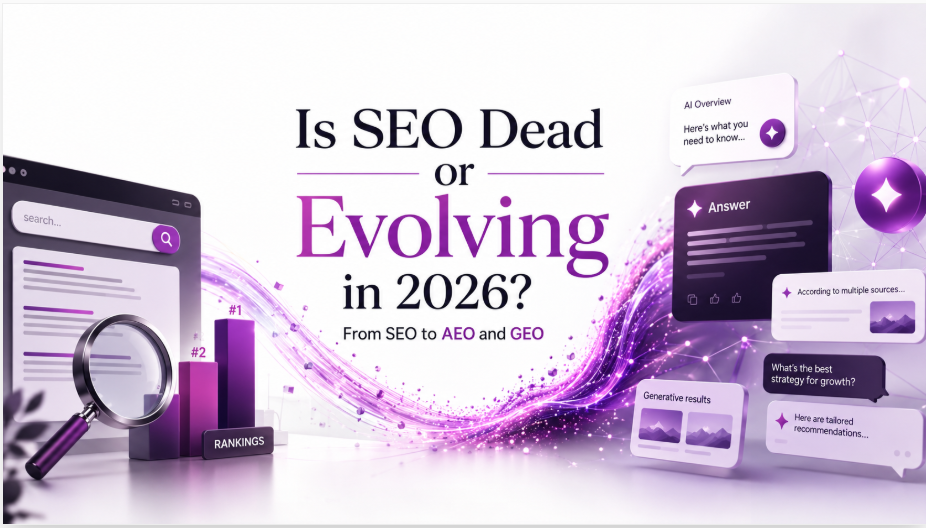
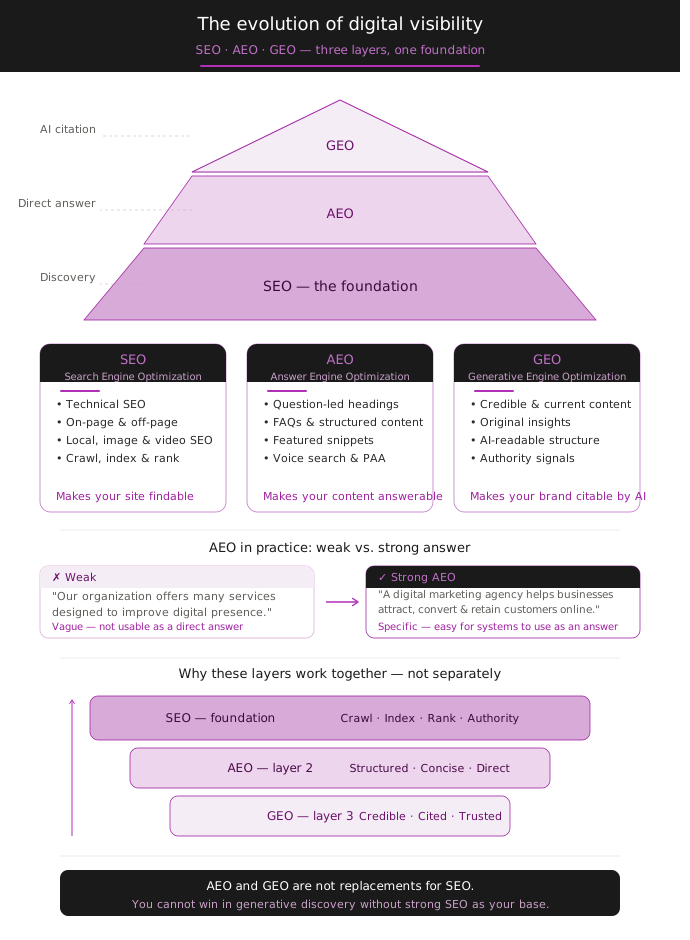
Modern visibility now has three connected layers: SEO, AEO and GEO. These three are not competing ideas. They work together.
SEO: Getting Discovered in Search Results
SEO, or Search Engine Optimization, is the foundation. It helps search engines discover, crawl, index and rank your website.
It includes technical SEO, on-page SEO, off-page SEO, local SEO, image SEO and video SEO. Without SEO, your website is harder to find and harder for search engines to understand.
AEO: Getting Selected as the Direct Answer
AEO, or Answer Engine Optimization, is about making your content easy to select as a direct answer.
This matters because users increasingly get answers without clicking through several websites. AEO focuses on question-led headings, concise explanations, FAQs, structured content, featured snippets, voice search and People Also Ask results.
For example, a weak paragraph might say:
“Our organization offers many services designed to improve digital presence.”
A stronger AEO-style answer would say:
“A digital marketing agency helps businesses attract, convert and retain customers online through SEO, paid ads, social media, content marketing, analytics and conversion optimization.”
The second version is clearer, more specific and easier for a search system to use as an answer.
What is GEO: Getting Cited by AI Answer Systems
GEO, or Generative Engine Optimization, is about making your brand, expertise or content more likely to be retrieved, trusted, synthesized and cited by AI answer systems. GEO matters because AI tools do not always show users a traditional list of links. They summarize information and cite selected sources. To be cited, your content needs to be credible, current, original and easy to interpret.
Why AEO and GEO Do Not Replace SEO
The mistake many brands are making is treating AEO and GEO as replacements for SEO. They are not replacements. They are layers on top of SEO.
You cannot win in generative discovery if your basic website structure, content quality and authority signals are weak.
SEO in the Age of AI: What Has Changed?
AI has changed search in several important ways. These shifts explain why marketers, communicators, PR professionals and organizations need to rethink how they approach search visibility.
-
Users Are Asking Longer and More Complex Questions
Instead of searching “media monitoring tools”, a user may now ask, “What is the best media monitoring tool for PR teams in Kenya tracking brand sentiment across social media and news?”
That kind of query needs more than a keyword-matched page. It needs a useful, contextual and credible answer.
-
Zero-Click Search Is Growing
Many users now get answers directly on the search results page. They may see a featured snippet, People Also Ask result, knowledge panel or AI-generated summary before clicking any website.
This means brands must measure visibility differently. A click is still valuable, but visibility, mentions, snippets and citations also matter.
-
Search Is Becoming Multimodal
People now search using text, images, video, screenshots and voice. This makes image SEO, video SEO and structured visual content more important.
A brand that only optimizes written articles is missing part of the search opportunity.
-
Authority Is Becoming Harder to Fake
AI systems and search engines need trusted sources. Clear authorship, expert credentials, original data, case studies, reviews, reputable mentions and consistent brand information now matter more.
Generic content is easy to produce. Trusted content is harder to build. That is where serious brands can win.
-
AI Search Uses Query Fan-Out
AI search can break one user question into several related searches before generating an answer. This means your content must cover topics deeply, not just target one narrow keyword.
If your website has one shallow blog post on a topic, that is not enough. You need depth, related pages, evidence, examples and a clear point of view.
How to Do SEO in the Age of AI
SEO in 2026 needs a stronger operating rhythm. It is not a one-off website task. It sits at the intersection of content, communications, product, analytics and leadership.
1. Start With the SEO Basics
Many brands want to jump into GEO before fixing the foundation. That is a mistake.
Check whether your website is indexed. Use Google Search Console. Fix crawl errors. Improve page speed. Make sure your site works well on mobile. Use HTTPS. Remove broken links. Update old pages.
A technically weak website loses visibility even when the content is good.
2. Build Content Around Intent, Not Just Keywords
Keywords still matter, but they should guide your understanding of what people want.
For every important topic, ask:
- What does the user want to know?
- What decision are they trying to make?
- What fear, confusion or problem are they bringing to search?
- What answer would actually help them?
A page that answers intent will outperform a page that simply repeats keywords.
3. Create Answer-Ready Content for AEO
Use question-based H2 and H3 headings. Give a direct answer immediately after the heading before expanding. Add FAQs to service pages. Use tables where comparison is needed. Use numbered steps for how-to content.
Write in a natural style that can be read aloud for voice search. This is how you build for Answer Engine Optimization.
4. Create Original, Expert-Led Content for GEO
AI can summarize generic content easily. It cannot replace your real experience, data, local insight, client work, industry observations or case studies.
In East Africa especially, there is still a major gap in credible local content. This is an opportunity for consultants, agencies, universities, public sector organizations, NGOs and brands to own their niche through original explainers, research reports, local examples and expert commentary.
If you want AI systems to cite you, publish content worth citing.
5. Strengthen Your Entity Signals
Search engines and AI systems need to understand who you are, what you do, where you operate and why you should be trusted.
Keep your organization name, address, phone number, service descriptions and profiles consistent across your website, Google Business Profile, LinkedIn, media mentions, directories and partner pages.
Add author bios. Show credentials. Link to credible sources. Publish an About page that actually explains your expertise.
6. Use Structured Data, But Do Not Obsess Over It
Schema can help search engines understand your content and qualify your pages for rich results.
Use the FAQ schema, Article schema, LocalBusiness schema, Product schema or HowTo schema where relevant. But schema is not a shortcut for weak content. It supports clarity; it does not create authority by itself.
7. Build Topic Clusters
One blog post is rarely enough to prove authority.
If you want to rank and be cited for digital marketing, PR measurement, media monitoring, social listening or AI search, build a cluster of related pages.
Create pillar guides, practical how-to articles, FAQs, case studies, glossary pages, comparison pages and industry insights. Search engines and AI systems reward depth, consistency and topical authority.
8. Do Not Ignore Local SEO
For businesses in Kenya and East Africa, local visibility is still powerful.
Claim and optimize your Google Business Profile. Keep your name, address, and Phone number consistent. Encourage reviews. Respond to reviews. Add local service pages. Use natural location references such as Nairobi, Kenya, Kampala, Dar es Salaam or Mombasa where relevant.
Local SEO is especially important for agencies, consultants, training institutions, restaurants, health facilities, public services, real estate firms and professional service businesses.
9. Optimize for Images, Video and Social Search
Search is no longer limited to Google’s traditional results page. Users search on YouTube, TikTok, Instagram, LinkedIn, Pinterest and AI tools.
Use descriptive file names, alt text, captions, transcripts and clear titles for images and videos. Repurpose strong articles into carousels, short videos, explainers and LinkedIn posts. This improves discoverability across platforms where audiences are already searching.
10. Measure Beyond Rankings
In 2026, SEO reporting should not stop at keyword rankings.
Track organic traffic, impressions, click-through rate, indexed pages, Core Web Vitals, backlinks, featured snippet ownership, People Also Ask visibility, local pack appearances, branded search growth, AI Overview appearances, AI citations and conversions.
The master metric is visibility share: how often your brand appears across traditional search, answer engines and AI-generated responses for the conversations that matter in your sector.
What This Means for Brands and Organizations
The brands that will win search in 2026 are not the ones producing the most content. They are the ones producing the most useful, credible and findable content.
Organizations need to stop treating SEO as a technical task left to one person after the website is built. SEO now affects brand reputation, thought leadership, customer acquisition, public communication and digital trust.
- A public institution should ask: are citizens finding accurate answers from us or from third-party summaries?
- A PR team should ask: when people search our brand during a crisis, what do they find first?
- A university should ask: are prospective students finding clear programme pages, credible faculty profiles and useful application information?
- A business should ask: when AI tools recommend service providers in our sector, are we visible or invisible?
- These are no longer small questions. They are visibility, reputation and revenue questions.
So, Is SEO Dead?
To conclude, No. SEO is not dead. It is becoming more strategic, more technical, more content-led and more reputation-driven.
What is dead is lazy SEO. Publishing generic articles, adding keywords mechanically, buying weak backlinks and hoping Google will reward you is no longer a serious strategy. The brands that will win in 2026 are the ones that understand how people search, how AI systems retrieve information, and how trust is built across the open web.
SEO has evolved from ranking pages to earning visibility. AEO helps you become the answer. GEO helps you become the cited source. But SEO remains the foundation that makes both possible.
If Google, ChatGPT or Gemini introduced your organization to a stranger today, would you be proud, worried, shocked or invisible?
That is the real SEO audit for 2026.
Contact us for SEO and Website Optimization services at info@samodigitalagency.com
AI Slop in Marketing Isn’t Failure: Ketepa, NTSA, and the Messy Middle
TLDR: AI-generated marketing can misfire — or create what’s called AI slop. Ketepa Tea, NTSA, and Coca-Cola show how public feedback and iteration turn AI missteps into stronger campaigns.
February is the month of love, a season when brands lean heavily into emotion, gifting, and cultural moments. This year in Kenya, however, Valentine’s conversations went beyond flowers and chocolates. The Central Bank of Kenya cautioned against the misuse of banknotes amid the growing trend of money bouquets, highlighting how cultural moments, regulations, and public behavior intersect.
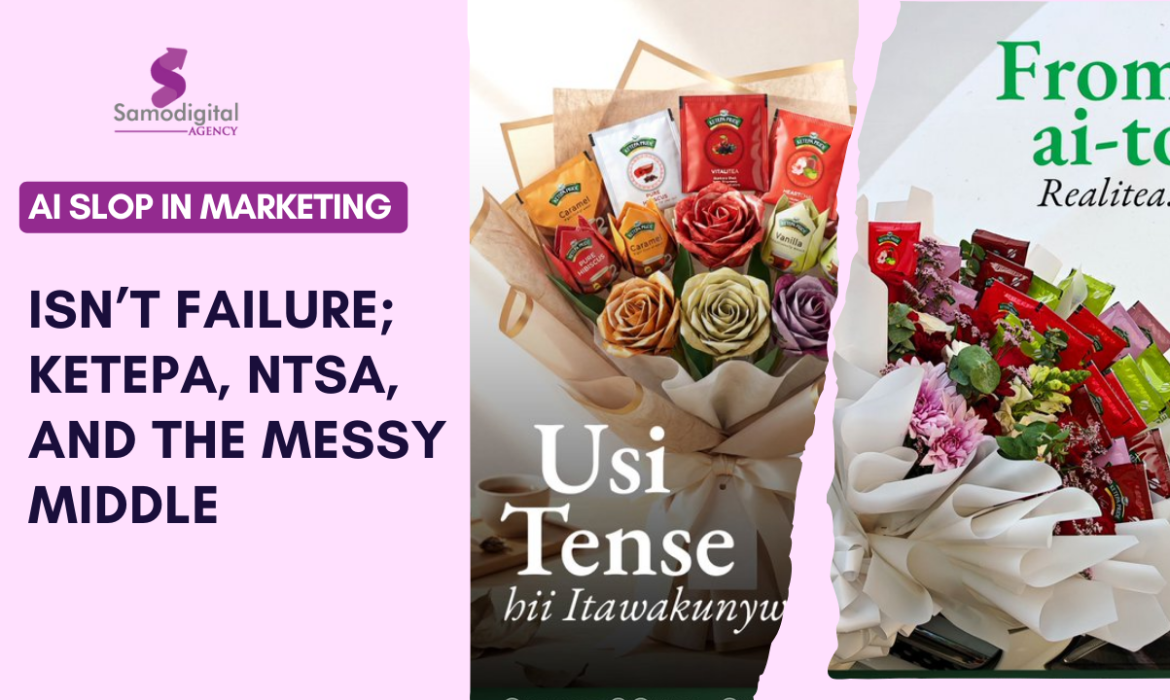
Against this backdrop, brands and public institutions turned to AI-generated images to participate in the moment. Ketepa Tea shared an AI-generated image of tea sachets arranged as a bouquet, prompting criticism around tone, timing, and authenticity.
Around the same time, the National Transport and Safety Authority (NTSA) faced backlash after publishing an AI-generated #UsalamaBarabarani image that appeared to contradict its own road safety message. In both cases, audiences quickly identified the gaps and voiced their feedback.
These moments sparked a broader conversation about AI-generated images and videos in marketing and the growing phenomenon often referred to as AI slop. More than isolated missteps, they reveal how brands are learning to use AI in public — navigating feedback, iterating in real time, and refining their approach as audiences become more AI-aware.
What is AI slop in Marketing?
AI slop refers to low-quality, obviously AI-generated content that fails authenticity tests and lacks the human oversight necessary for quality marketing. It is characterized by visual tells like distorted hands, impossible physics, nonsensical text, and, perhaps most critically, missing cultural context that make content resonate.
AI slop is not simply “bad content.” It often results from:
- Over-reliance on AI tools
- Weak or rushed prompting
- Limited human oversight
- Speed prioritized over strategy
Crucially, AI slop reflects process gaps, not proof that AI itself does not work. Many of these outputs are not failures, but early-stage experiments published too quickly.
But here’s what makes AI slop particularly problematic in 2025: today’s consumers are AI-literate. They can spot it instantly, and they expect better.
Why AI Slop Happens, Especially With Images and Video
AI slop is most visible in visual marketing for several reasons.
First, AI lacks lived context. Generative tools do not understand cultural nuance, regulation, emotion, or local realities. They work from patterns, not experience. Without human review, inconsistencies slip through.
Second, AI accelerates execution faster than judgment. What once took days of creative review can now be produced in minutes. When thinking does not keep pace with production, mistakes become public.
Third, visual content leaves no room for explanation. Audiences interpret images instantly. A single contradiction can undermine an entire message.
A Global Example: Coca-Cola’s Christmas Controversy and AI-Generated Creativity
In 2024 and 2025, Coca-Cola attempted to recreate its iconic “Holidays Are Coming” Christmas campaign using AI generation. The result? A soulless recreation that lost all the warmth and nostalgia of the beloved hand-crafted original. Visible AI artifacts and uncanny valley effects prompted hashtags like #BoycottCokeAI to trend. The message from consumers was clear: when you’re a heritage brand built on emotion, AI cost-cutting feels like betrayal.
Kenyan Case Study: NTSA and the #UsalamaBarabarani Campaign
Kenya’s National Transport and Safety Authority’s campaign #Safewalking #UsalamaBarabarani (Road Safety) campaign, advocating for zebra crossing usage, offers a clear example of contextual misalignment.

One of their AI-generated image shared on social media showed both a zebra crossing and a footbridge in the same frame. The public response was immediate: “Why would anyone use a ground-level crossing when there’s a safer footbridge option?” The image undermined the entire safety message, demonstrating AI’s inability to understand contextual logic.
NTSA deleted the post, but the damage to credibility was done. Here is the next post they shared on X.
Every minute saved is not worth a life lost.
Use the footbridge, it’s there to protect you.
#SafeWalking #UsalamaBarabarani pic.twitter.com/NBsFRiLWW3— NTSA KENYA (@ntsa_kenya) February 4, 2026
Ketepa Tea: Turning AI Backlash Into Iteration
Unlike the others, Ketepa’s response became a masterclass in crisis management. Ketepa Tea’s response stands out as a positive example of how brands can move forward after criticism.
After backlash over its AI-generated sachet bouquet, Ketepa did not defend the output or disengage. Instead, the brand listened. Here is the post that received a lot of criticism online.
Ketepa wishes to remind the public that section 1 of the Love Languages Code – aka the gifting of Ketepa Tea bags in decorative and romantic bouquet displays during this month of love is an enshrined freedom that all Kenyans across all walks can engage in without fear of… pic.twitter.com/c6rmS4ZGgb
— Kenya Tea Packers (@KetepaLtd) February 3, 2026
Kenya Tea Packers followed up with a new post featuring real flowers, real tea sachets, and a human presence, accompanied by the message “From AI to real tea.”
Ilibidi tutea.
Ketepa Tea Bouquet iko official,
romantic, inabrew love live.
Mapenzi ni vitendo… na tea ni lugha yetu.#KetepaTeaBouquet#ChaiNiKetepa#BrewLove pic.twitter.com/bbdehAiMOD— Kenya Tea Packers (@KetepaLtd) February 6, 2026
This shift mattered. It showed responsiveness, humility, and an understanding that AI should support storytelling, not replace human connection.
The Messy Middle of AI in Marketing
These examples illustrate what can be described as the messy middle, the phase between experimentation and mastery.
Marketing has always evolved this way. Early social media content was awkward. Early mobile ads were intrusive. AI is no different. The difference today is visibility. AI compresses timelines and exposes learning curves publicly.
The case of Coca-Cola, Ketepa Tea, and NTSA, among others, who have boldly shared their AI-generated campaigns are example of brands that are no longer iterating behind closed doors. They are doing so in real time, with audiences actively participating in the feedback loop.
They proved that listening and adapting create more trust than getting it perfect the first time.
Each public failure trains marketers on what doesn’t work. Failed examples become case studies that refine our collective understanding of AI’s appropriate use. Community feedback improves prompt engineering industry-wide. The messy middle isn’t where brands get stuck; it’s where they build the institutional knowledge that leads to mastery.
Today’s Awakened Consumer
What makes 2026 different from even two or three years ago is audience sophistication. Some consumers can increasingly spot AI-generated content through visual tells, tonal genericness, and logical inconsistencies. More importantly, they expect better. The sentiment you see on social media isn’t “don’t use AI”, it’s “if you’re using AI, at least make it good.”
This creates what is known as the authenticity paradox: brands must use AI for efficiency and creativity, yet audiences crave human connection and genuineness. The solution is not choosing between AI and authenticity. It needs brands to use AI as a tool while keeping humans as decision-makers.
Moving From AI Slop to AI-Smart Marketing
The difference between AI slop and AI success comes down to process. Successful AI marketing follows this framework:
- Generate multiple versions using AI for speed and scale.
- Review through multi-stakeholder quality checks that include cultural consultants and brand guardians. Refine based on expert input and cultural context.
- Test with small audience segments before full rollout. Approve only after final human sign-off confirming brand alignment.
- Monitor real-time sentiment post-publication. Iterate continuously based on learnings.
The critical element? Human oversight at every stage. AI should accelerate creativity, not replace judgment.
Brands must also build internal AI governance: documented learnings, prompt libraries with proven results, brand-specific guidelines, and team training on AI literacy. Quality thresholds should be established before generation begins, not after problems arise.
Conclusion
AI slop is not the end state of AI in marketing. It is a transitional phase that reflects experimentation, learning, and adjustment.
What defines strong brands is not the absence of mistakes, but how they respond. Brands that listen, iterate, and humanize their use of AI will build stronger trust and more resilient connections with their audiences.
In marketing, progress has never been perfectly polished. With AI, the learning just happens in public and when handled well, that visibility can become a strength rather than a weakness.
GPT-5 Explained: What Business Owners and Marketers Need to Know
OpenAI has just unveiled GPT-5, the latest and most advanced version of its AI model, and it’s already transforming the way we work, create, and communicate. Whether you are running a business, leading a marketing team, creating content, or simply trying to keep up with digital trends, GPT-5 promises faster, smarter, and more accurate results compared to previous models.
What Exactly is ChatGPT-5?
Think of GPT-5 as your new AI partner that’s sharper, more reliable, and more flexible than previous versions. According to OpenAI, GPT-5 is designed to handle complex tasks from drafting high-quality content and brainstorming creative campaigns, to analysing data and even interpreting images or charts.
Compared to GPT-4, GPT-5 has a stronger “long-memory,” meaning it can follow your train of thought over longer conversations, remember key details, and adapt its tone to match your style. It also does a much better job of reasoning through tricky problems, making it a powerful tool for marketers, business owners, and digital creators who want smart support on demand.
GPT-5 Access and Pricing Plans
OpenAI offers ChatGPT through different subscription plans tailored to your usage needs:
- Free Plan: Provides limited access to GPT-5 with daily usage caps. Ideal if you want to try out the model casually. Once you hit your limit, you might get downgraded to a smaller, lighter version like GPT-5 Mini.
- ChatGPT Plus: This paid plan gives you higher usage limits and priority access to GPT-5. It’s perfect for marketers and creators who need reliable, faster responses throughout their day.
- ChatGPT Pro: Designed for power users and businesses, Pro users get the highest usage limits and access to GPT-5 Pro — a more capable variant built for handling complex, resource-intensive tasks with ease.
ChatGPT pricing plans 2025
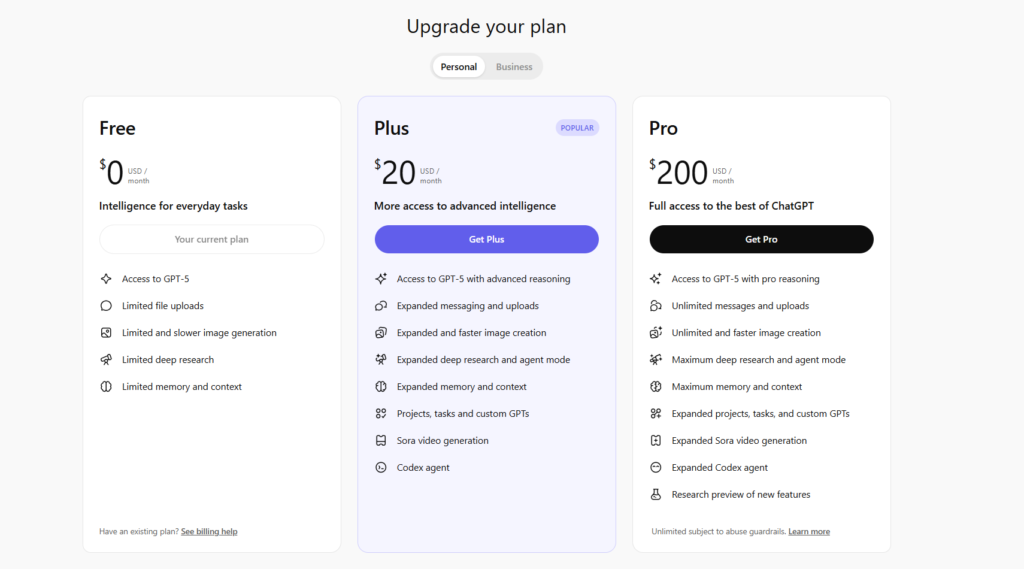
If you are a small business owner or a content team, these flexible plans let you pick the right balance of performance and cost for your needs. You can also explore the ChatGPT business plans
Key Features That Make GPT-5 Stand Out
Now let us look at some of the key features of ChatGPT-5:
- Sharper Reasoning
GPT-5 excels at multi-step thinking, breaking down complex questions and delivering more accurate answers. - Longer Context
It can follow your conversation or project for much longer without “forgetting” earlier points, perfect for ongoing campaigns or content strategies. - Multimodal Power
Beyond text, GPT-5 can understand and work with images, charts, and diagrams, giving you richer insights. - Smarter Adaptability
It adjusts its style and tone automatically — whether you need professional copy for a client pitch or a playful caption for social media. - Better Accuracy
Hallucinations (AI-generated wrong facts) are significantly reduced, making responses more trustworthy. - Custom Controls
You can fine-tune how detailed or concise it should be, or how much “thinking” it puts into an answer.
The Limitations to Keep in Mind
While GPT-5 is impressive, it’s not perfect. It’s still not “true AI” that understands the world the way humans do and it can make occasional mistakes, especially with niche or tricky questions. This is evident with what some of the earlier users on Reddit are saying about ChatGPT-5.
Moreover, Free-tier users will also face daily limits, and while it’s much more accurate than GPT-4, it’s not immune to errors.
GPT-4 vs GPT-5: The Big Differences
Here’s how the new version stacks up side by side:
| Feature | GPT-4 | GPT-5 |
| Reasoning Ability | Strong, but can struggle with complex multi-step problems | Much better at multi-step, complex reasoning |
| Accuracy | Good, but prone to occasional errors and hallucinations | Fewer errors, more factually reliable |
| Context Memory | Handles shorter conversations, limited long-term recall | Maintains context over much longer exchanges |
| Content Length | Up to ~100,000 tokens | Supports up to ~400,000 tokens or more |
| Pricing | Higher token costs, less cost-efficient | More cost-effective with flexible pricing plans |
| Adaptability | Can switch styles but may need prompts | Smooth and natural tone/style adaptation |
| Multimodal Support | Basic image and text handling (GPT-4o) | Advanced multimodal inputs (text, images, charts, audio, video) |
| Safety & Honesty | Occasional sycophancy and overconfident answers | More honest, transparent, and safer responses |
Why This Matters for You
If you run a business, create content, or work in digital marketing, GPT-5 can save you time, sharpen your campaigns, and even spark ideas you might not have considered. At Samodigital Agency, we are already exploring ways to use GPT-5 for smarter automation, content creation, customer engagement, and market analysis.
The bottom line? GPT-5 is not just another tech upgrade. It is a productivity boost, a creativity partner, and a competitive edge rolled into one.

SEO in the Gemini Era: How Google’s AI Updates Impact Search Optimization
At the just concluded Google I/O 2024, Google announced expanded AI features for Google Search. How will this impact search engine optimization? Google has been making changes to Google search to improve how users find information in the search results.
The generative AI has even accelerated the improvement since the introduction of Gemini and the search lab’s search generative experience.
Here are some of the updates coming to Google Search in the Gemini Era
Google Search is introducing a new feature called AI Overviews.
AI overviews are summaries of search results that are designed to give users a quick overview of a topic without them having to click on multiple links. The feature has been tested in Search Labs, and users liked that they could get a quick summary and then links to learn more if they wanted. Google is rolling out AI Overviews to everyone in the US this week and expects to bring them to over a billion people by the end of the year.
Ability to Customize AI Overviews
Google Search will soon let you customize AI Overviews. You’ll be able to choose to simplify the language for easier understanding or get a more detailed breakdown of the topic
Search is getting smarter!
You can now ask complex questions in one go, thanks to a new AI model called Gemini. This means you can include all the details you want in your search, like location, criteria, and comparisons.
Google gives an example “For example, maybe you’re looking for a new yoga or pilates studio, and you want one that’s popular with locals, conveniently located for your commute, and also offers a discount for new members. Soon, with just one search, you’ll be able to ask something like “find the best yoga or pilates studios in Boston and show me details on their intro offers, and walking time from Beacon Hill.”
Plan Ahead!
Search can now help you create meal plans and trip itineraries. You can search for things like “easy 5-day meal plan for a group” and get recipe suggestions. Google says you can even customize the plan by asking for vegetarian options. You can then export the plan to Docs or Gmail. This feature is currently in testing but will be expanded to include other planning categories like parties and workouts.
Get AI-organized Results Pages
They’re introducing AI-organized results pages to help you brainstorm ideas. These pages will use AI to categorize different websites under unique headings, giving you a broader perspective on your search topic. This will be available first for searches related to dining and recipes, with plans to expand to movies, music, and more.
Google Search is getting a video search upgrade!
You’ll soon be able to search using videos. This means you can record a problem, like a malfunctioning record player, and Search will use AI to understand the video and provide solutions with steps and resources. No more struggling to describe the issue with text!
What does this mean for SEO?
The SEO Impact of Generative AI in Google Search
In my view, the question of how generative AI in Google searches will affect search engine optimization (SEO) has been a major concern. Is SEO dead? While the impact is undeniable, I believe SEO will adapt rather than become obsolete.
Firstly, website traffic might be affected. Users may get some answers directly from search results, reducing clicks to websites for basic information.
Secondly, content creators like bloggers and writers will face a challenge in crafting high-quality, relevant content that stands out for AI algorithms. However, Google’s inclusion of recommended articles within the search generative experience suggests that valuable content will still be crucial.
In essence, generative AI offers easier information access for users but presents a challenge for content creation.
What are your thoughts?

