
Meta Launches Meta One Globally, Putting Advanced Creator and Business Tools Behind Subscriptions
Meta One Launches Globally With 50+ Features for Creators and Businesses
Meta has officially launched Meta One, a new subscription service bringing paid features across Instagram, Facebook, WhatsApp and Meta AI under one umbrella.
Announced on 15 September 2026, Meta One launches with more than 50 features and plans designed for individuals, creators and businesses. Meta says its subscription products have so far recorded 15 million subscriptions and trials. The plans are available globally, although the company says individual features, pricing and availability may vary by region, app and account.
For creators, businesses and social media managers, Meta One is more than another verification subscription. Meta is putting professional tools such as deeper analytics, Story scheduling, organic links, team access and tools for converting engagement into followers into its paid subscription plans.
The core versions of Instagram, Facebook, WhatsApp and Meta AI will remain free. What subscribers are paying for is additional functionality, professional tools and higher usage of some of Meta’s AI features.
What is Meta One?
Meta One is Meta’s new subscription service covering its major social platforms and AI products.
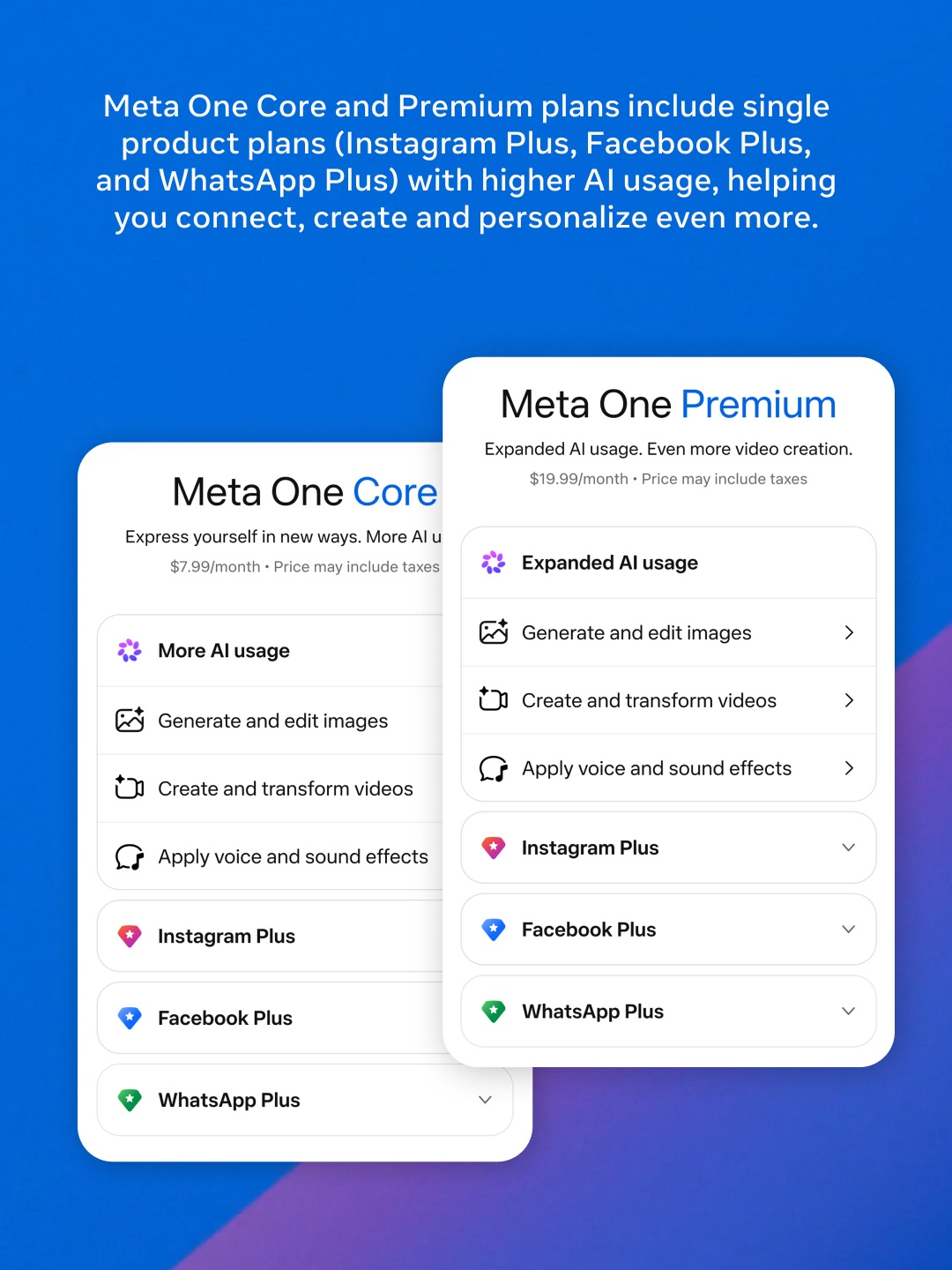
It builds on individual subscriptions introduced earlier this year, including Instagram Plus, Facebook Plus and WhatsApp Plus. Meta One now adds bundled plans for people who want more access to AI tools as well as separate plans aimed at creators and businesses.
This means Meta now has different subscription options depending on how someone uses its platforms.
An individual user can pay for additional customisation and AI features, while creators and businesses can subscribe to plans offering tools for audience growth, publishing, analytics, customer communication and account management.
For marketers, that distinction is important. Meta is increasingly offering capabilities used for professional social media management through paid subscription tiers.
What does Meta One offer creators and businesses?
Some of the most interesting Meta One features are found in the creator and business plans.
Subscribers can get an enhanced profile that highlights information such as their website, business locations and what people say about them.
Meta is also introducing a more prominent Follow button on Reels and automatic follow invitations that can be sent to people who engage with an account’s content. Businesses can also get increased access to Meta Business Agent, Meta’s AI-powered tool for responding to customers on WhatsApp.
The higher-tier plans introduce more advanced marketing tools.
The Advanced plan includes:
- Story scheduling up to 30 days in advance
- Links in organic posts and Reels
- Exportable analytics
- Deeper audience insights
- Team access without sharing account passwords
- More linked devices
- Additional WhatsApp business broadcast credits
- Increased Meta Business Agent responses
These are not simply profile customisation features. They are tools that businesses, agencies and social media managers already use as part of running social media accounts professionally.
Automatic follow invitations could help businesses grow their audience
One feature worth watching closely is automatic follow invitations.
Businesses and creators regularly generate engagement from people who do not follow their accounts. Someone may watch a Reel, like it or comment on it, but continue scrolling without following the page.
Meta One allows accounts to automatically invite people who have engaged with their content to follow them.
For marketers, this creates another opportunity to turn content engagement into audience growth.
Instead of relying entirely on someone to see a Reel, visit the profile and choose to follow the account, the business can follow up on that engagement with an invitation.
It could be particularly useful for brands investing heavily in Reels and other organic content but struggling to convert reach and engagement into followers.
The real test will be how users respond to these invitations over time and whether they translate into meaningful follower growth.
Meta is putting links in organic posts and Reels
Another significant feature is the ability to add links to organic posts and Reels under the Advanced plan.
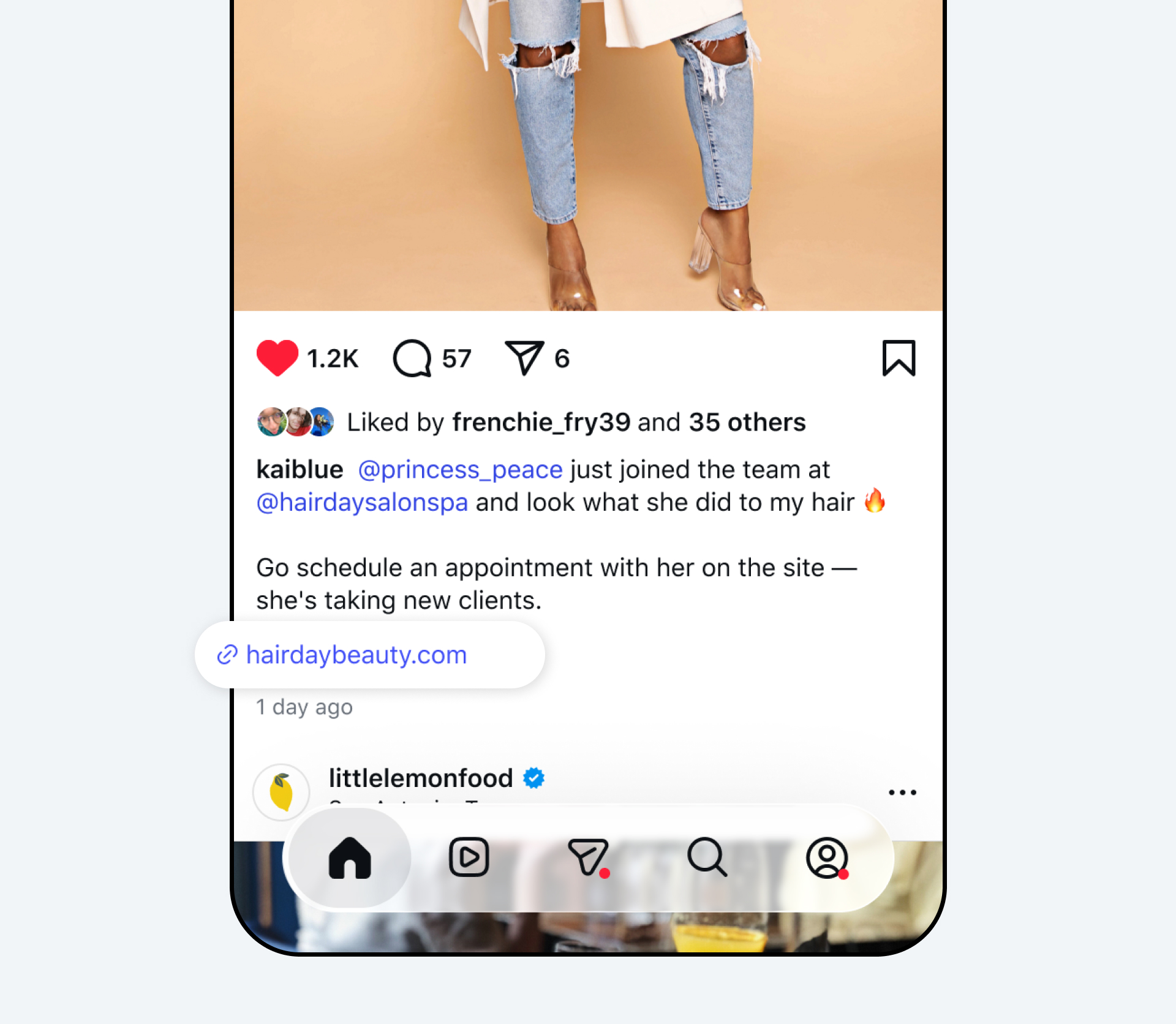
Getting users from social media content to a website, online store, booking page or other external destination has long been a challenge on platforms such as Instagram.
Businesses have often relied on profile links, Stories, paid advertising or phrases such as “link in bio” to move users outside the platform.
Allowing subscribers to place links directly in organic content could give businesses a more direct path between content and conversion.
For marketers, that could make organic Instagram content more useful for driving website traffic, lead generation or sales.
It also demonstrates the growing difference between what businesses can do with a free account and the additional functionality available when they pay.
Meta One also comes with more access to AI tools
AI is a major part of Meta One.
Meta’s Core and Premium subscription bundles offer increased usage of some of the company’s more compute-intensive AI tools.
Subscribers can get more image creation and editing, additional video generation using Meta’s Muse models and greater access to in-app AI tools such as Restyle on Instagram.
Meta says Meta AI will continue to be available for everyday use without a subscription. The paid plans are aimed at people who want higher usage of these creative AI capabilities. (About Facebook)
For creators and marketers, the more interesting development may be how Meta connects AI directly with content performance.
Meta says Edits Plus will eventually be added to Meta One. It will offer more cloud storage for syncing editing projects across devices and additional usage of an upcoming Edits assistant.
According to Meta, the assistant will be able to analyse Instagram insights and help users brainstorm new content ideas.
That moves AI beyond simply generating a caption or editing an image.
A creator could potentially have an AI assistant analyse how their Instagram content is performing and use that information when suggesting what they should create next.
How much does Meta One cost?
Meta One has several subscription levels depending on whether the user is an individual, creator or business.
For individual products, Meta lists the following starting prices:
WhatsApp Plus: $2.99 per month
Instagram Plus: $3.99 per month
Facebook Plus: $3.99 per month
For individual and AI-focused bundles:
Core: $7.99 per month
Premium: $19.99 per month
Creator and business plans start at:
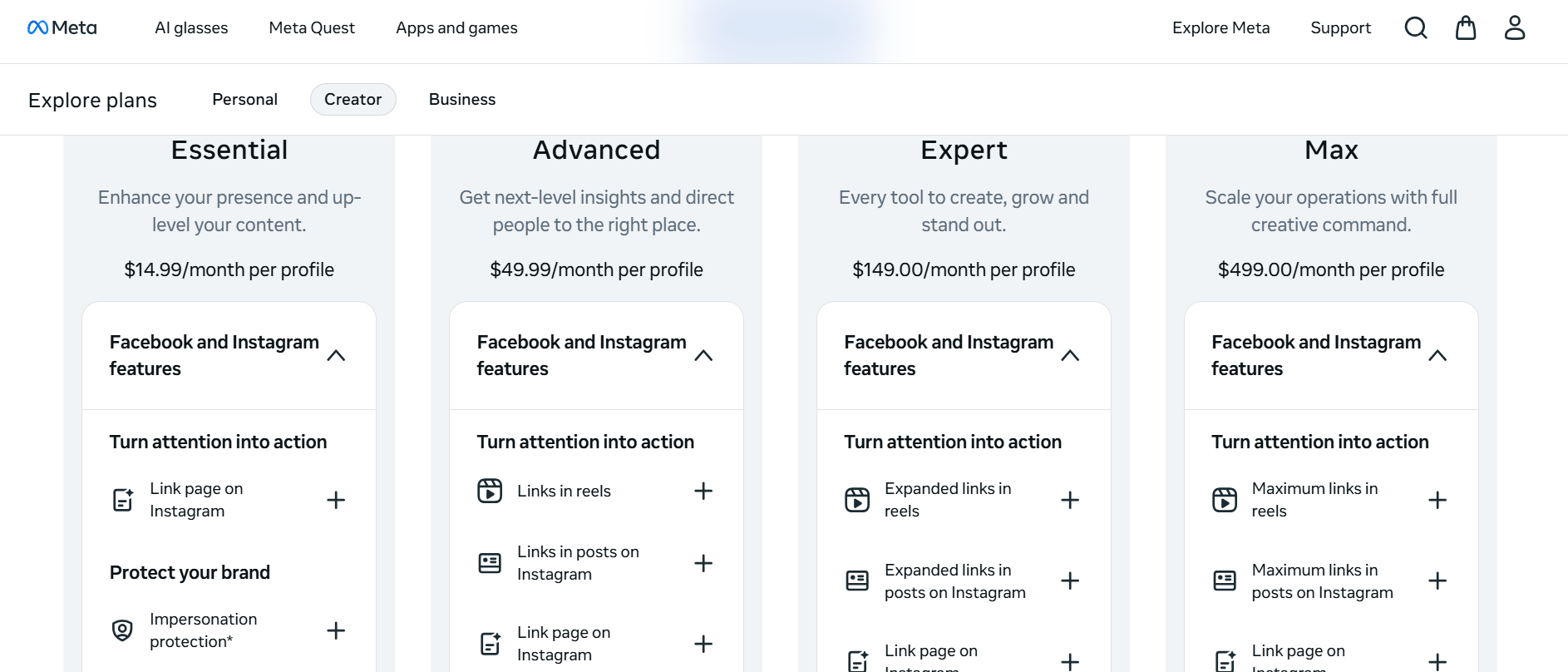
Essential: $14.99 per month
Advanced: $49.99 per month
Expert: $149 per month
Max: $499 per month.
The Essential plan also includes features such as a verified badge, impersonation protection and a verified channel on the WhatsApp Business app, subject to successful verification.
Meta says prices, benefits and availability may vary depending on the region, app and individual account. Kenyan users should therefore check the subscription options available directly on their accounts rather than assuming the US dollar prices will apply locally.
Is Meta One replacing free Facebook, Instagram and WhatsApp?
No.
Meta says the core experience across its apps and Meta AI will continue to be free.
You will not need a Meta One subscription simply to continue using Instagram, Facebook, WhatsApp or Meta AI.
What is changing is the amount of additional functionality available to people willing to pay.
For an ordinary social media user, many of these professional features may not matter.
For businesses, creators and agencies that depend heavily on Meta’s platforms for marketing, customer service and audience growth, the distinction between the free and paid experience could become more significant.
Why Meta One matters for marketers in Kenya
For Kenyan marketers and businesses, the bigger story is not simply that Meta has launched another subscription.
It is which tools are moving into the paid professional layer.
Audience insights, analytics exports, Story scheduling, organic links, team permissions and increased customer-service capacity are all features businesses use to manage their digital presence.
A small business that mainly uses Instagram to display products may not need a paid subscription.
But consider a business using Reels to attract customers, WhatsApp to handle enquiries, Instagram to drive people to its website and several employees or an agency to manage its accounts.
Features such as automatic follow invitations, direct links, deeper analytics, team access and additional Meta Business Agent capacity could have more practical value in that situation.
The question for Kenyan businesses should therefore not simply be, “Should we subscribe to Meta One?”
It should be: Which of these paid features solves a problem we currently have, and is that solution worth the monthly cost?
That is a much better way to evaluate any marketing technology subscription.
Social media management is becoming a bigger paid software stack
Meta One also reflects a wider change in how social platforms make money from professional users.
For years, businesses could create accounts and use most organic publishing tools without paying the platform directly. Their main spending usually went towards advertising, content production, staff or agencies.
Subscription products are adding another cost.
Meta can continue offering its core social platforms to billions of people for free while charging creators and businesses that want more automation, analytics, AI capacity and professional account-management features.
For marketing teams, this means social media budgets may increasingly include not only advertising and content production, but also platform subscriptions.
Businesses will need to decide which subscriptions genuinely improve performance and which simply add more tools they rarely use.
Should creators and businesses pay for Meta One?
That will depend on how heavily they use Meta’s platforms and which problems they are trying to solve.
If your biggest challenge is turning Reel engagement into followers, automatic follow invitations may be worth testing.
If reporting is a pain point, exportable analytics and deeper audience insights could make the Advanced plan more useful.
If several employees or agency partners manage your accounts, team access without sharing passwords could improve account management.
And if WhatsApp is an important customer-service channel for your business, additional Meta Business Agent capacity may offer more value.
But subscribing simply because Meta One has more than 50 features is not a marketing strategy.
Start with what your business needs, identify which paid features could address that need, and then determine whether the expected value justifies adding another monthly subscription.
Meta’s social platforms are still free at their core. What Meta One makes clearer is that more of the functionality designed for professional creators and businesses now comes at a price.
Primary source: Meta, 15 September 2026. Read Meta’s official Meta One announcement (About Facebook)
How to Build a Digital Strategy for NGOs That Supports Your Mission
Are you looking to develop a digital strategy for your NGO?
Non-governmental organizations (NGOs) are under increasing pressure to communicate their work clearly, reach communities, attract funding, engage policymakers, build public trust and demonstrate impact. Digital channels can support all these goals, but being active on social media or having a website does not automatically amount to a digital strategy.
For NGOs, digital strategy also comes with challenges that are different from those faced by many commercial organizations. Communication teams may be small, budgets limited and audiences highly varied. The same organization may need to communicate with communities, donors, government agencies, journalists, development partners, volunteers and employees, each with different information needs.
A useful digital strategy therefore needs to start with the mission rather than the platforms.
What is a digital strategy for an NGO?
A digital strategy for an NGO is a plan for how the organization will use digital channels, content, data and technology to advance its mission, reach its stakeholders and achieve specific organizational, communication, advocacy, programme or fundraising objectives.
For one NGO, the priority may be increasing applications for a youth programme. Another may need to influence policymakers, improve donor communication, raise awareness around an advocacy issue or make research easier to find online.
The strategy should clarify what the organization wants to achieve, who it needs to reach, which channels will be used, what role each channel will play and how success will be measured.
This distinction is very important. Posting on Facebook, sending newsletters and creating TikTok videos are digital activities. However, a digital strategy explains why those activities are necessary and how they contribute to the NGO’s mission.
How to build a practical digital strategy for your NGO
Now that you understand what a digital strategy for NGOs mean, now let us look at the steps to building a practical digital strategy for your NGO.
1. Start with the mission and organizational goals
Digital strategy should not begin with the question, “Should we be on TikTok?”
Start with what the organization is trying to achieve.
Suppose an NGO wants to increase women’s participation in digital-skills programmes in rural or urban counties. The digital objective may be to increase awareness among eligible women, make programme information easier to access and generate qualified applications.
An advocacy organization trying to influence education policy would need a different approach. Its priority audiences may include government officials, journalists, researchers, civil society organizations and development partners.
Once the organizational goal is clear, it becomes easier to decide which digital activities deserve attention.
2. Map your stakeholders
NGOs rarely communicate with one audience. A stakeholder map helps the communication team identify who needs what information and where those conversations should happen.
Communities may need clear programme information and updates. Funders may want evidence of impact, reports and organizational results. Policymakers may need research findings and concise advocacy messages, while journalists may be looking for timely information, data and expert sources.
The same message should not automatically be presented to all these groups in the same way.
For example, a 40-page research report may be valuable to a policymaker or development partner, while community audiences may benefit more from a short explainer, infographic, video or local-language summary.
Audience understanding should influence both channel choice and content format.
3. Audit your current digital footprint
Before creating new accounts or buying new tools, review what the organization already has.
Look at the website, social media accounts, email database, search visibility, analytics, digital advertising and online reputation. Check whether account ownership and passwords are properly managed and whether the information published across channels is current.
The audit should also consider capacity. Does the team have people who understand analytics, content creation, community management, social listening or digital advertising? Are platforms being maintained because they contribute to organizational goals or simply because the accounts have existed for years?
A small NGO may discover that improving its website and two important social channels produces more value than trying to manage seven platforms poorly.
4. Give every digital channel a clear role
Not every NGO needs to be everywhere online. The more useful question is: What job should each channel do?
A website can serve as the organization’s authoritative source for programme information, reports, research, impact stories and contact details. LinkedIn may be useful for funders, professionals, development partners, policymakers and organizational credibility.
Facebook and WhatsApp may support community communication where those channels are widely used by programme participants. YouTube can host webinars, explainers, interviews, documentaries and other educational resources, while email can maintain direct relationships with donors, partners and supporters.
Search also matters. A journalist looking for research, a young person searching for a programme or a potential partner researching the organization may encounter the NGO through Google before seeing any social media content.
The role of each channel should therefore reflect audience behaviour and organizational objectives rather than trends.
5. Turn the mission into useful content
NGO communication often focuses heavily on announcing what the organization has done. Effective digital content should also help audiences understand why the work matters.
A balanced content strategy can include programme information, research findings, educational content, community stories, advocacy messages, field updates, impact data, partnership opportunities and calls to action.
Storytelling is important, but NGOs also need to consider dignity, consent and privacy. A powerful story should not expose a programme participant to harm or reduce someone to their most difficult circumstances simply because emotional content attracts attention. Ethical storytelling is very important.
Where possible, community members should be represented as people with agency, knowledge and aspirations rather than passive recipients of assistance.
6. Build safeguarding and governance into the strategy
Digital strategy for NGOs should include governance, particularly where organizations work with children, vulnerable communities or sensitive information.
Teams need clear guidance on who can publish on official accounts, how passwords are managed, what information employees can share and how online issues are escalated.
Consent should be considered before publishing photographs, videos or personal stories. Data protection also matters when collecting email addresses, application information or community data.
Generative AI adds another layer. NGOs should decide what information staff may enter into external AI tools, how AI-generated content is reviewed and who remains accountable for the final communication.
These issues should be addressed before a problem occurs, not during a crisis.
7. Measure outcomes that matter to the mission
Follower numbers, likes and impressions can provide useful information, but they should not become the main definition of success.
The right metrics depend on the objective.
An awareness campaign may track reach, website traffic, media mentions and search visibility. A programme recruitment campaign may focus on applications, enquiries and registrations. Advocacy teams may monitor stakeholder engagement, downloads of research, policy mentions or participation in campaign activities.
Fundraising objectives can include donations, recurring contributions and donor retention, while community-engagement programmes may measure participation, feedback and service uptake.
Social listening can add another layer by showing what people are saying, which issues are emerging and whether communication is being understood as intended.
Measurement should ultimately help the team answer: What happened, why did it happen and what should we do next?
A simple 30-day starting plan
Small communication teams do not need to redesign their entire digital ecosystem at once.
During the first week, review existing channels and identify the organization’s priority objectives. In week two, map stakeholders and define the role of each channel. Week three can focus on content priorities, responsibilities, governance and KPIs. During week four, begin implementation and create a simple reporting process for reviewing what is working.
The strategy can then be improved as the team learns more about audience behaviour and organizational needs.
Build around the mission, not the platforms
A good digital strategy for an NGO is not about having the largest social media presence or adopting every new technology. It is about using digital channels deliberately to advance the organization’s mission.
That means reaching the right stakeholders, communicating evidence clearly, making programmes easier to access, supporting advocacy, protecting the people represented in the content and measuring outcomes that matter.
When the mission, audiences and objectives are clear, digital channels become tools for achieving impact rather than another list of activities for an already busy communication team.
Need Support With Your NGO’s Digital Communication?
Samodigital Agency works with NGOs, nonprofits and development organizations to strengthen their digital communication and build the skills of their teams. Through Egline Samoei, digital marketing and communications consultant, trainer and facilitator, we support organizations with digital strategy, social media strategy, content planning, campaign communication, social listening, digital storytelling and online visibility.
Egline also designs and facilitates practical training, workshops and masterclasses for communication teams on digital marketing, digital communication, social media, AI for communication, content creation, digital literacy and emerging digital trends.
If your organization is reviewing its digital strategy, strengthening its communications function or equipping staff with practical digital skills, get in touch with egline@samodigitalagency.com to discuss how Egline can support your team.
ChatGPT Ads Reaches $1 Billion in Annualized Revenue Run Rate: How It Works, What It Costs and How to Get Started
ChatGPT Ads has reached $1 billion in annualized revenue run rate less than 200 days after launch, giving OpenAI’s advertising business a significant milestone while the company continues expanding access to advertisers around the world.
OpenAI announced on August 31, 2026 that tens of thousands of advertisers are now using ChatGPT Ads. The company has also expanded self-service buying through Ads Manager across India, Europe, the Middle East and North Africa. ChatGPT Ads is now available in more than 40 countries through OpenAI’s advertising team, agencies and technology partners.
The $1 billion figure does not mean OpenAI has already collected $1 billion in advertising revenue in less than 200 days. Annualized revenue run rate takes the current pace of revenue and estimates what that would amount to over a full year if the same rate continued.
Even so, the speed at which ChatGPT Ads has grown is worth paying attention to. OpenAI says ChatGPT serves more than 1 billion weekly active users, while advertising is becoming another part of its business alongside subscriptions, enterprise products and API usage.
For marketers, advertisers and businesses, this raises more practical questions: How do ChatGPT Ads work? What do they look like? How much do ChatGPT Ads cost? And how can a business start advertising on ChatGPT?
Does ChatGPT Have Ads?
Yes. ChatGPT now shows advertising to some users on its Free and Go plans in markets where ads are available.
Ads are not shown to users on Plus, Pro, Business, Enterprise or Edu plans. OpenAI also says it does not show ads to accounts identified as belonging to people under 18, and Temporary Chats do not show ads.
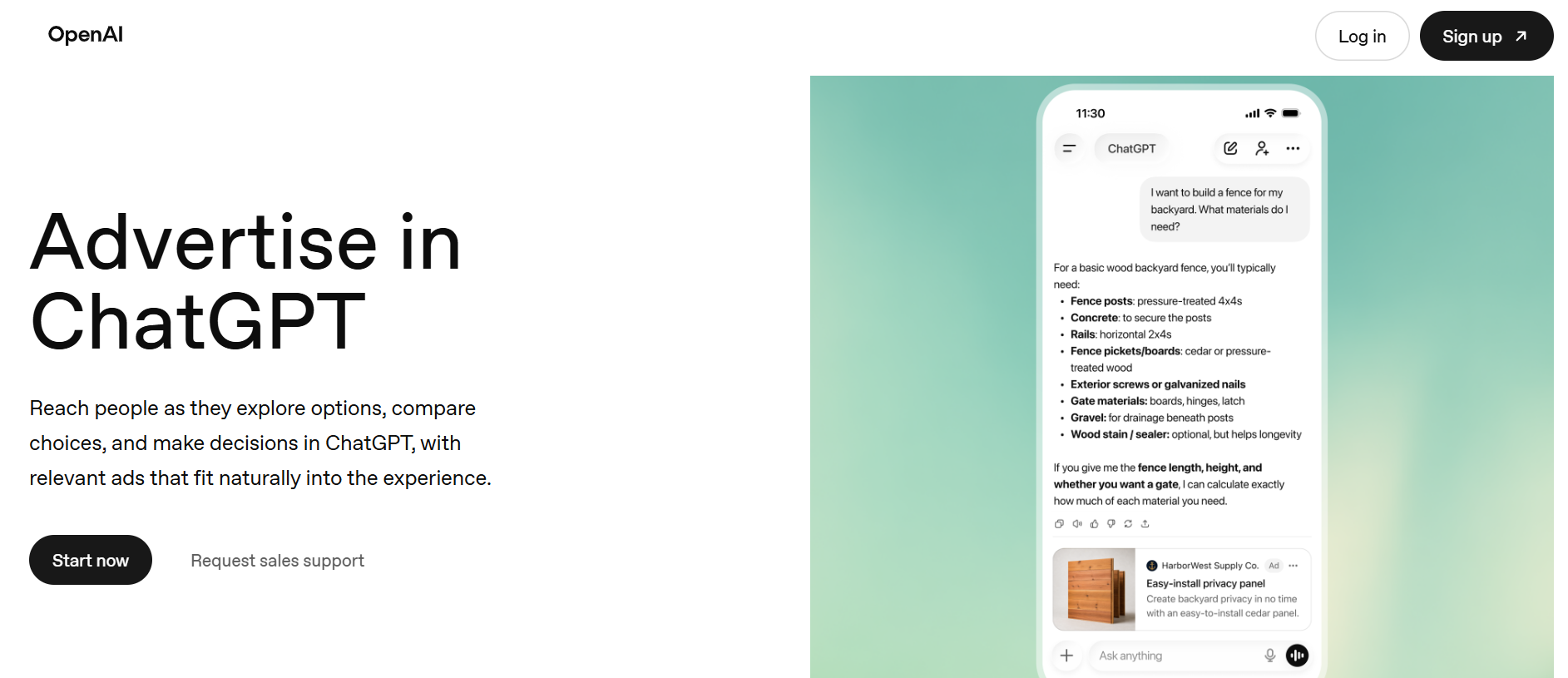
The ads appear below ChatGPT responses and are clearly marked as sponsored. They are separate from the answer generated by ChatGPT.
This is an important distinction. Advertisers are paying for an ad placement, not for ChatGPT to recommend their product inside an answer. OpenAI says advertisers cannot pay to shape, rank or alter ChatGPT responses, and seeing an ad does not mean OpenAI endorses that advertiser or product.
How Do ChatGPT Ads Work?
ChatGPT Ads uses the context and intent of a conversation to help determine whether an advertisement may be relevant.
That makes the advertising experience different from traditional keyword-based search advertising.
Someone using a search engine might type best accounting software for a small business. In ChatGPT, the same person could explain that they run a five-person company, need software that integrates with their bank, want simple invoicing and cannot afford an expensive enterprise system.
The conversation gives the system much more context about what the person is trying to achieve.
OpenAI says its advertising system considers several signals when deciding which ads may be relevant. These include the context and intent of the current conversation, the advertiser’s landing page, headline, ad copy, targeting selections and advertiser-provided context hints. When ad personalization is enabled, selected signals from a user’s wider ChatGPT experience may also contribute to ad relevance.
For marketers, this means advertising on ChatGPT cannot simply be treated as another place to upload a long list of keywords.
What Are Context Hints in ChatGPT Ads?
Context hints help advertisers describe the kinds of needs, conversations or situations where their product or service may be useful.
For example, an advertiser selling running shoes could provide a broad description such as running shoes. But OpenAI recommends giving more useful context, such as cushioned everyday running shoes for beginners training for their first 5K.
The idea is to help the advertising system understand the customer situation behind the product.
Context hints are not exact-match keywords. Someone does not need to type the exact phrase provided by the advertiser before the ad becomes eligible to appear, and adding a context hint does not guarantee that an advertisement will be shown.
This is one of the areas marketers will need to learn. Instead of thinking only about what keyword would someone search?, it may become equally important to ask what problem is this person trying to solve, and when would our product genuinely be useful?
What Do ChatGPT Ads Look Like?
ChatGPT Ads appear below ChatGPT’s response.
A standard ad can include the advertiser’s name, brand favicon or logo, headline, description, landing page and an image. OpenAI may show one or more sponsored items when there is a relevant match to the conversation
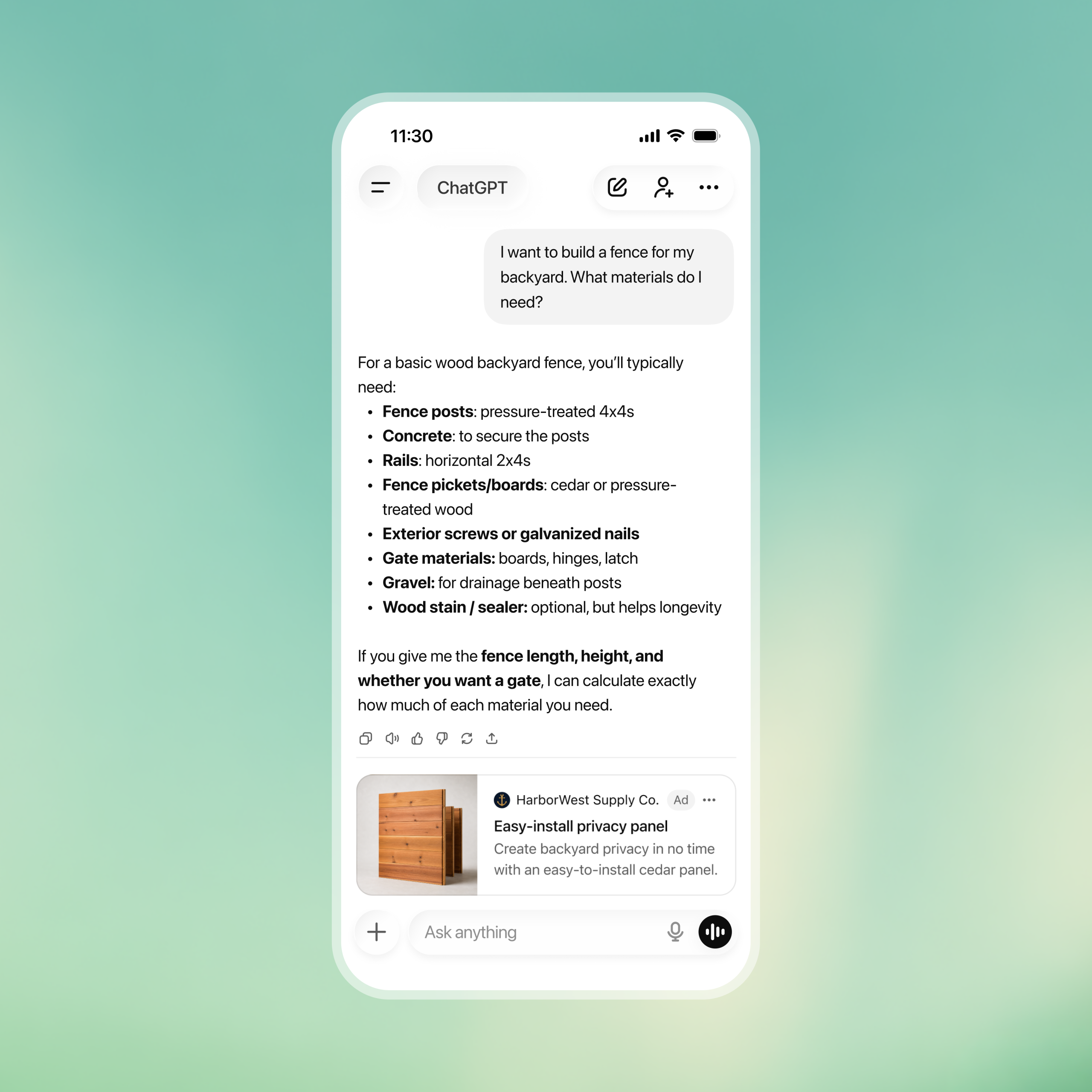
That placement puts advertising close to the moment when someone may already be researching something, comparing alternatives or deciding what to do next.
This could be particularly useful for businesses selling products and services that customers normally research before making a decision. The challenge for advertisers will be making sure the ad is genuinely helpful within the context of that conversation instead of simply interrupting it.
OpenAI’s own guidance encourages advertisers to use clear, useful copy that explains what a product offers, who it is for and when it may help. It advises against relying too heavily on generic slogans and broad marketing language.
What Does ChatGPT Ads Manager Do?
OpenAI Ads Manager Beta is the self-service platform advertisers use to create, launch and manage ChatGPT advertising campaigns.
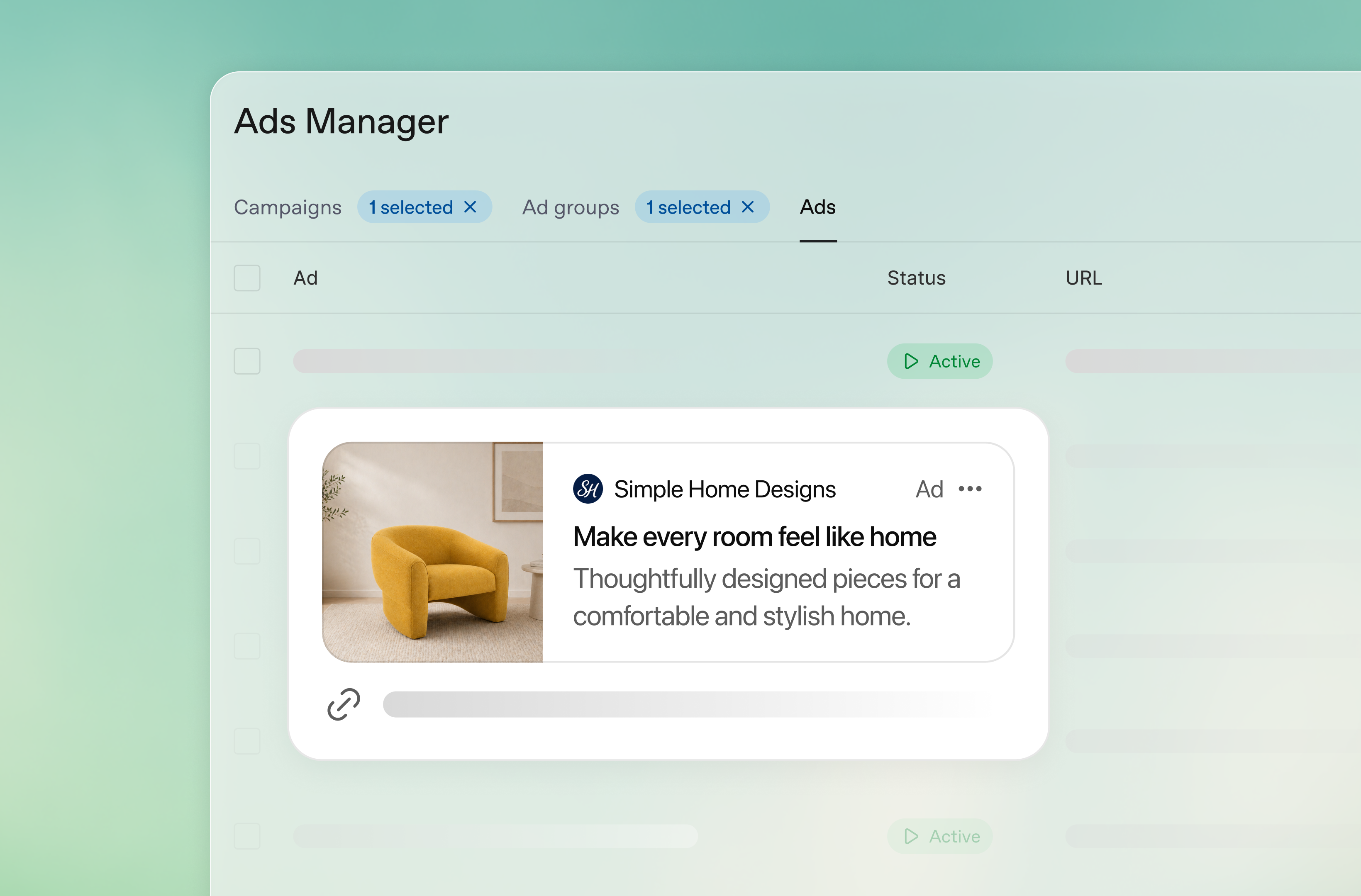
Businesses can use Ads Manager to set up campaigns, create ad groups and ads, control budgets and targeting, manage billing and account access, and monitor performance. Campaigns can be built individually through the guided workflow or created at scale using bulk uploads.
Advertisers can currently monitor metrics including impressions, clicks, spend, click-through rate, average CPC, average CPM and conversions where conversion tracking has been configured. Reporting is available through tables, charts and CSV exports.
Ads Manager also supports conversion measurement, while OpenAI has introduced tools including its Pixel and Conversions API to help advertisers understand what people do after clicking an ad.
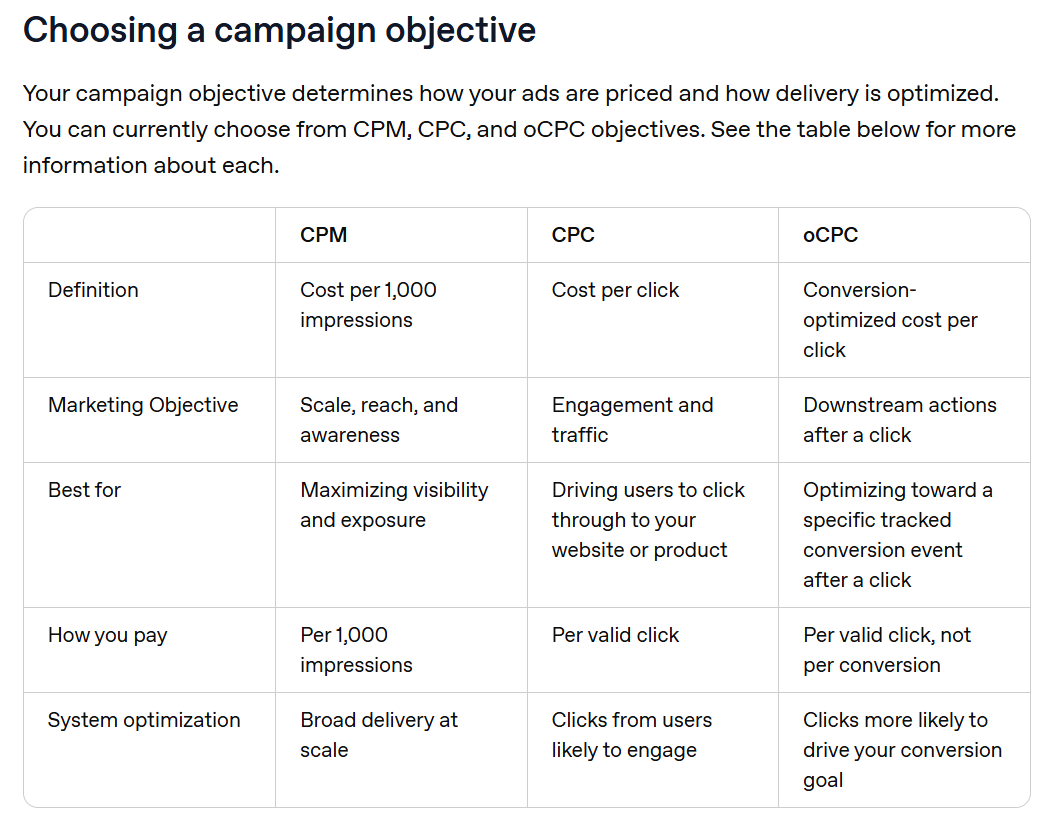
ChatGPT ad Campaigns can currently be optimized for reach, clicks or conversions. OpenAI supports CPM, where advertisers pay per 1,000 impressions; CPC, where advertisers pay for valid clicks; and oCPC, which optimizes delivery towards a selected conversion action while the advertiser is still billed for valid clicks.
How Much Do ChatGPT Ads Cost?
There is no single fixed cost for advertising on ChatGPT.
ChatGPT Ads uses an auction-based advertising system, so the amount an advertiser pays can depend on the campaign objective, bid, competition and relevance.
For CPC campaigns, OpenAI currently recommends starting with a maximum CPC bid of US$3 to US$5 per click. That does not mean every click will cost between $3 and $5. It is a recommended starting maximum bid, with the actual amount determined through the advertising auction.
OpenAI says it uses a relevance-weighted second-price auction. This means having the highest bid alone is not enough. The system also considers how relevant an advertisement is expected to be to the user and conversation.
There are also minimum campaign budgets.
For example, the current daily minimum is US$25 for advertisers billed in the United States, £15 in the UK, ₹725 in India, A$25 in Australia, C$25 in Canada and ¥2,500 in Japan. Minimums vary by country and billing currency. (OpenAI Help Center)
Advertisers should therefore think about ChatGPT Ads pricing in much the same way they would approach other auction-based platforms: set a test budget, measure results and optimize based on actual performance rather than assuming one universal cost per click.
OpenAI also says ChatGPT Ads is still an early platform and does not yet have established performance benchmarks covering all advertisers, industries and campaign types.
How to Start Advertising With ChatGPT
Businesses in supported countries can buy ads directly through OpenAI Ads Manager. Open ChatGPT Ads Manager
The process works as follows:
- Create your Ads Manager account. Sign in using an existing OpenAI account connected to your work email or create a new account.

- Set up your advertiser profile. Add your business information and brand logo, then complete the required advertiser verification.
- Add billing information. Set up your billing profile and payment method before your campaigns can begin running.
- Create your campaign. Choose your advertising objective, campaign budget, dates, locations and supported platforms.
- Create your ad groups. Organize ads around a particular product, customer need, theme or intent and add context hints to explain where the offer could be useful.
- Create your ads. Add your headline, description, image and landing page. Your landing page should clearly match what the ad promises.
- Submit the campaign for review. OpenAI reviews campaigns and ads before they are eligible to serve.
- Monitor the campaign. Once approved, track impressions, clicks, CTR, average CPC, average CPM, spend and conversions where measurement has been configured.
- Optimize based on results. Test different messages, context hints, bids, landing pages and creatives as you collect more performance data.
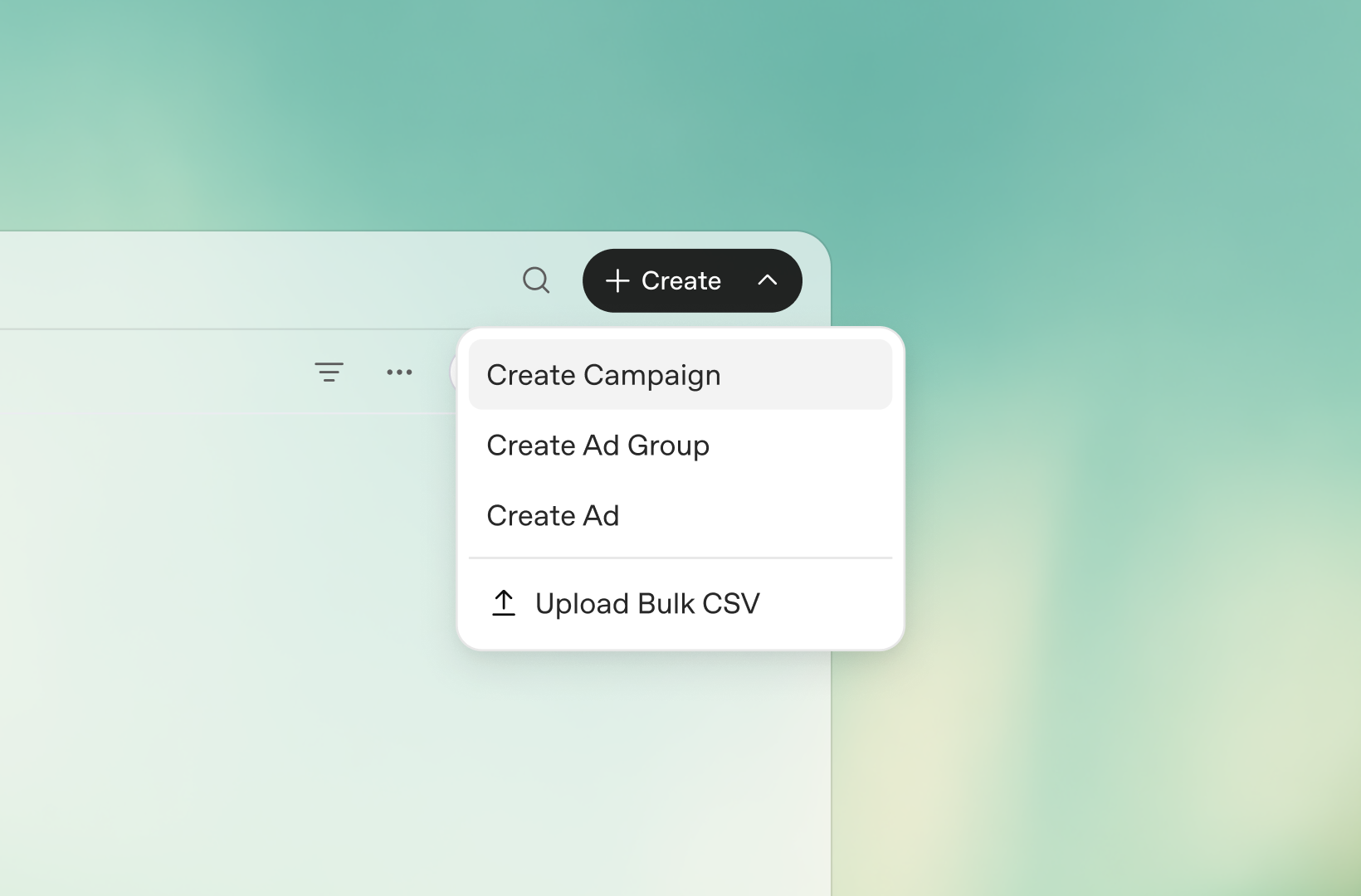
For businesses managing large numbers of ads, Ads Manager also supports bulk campaign creation and editing.
Can I Run Ads on ChatGPT?
Yes, if advertiser access is available in your market.
OpenAI has been expanding ChatGPT Ads internationally, and self-service Ads Manager access is now available across a growing number of countries in Europe, the Middle East, North Africa, Asia and other markets.
For businesses in Kenya, there is one important point to note.
Kenya is not currently listed among the countries with self-service ChatGPT Ads Manager access as of September 2026. Businesses can still create an Ads Manager account and OpenAI says it will notify advertisers when self-service becomes available in their country. Larger advertisers with more complex requirements can also contact the OpenAI Ads team about sales support.
For Kenyan marketers, this makes the current expansion worth following. Several North African and Middle Eastern markets are now supported, which shows that availability is moving beyond the initial group of countries.
Do Advertisers See Your ChatGPT Conversations?
No.
OpenAI says advertisers do not receive access to users’ ChatGPT conversations, chat histories, memories or personal information. Advertisers receive aggregated performance information such as the total number of views or clicks generated by their campaigns.
This is particularly important because conversational advertising can easily create the impression that the advertiser is somehow reading what an individual user has told ChatGPT.
According to OpenAI, that is not how the system works.
Information from the conversation can stay within ChatGPT and be used to determine whether an advertisement may be relevant, but the conversation itself is not passed to the advertiser. OpenAI also says it does not sell user data to advertisers.
Users can turn off ad personalization. When personalization is disabled, ads can still be selected based on the current conversation, but other chat threads, ad history and broader signals are not used in the same way.
Is AI Advertising Illegal?
No. Advertising through an AI platform such as ChatGPT is not inherently illegal.
Advertisers are still responsible for following the advertising, consumer protection, privacy and sector-specific laws that apply in the markets where they operate. They must also comply with OpenAI’s own advertising policies.
OpenAI prohibits or restricts several advertising categories and also controls the types of conversations beside which ads can appear. Its policies are designed to prevent advertising from appearing around sensitive or brand-unsafe conversations.
Political advertising is currently prohibited on ChatGPT, while some regulated sectors such as health, financial and legal services have additional requirements or restrictions depending on the market.
So using AI to deliver an advertisement does not remove the normal responsibilities around truthful claims, privacy, consumer protection and responsible targeting.
Why ChatGPT Ads Matter for Marketers
The most interesting part of ChatGPT advertising is not simply that OpenAI has created another place to display ads.
It is where those ads can appear in the customer decision process.
People come to ChatGPT to explain problems, research products, understand unfamiliar topics, compare alternatives and ask follow-up questions. A conversation can therefore reveal much more about what someone is trying to achieve than a single search term or social media interaction.
OpenAI describes ChatGPT as a place where discovery, consideration and decision-making can happen within one experience. The company says its advertiser base is becoming increasingly global and advertisers outside the United States now represent a growing share of revenue.
For marketers, this will require a slightly different mindset.
A ChatGPT Ads strategy should not simply copy a Google Search campaign or take a Meta ad and place it somewhere else. Advertisers will need to understand the questions customers ask, the situations that lead them towards a product, the language customers use to explain their problems and what information is useful at that point in the journey.
Landing-page experience will matter too. If an ad appears beside a detailed conversation and sends someone to a generic page that does not answer the need that brought them there, the opportunity may be wasted.
ChatGPT Ads Is Still Developing
The $1 billion annualized revenue run rate is a significant milestone, but ChatGPT Ads and Ads Manager are still developing.
OpenAI describes Ads Manager as a beta product and says additional capabilities will be introduced over time. The company is continuing to develop its advertising formats, measurement systems, buying options and tools for advertisers.
That is another reason advertisers should treat the platform as a place to test rather than assuming the rules, prices and formats available today will remain unchanged.
The more useful question for marketers now is how advertising performs when it sits alongside a conversation where somebody is actively researching, comparing or trying to make a decision.
Reaching $1 billion in annualized revenue run rate in less than 200 days, while attracting tens of thousands of advertisers, suggests businesses are already willing to test that opportunity.
For advertisers with self-service access, ChatGPT Ads is becoming another digital advertising channel worth testing alongside search and social media.
For Kenyan marketers, Ads Manager is not yet available for direct self-service buying, but now is a good time to understand how conversational advertising works. When access expands, the marketers who already understand context, intent, campaign structure and measurement will have a much easier place to start.
Want to explore ChatGPT advertising for your business or understand how AI is changing digital marketing? Samodigital helps businesses and marketing teams understand emerging digital platforms and turn them into practical marketing opportunities.
AI Slop in Marketing Isn’t Failure: Ketepa, NTSA, and the Messy Middle
TLDR: AI-generated marketing can misfire — or create what’s called AI slop. Ketepa Tea, NTSA, and Coca-Cola show how public feedback and iteration turn AI missteps into stronger campaigns.
February is the month of love, a season when brands lean heavily into emotion, gifting, and cultural moments. This year in Kenya, however, Valentine’s conversations went beyond flowers and chocolates. The Central Bank of Kenya cautioned against the misuse of banknotes amid the growing trend of money bouquets, highlighting how cultural moments, regulations, and public behavior intersect.
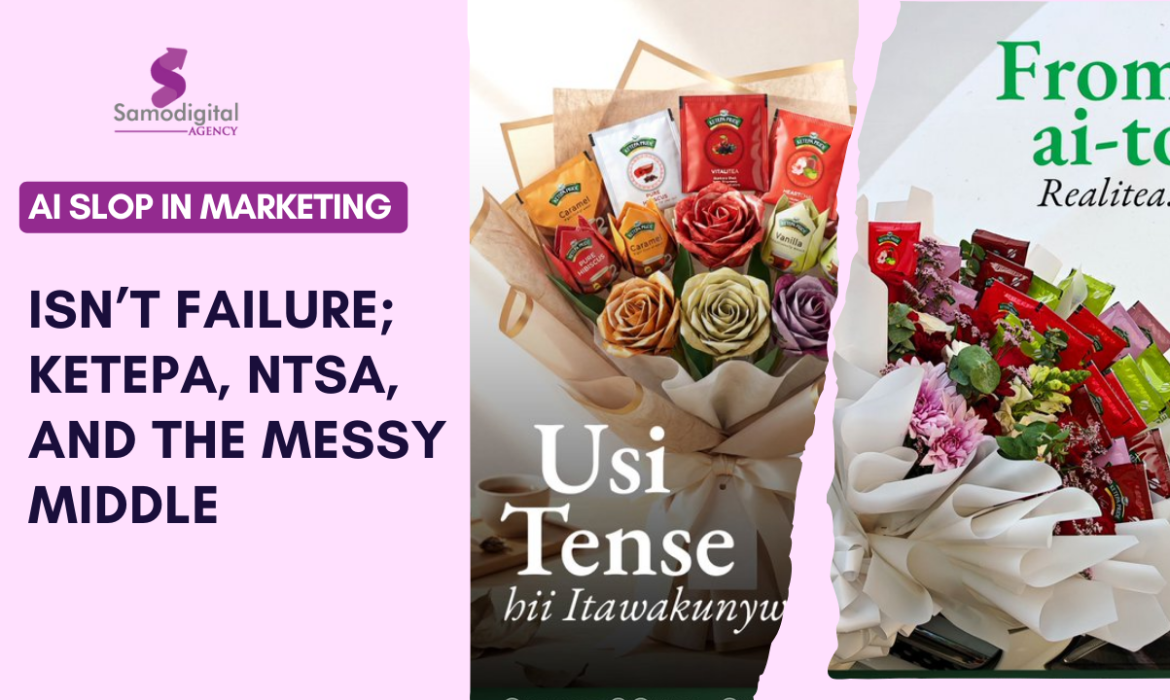
Against this backdrop, brands and public institutions turned to AI-generated images to participate in the moment. Ketepa Tea shared an AI-generated image of tea sachets arranged as a bouquet, prompting criticism around tone, timing, and authenticity.
Around the same time, the National Transport and Safety Authority (NTSA) faced backlash after publishing an AI-generated #UsalamaBarabarani image that appeared to contradict its own road safety message. In both cases, audiences quickly identified the gaps and voiced their feedback.
These moments sparked a broader conversation about AI-generated images and videos in marketing and the growing phenomenon often referred to as AI slop. More than isolated missteps, they reveal how brands are learning to use AI in public — navigating feedback, iterating in real time, and refining their approach as audiences become more AI-aware.
What is AI slop in Marketing?
AI slop refers to low-quality, obviously AI-generated content that fails authenticity tests and lacks the human oversight necessary for quality marketing. It is characterized by visual tells like distorted hands, impossible physics, nonsensical text, and, perhaps most critically, missing cultural context that make content resonate.
AI slop is not simply “bad content.” It often results from:
- Over-reliance on AI tools
- Weak or rushed prompting
- Limited human oversight
- Speed prioritized over strategy
Crucially, AI slop reflects process gaps, not proof that AI itself does not work. Many of these outputs are not failures, but early-stage experiments published too quickly.
But here’s what makes AI slop particularly problematic in 2025: today’s consumers are AI-literate. They can spot it instantly, and they expect better.
Why AI Slop Happens, Especially With Images and Video
AI slop is most visible in visual marketing for several reasons.
First, AI lacks lived context. Generative tools do not understand cultural nuance, regulation, emotion, or local realities. They work from patterns, not experience. Without human review, inconsistencies slip through.
Second, AI accelerates execution faster than judgment. What once took days of creative review can now be produced in minutes. When thinking does not keep pace with production, mistakes become public.
Third, visual content leaves no room for explanation. Audiences interpret images instantly. A single contradiction can undermine an entire message.
A Global Example: Coca-Cola’s Christmas Controversy and AI-Generated Creativity
In 2024 and 2025, Coca-Cola attempted to recreate its iconic “Holidays Are Coming” Christmas campaign using AI generation. The result? A soulless recreation that lost all the warmth and nostalgia of the beloved hand-crafted original. Visible AI artifacts and uncanny valley effects prompted hashtags like #BoycottCokeAI to trend. The message from consumers was clear: when you’re a heritage brand built on emotion, AI cost-cutting feels like betrayal.
Kenyan Case Study: NTSA and the #UsalamaBarabarani Campaign
Kenya’s National Transport and Safety Authority’s campaign #Safewalking #UsalamaBarabarani (Road Safety) campaign, advocating for zebra crossing usage, offers a clear example of contextual misalignment.

One of their AI-generated image shared on social media showed both a zebra crossing and a footbridge in the same frame. The public response was immediate: “Why would anyone use a ground-level crossing when there’s a safer footbridge option?” The image undermined the entire safety message, demonstrating AI’s inability to understand contextual logic.
NTSA deleted the post, but the damage to credibility was done. Here is the next post they shared on X.
Every minute saved is not worth a life lost.
Use the footbridge, it’s there to protect you.
#SafeWalking #UsalamaBarabarani pic.twitter.com/NBsFRiLWW3— NTSA KENYA (@ntsa_kenya) February 4, 2026
Ketepa Tea: Turning AI Backlash Into Iteration
Unlike the others, Ketepa’s response became a masterclass in crisis management. Ketepa Tea’s response stands out as a positive example of how brands can move forward after criticism.
After backlash over its AI-generated sachet bouquet, Ketepa did not defend the output or disengage. Instead, the brand listened. Here is the post that received a lot of criticism online.
Ketepa wishes to remind the public that section 1 of the Love Languages Code – aka the gifting of Ketepa Tea bags in decorative and romantic bouquet displays during this month of love is an enshrined freedom that all Kenyans across all walks can engage in without fear of… pic.twitter.com/c6rmS4ZGgb
— Kenya Tea Packers (@KetepaLtd) February 3, 2026
Kenya Tea Packers followed up with a new post featuring real flowers, real tea sachets, and a human presence, accompanied by the message “From AI to real tea.”
Ilibidi tutea.
Ketepa Tea Bouquet iko official,
romantic, inabrew love live.
Mapenzi ni vitendo… na tea ni lugha yetu.#KetepaTeaBouquet#ChaiNiKetepa#BrewLove pic.twitter.com/bbdehAiMOD— Kenya Tea Packers (@KetepaLtd) February 6, 2026
This shift mattered. It showed responsiveness, humility, and an understanding that AI should support storytelling, not replace human connection.
The Messy Middle of AI in Marketing
These examples illustrate what can be described as the messy middle, the phase between experimentation and mastery.
Marketing has always evolved this way. Early social media content was awkward. Early mobile ads were intrusive. AI is no different. The difference today is visibility. AI compresses timelines and exposes learning curves publicly.
The case of Coca-Cola, Ketepa Tea, and NTSA, among others, who have boldly shared their AI-generated campaigns are example of brands that are no longer iterating behind closed doors. They are doing so in real time, with audiences actively participating in the feedback loop.
They proved that listening and adapting create more trust than getting it perfect the first time.
Each public failure trains marketers on what doesn’t work. Failed examples become case studies that refine our collective understanding of AI’s appropriate use. Community feedback improves prompt engineering industry-wide. The messy middle isn’t where brands get stuck; it’s where they build the institutional knowledge that leads to mastery.
Today’s Awakened Consumer
What makes 2026 different from even two or three years ago is audience sophistication. Some consumers can increasingly spot AI-generated content through visual tells, tonal genericness, and logical inconsistencies. More importantly, they expect better. The sentiment you see on social media isn’t “don’t use AI”, it’s “if you’re using AI, at least make it good.”
This creates what is known as the authenticity paradox: brands must use AI for efficiency and creativity, yet audiences crave human connection and genuineness. The solution is not choosing between AI and authenticity. It needs brands to use AI as a tool while keeping humans as decision-makers.
Moving From AI Slop to AI-Smart Marketing
The difference between AI slop and AI success comes down to process. Successful AI marketing follows this framework:
- Generate multiple versions using AI for speed and scale.
- Review through multi-stakeholder quality checks that include cultural consultants and brand guardians. Refine based on expert input and cultural context.
- Test with small audience segments before full rollout. Approve only after final human sign-off confirming brand alignment.
- Monitor real-time sentiment post-publication. Iterate continuously based on learnings.
The critical element? Human oversight at every stage. AI should accelerate creativity, not replace judgment.
Brands must also build internal AI governance: documented learnings, prompt libraries with proven results, brand-specific guidelines, and team training on AI literacy. Quality thresholds should be established before generation begins, not after problems arise.
Conclusion
AI slop is not the end state of AI in marketing. It is a transitional phase that reflects experimentation, learning, and adjustment.
What defines strong brands is not the absence of mistakes, but how they respond. Brands that listen, iterate, and humanize their use of AI will build stronger trust and more resilient connections with their audiences.
In marketing, progress has never been perfectly polished. With AI, the learning just happens in public and when handled well, that visibility can become a strength rather than a weakness.
How TikTok Is Shaping the Future of Music Discovery and Streaming
TikTok has changed the way we discover, engage with, and consume music. What used to take weeks of radio play or curated playlists now happens in seconds on a 15-second video. But beyond the viral dance challenges and catchy hooks, TikTok is evolving, with its “Add to Music App” feature that creates a direct pipeline from viral clip to full-stream playback.
This blog breaks down:
- How TikTok influences music discovery and streaming
- Whether it’s a good platform to promote music
- Its overall impact on the music industry
What is the Add to Music App Feature on TikTok?
In December 2023, TikTok introduced a game-changing feature called the Add to Music feature. The goal? To leap at hearing a 15-second clip on your For You Page to stream the full track on your favorite music app as effortlessly as a tap.
This new feature is available in the U.S. and U.K. (with more countries expected soon), and it’s already transforming how users save and engage with music, while offering artists a powerful new way to convert TikTok virality into real-world streams.
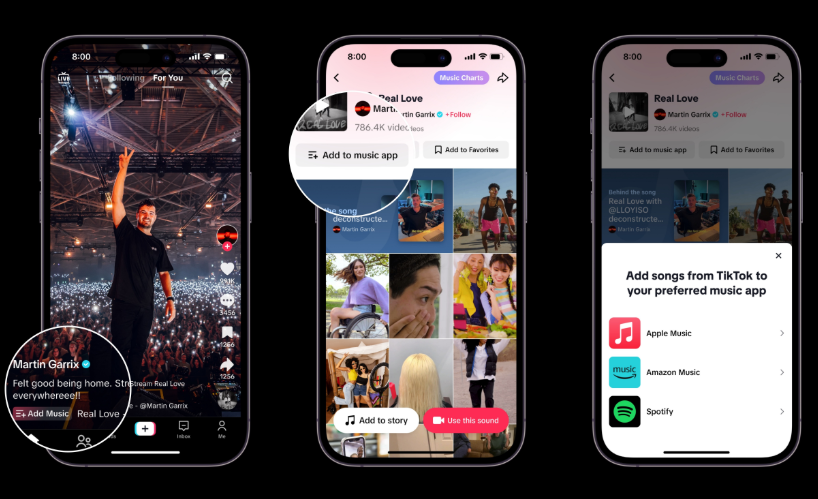
TikTok Add to Music App: Source TikTok News
How Does TikTok Influence Music Discovery and Streaming?
TikTok has become a cultural accelerator for music. Its algorithm-driven content serves up sound-backed videos that often lead users to fall in love with a song before they even know the title or artist. Research shows that TikTok users are significantly more likely to both discover and share new music content in the app, while 75% of its users also find new artists via TikTok clips.
Here’s how TikTok drives music discovery and streaming:
- Algorithmic exposure: TikTok surfaces content based on what you engage with, and music plays a big part in that. Trending sounds quickly gain traction and visibility.
- Viral loops: Users create thousands of videos using a trending sound, compounding its reach.
- In-app audio identification: You can tap the song name in a TikTok video and see other content using it, leading to deeper listening.
- Now: “Add to Music App”
This feature allows users to add a song to Spotify, Apple Music, or Amazon Music directly from TikTok. It eliminates the need to manually search for a song you liked in a video—just tap and it’s in your library.
In short, TikTok isn’t just a music discovery tool anymore—it’s a music streaming funnel.
Is TikTok a Good Place to Promote Music?
Yes, arguably one of the best right now.
Whether you’re an independent artist or a major label, TikTok offers:
- Unmatched reach: A single piece of content can go viral and reach millions without paid promotion.
- Authentic fan engagement: Fans don’t just listen; they create. TikTok encourages interaction through duets, challenges, remixes, and trends.
- Short-form storytelling: Artists can tell the story behind their music, share behind-the-scenes moments, or even test unreleased tracks.
And with the new Add to Music App integration, TikTok now gives musicians a direct path to monetization. If your song gains traction, users can easily save and stream it, turning likes and shares into actual plays.
What Is the Impact of TikTok on the Music Industry?
TikTok has had a seismic impact on how music is made, promoted, and consumed for :
Artists:
- Launchpad for careers: Many artists, like Lil Nas X, Ice Spice, and PinkPantheress, gained mainstream success after going viral on TikTok.
- Data insights: Artists and labels can use real-time engagement data to decide which songs to release, promote, or even remix.
- More control for independents: You don’t need a record deal to blow up. Creativity and consistency can take you far on TikTok.
The Industry:
- Influencing charts: A viral TikTok song often climbs Billboard and Spotify charts days or weeks later.
- Shaping sound: Artists now create songs with TikTok in mind—short intros, catchy hooks, and strong beats are designed to “hit” within 5–10 seconds.
- New marketing models: Traditional music marketing has shifted toward influencer partnerships, TikTok challenges, and trend-hopping.
Listeners:
- Interactive discovery: Fans feel like they “find” a song before it hits mainstream radio.
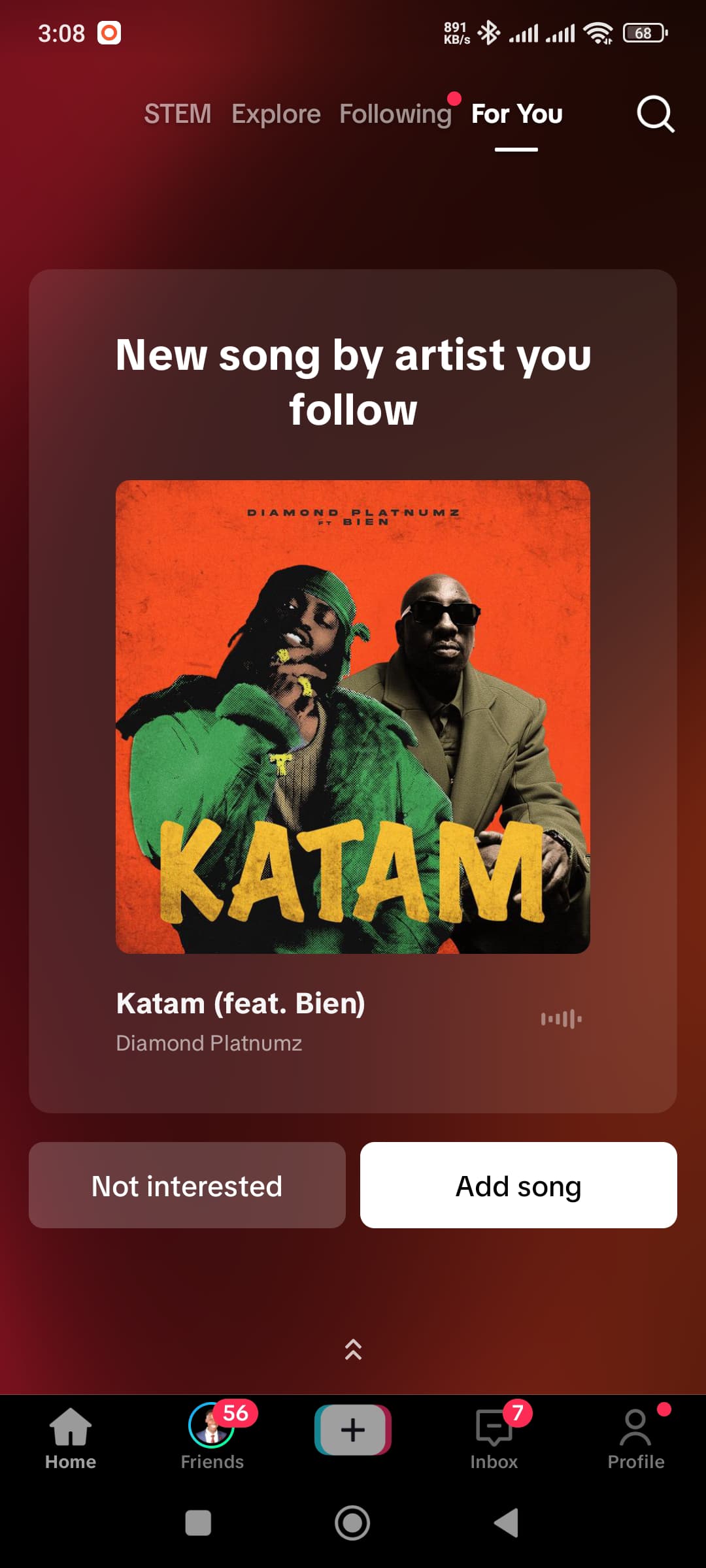
- Faster access to music: Features like “Add to Music App” make saving and streaming immediate.
Final Thoughts
TikTok has evolved from a fun video-sharing app to a powerful music ecosystem. It blends discovery, social interaction, and streaming into one seamless experience.
Whether you’re a music lover, an artist, or a marketer, understanding how TikTok influences music—and now powers it—could be the key to unlocking new opportunities in the digital music era.
With tools like “Add to Music App” becoming more visible in the For You Feed, TikTok is no longer just about trends—it’s about what’s next in music.
10 Proven Strategies to Boost Your Business on X in 2025
X formerly Twitter remains a powerhouse for real-time engagement, thought leadership, and customer connection in 2025. For marketers, brands, social media managers, businesses, solopreneurs, and creators, mastering X can drive visibility and conversions. In this article we share 10 actionable strategies to elevate your presence on X platform.
1. Optimize Your Profile for Maximum Impact
The first thing you need to do on X is to optimize your profile. Craft a profile that stands out. Use a clear logo or headshot, a professional header. Also have a bio that nails your brand’s value proposition. As you craft your bio, include niche-specific keywords and a link to your website to boost discoverability and conversions.
You can also add location and link to your other platforms or website.
2. Post Consistently with Diverse Content
Having an account on X without posting won’t bear you fruit. You need to post content consistently.Aim for 1-2 daily posts to stay visible without spamming followers. Mix text updates, images, short videos, and polls to keep your feed engaging. Data shows visuals and emojis can lift engagement by 30%. Keep posts concise (under 280 characters) for X’s fast-moving feed.
If you need to post content beyond 280 characters, you need to subscribe to X Premium. Understand the different features offered and go for the one that you can afford. X Premium also promises to boost your visibility on X.
3. Prioritize Real-Time Engagement
On X users expect quick responses 59% use the platform for news and updates. Therefore, you need to reply to comments, mentions, and DMs promptly to build trust. Moreover, you also need to join trending conversations in your industry to establish authority and use relevant hashtags to expand reach. This enhances visibility on the platform and helps you grow your brand and build an engaging community.
4. Embrace Video and Audio Features
X is doubling down on video and audio in 2025. Over time, they have made enhancements on video features such as introducing the ability to upload longer and 4K high quality videos. With that in mind, you need to create short-form videos (e.g., product demos or behind-the-scenes clips) to capture attention. Besides posting videos, you can also host Spaces for live audio discussions on industry topics to connect authentically with your audience. You can have thematic areas and recurring days when you are hosting Spaces.
Our Corporate Banking clients are at the heart of our success. With a customer-first approach and a comprehensive suite of solutions, I&M Bank is your partner for sustainable business growth.#IMBank #OnYourSide pic.twitter.com/Jo5MxJVgD6
— I&M Bank Kenya (@imbankke) May 26, 2025
5. Tell Stories That Resonate
Trends come and go, but storytelling drives conversions. There are different approaches to story telling. You can share customer success stories, company updates, or relatable insights. Repurpose high-performing content from Instagram or TikTok, but tweak it for X’s conversational vibe.
While on a routine wildlife health assessment in Meru National Park, the Meru Mobile Veterinary Unit encountered a solitary plains zebra stallion that had distanced itself from its herd. The zebra showed signs of severe pain, lack of appetite, and difficulty walking—prompting an… pic.twitter.com/aM3rGhhH5x
— Kenya Wildlife Service (@KWSKenya) April 24, 2025
6. Leverage Analytics for Smarter Posting
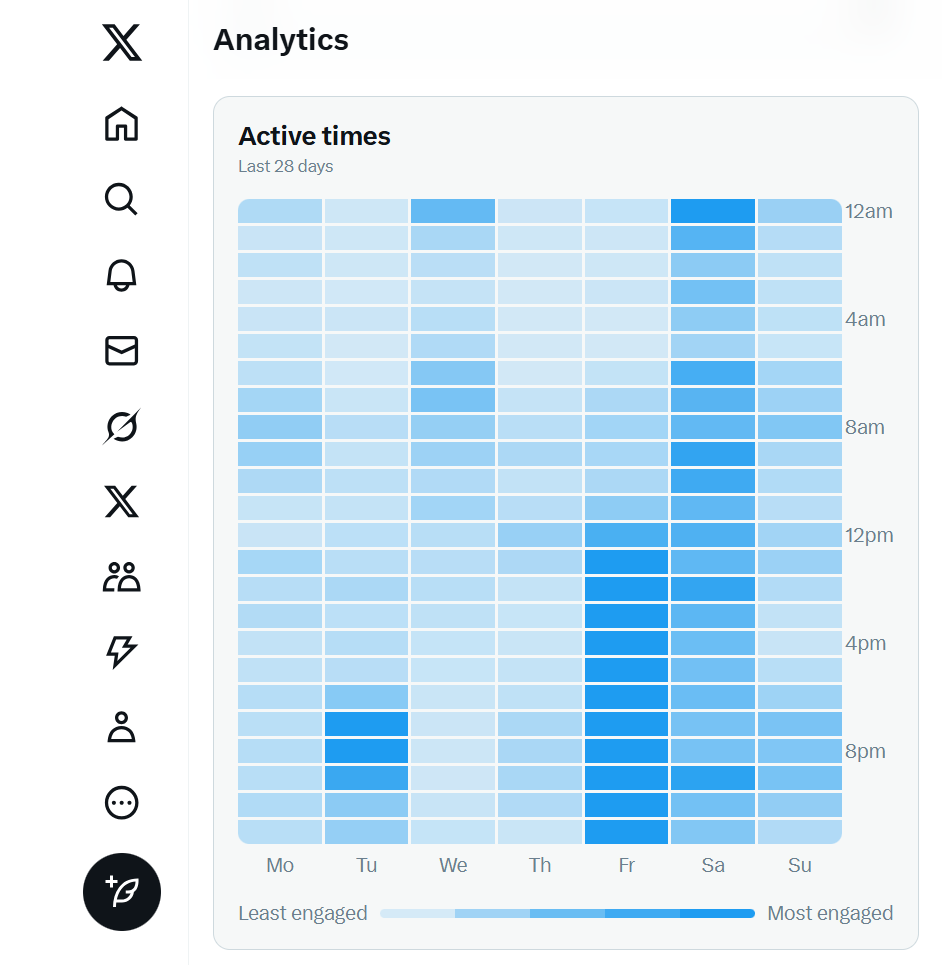
Use X analytics or tools like Hootsuite to identify peak engagement times and track performance. Nowadays, X analytics can show you when most of your audience are most active. Make use of this to know when best you can post content for maximum visibility and engagement. To add on, you need to conduct monthly audits to monitor follower growth and engagement rates, benchmarking against industry standards to refine your strategy.
7. Build an Email List for Control
X’s algorithm and ownership shifts can affect visibility. Besides that, an outage can appear and your audience will be in the dark. You need to build and email list and drive followers to your email list with compelling CTAs, like exclusive offers or newsletters, to maintain direct audience access.
8. Invest in Paid Promotion
Over time, the organic reach on social media platforms has declined, hence you need to boost your reach with paid ads. X leaning pay-to-play, consider ads or boosted posts to ensure reach. Target by interests or demographics for precision, and amplify high-performing organic content for better ROI. To start running your ads go to X ads manager. Alternatively, you can contact us at Samodigital to help you set up converting ads on X.
9. Collaborate for Growth
Another strategy that works like magic on X is partnering with influencers. Be strategic and Partner with micro-influencers or complementary brands to expand reach. Tag non-competing creators in posts to encourage reshares. Engage in X communities or niche discussions to build credibility and attract followers.
10. Stay Agile with Platform Changes
Just like any other social media platform, X keeps evolving with new features, tweaks in algorithms. X’s ad landscape and X continues to evolve its AI tools, with its Grok AI chatbot now able to generate images, including ad variations, based on text prompts. You also need to test new formats like X Money for monetization potential and see how they help you grow. and use tools like SocialBee to streamline scheduling and monitoring.
Adapt quickly to stay ahead.
Why X Matters in 2025
X’s real-time nature makes it ideal for customer service, PR, and thought leadership. Its audience (56.8% male, 43.2% female, mostly 25-34) is highly engaged, especially in the U.S. and Europe. Combine X with 2-3 platforms like LinkedIn or Instagram to maximize impact. For ad pricing or subscription details, visit X Premium.
Focusing on authenticity, engagement, and strategic testing, you can turn X into a growth engine for your brand in 2025.
Using Generative AI in Digital Marketing: Opportunities & Challenges [Presentation]
Generative artificial intelligence became popular in 2023 thanks to the release of ChatGPT in November 2022. It has become a hot topic for marketers and businesses with each trying to see how they can weave in generative AI in their marketing strategy or day-to-day operations.
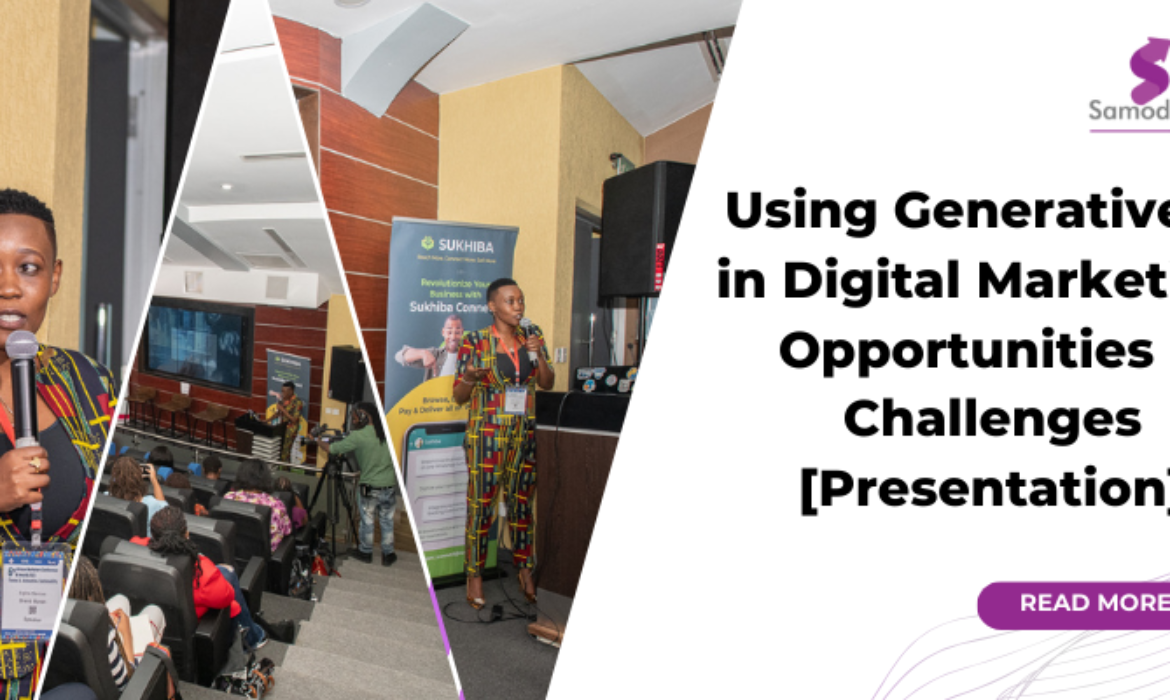
On 1st December 2023, I was privileged to give a talk on Using Generative AI in Digital Marketing at the 6th Marketers Conference and Awards 2023 in Nairobi, Kenya hosted by the Top Marketers Club.
What are the opportunities and what are the challenges for digital marketers in Kenya? In this article, I will give a summary of the points that I touched on at the conference. Here is how it started.
What is Generative AI?
Generative AI refers to deep-learning models that can generate high-quality text, images, and other content based on the data they were trained on according to IBM Research. Simply put, it includes language learning models that generate texts like ChatGPT, Bard or text-to-image such as Stable Diffusion, Midjourney, and DALL·E 2 among others.
The generative AI market is projected to reach USD 110.8 billion by 2030, and 80% of organizations have already adopted generative AI or plan to do so in the next three years.
What are the Benefits of Generative AI for Marketers in Kenya
I also touched on the benefits of generative AI. I mentioned that generative AI in marketing offers benefits such as:
- Creating high-quality visuals with fewer resources
- Enhanced content creation
- Personalized customer experiences
- Improved efficiency and productivity
- Improved customer service
- Trend forecasting and predictive analytics.
9 Generative AI Opportunities for Marketers in Kenya
Now let’s look at some of the opportunities that generative AI presents for digital marketers
-
Content Generation
Have you started using AI tools to create content? Generative AI presents opportunities for content generation, including content idea generation, converting long-form content to social media posts, creating content outlines, writing the first draft of content, writing press releases, and conducting content research and data analysis. For content generation, you can use tools like ChatGPT or Jasper AI
-
Search Engine Optimization
Also, generative AI can assist marketers with search engine optimization by conducting competitive and keyword research, creating SEO titles and meta descriptions, generating content, and editing and proofreading drafts. You can use tools like Surfer, Bard and ChatGPT to get keywords and cluster keywords.
-
Video Creation and Editing
Moreover, generative AI can be used for creating and editing videos, including explainer videos to introduce new concepts or products, promotional videos for marketing purposes, and product demos to showcase features and benefits. You can use tools like Virbo AI, Synthesia, Designs.ai and Rephrase.ai
-
Image Creation
You can use AI text-to-image platforms to create images for your social media posts, blog cover ads and even your infographics. It’s time-saving and you can play with different elements. Some of the popular text-to-image websites include Imagen, DALL-E 2, Midjourney and Stable Diffusion
-
Voice Generation
Voice generation using AI allows marketers to create unique audio content with customized brand voices for advertisements and marketing campaigns. It also enables businesses to develop AI-generated voice-overs for commercials, podcasts, and interactive advertisements, as well as realistic voice-overs for animations and video games. Examples of AI voice generators include Replica Studios, Lovo, and Synthesys.
-
Chatbots and Virtual Assistants
Generative AI can enhance chatbots and virtual assistants by improving natural language processing, personalizing customer interactions, automating content creation, generating insights from data, creating creative content, automating lead nurturing, analyzing sentiment, providing proactive customer service, supporting multiple languages, and continuously learning. This allows marketers to deliver personalized, engaging, and data-driven customer experiences, ultimately driving business growth and success.
-
Sentiment Analysis
ChatGPT’s natural language processing capabilities make it a powerful tool for sentiment analysis, enabling businesses to gain insights from customer feedback, reviews, and social media interactions. Marketers can harness this power to uncover customer sentiment trends, identify potential issues proactively, craft tailored customer service responses, predict future customer needs, track brand reputation, and make data-driven decisions that enhance customer experiences.
-
Hyper-Personalization
We are now used to personalization but generative AI takes personalization to a new level by predicting and generating content based on customer preferences, allowing businesses to deliver more personalized experiences that customers are more likely to engage with. This can include creating custom promotional offers, personalized shopping guides, or unique user experiences tailored to each customer.
-
Automating Process
AI tools that combine public and private AI models with CRM data are becoming increasingly popular for businesses. These tools can help businesses automate tasks, generate personalized content, and gain insights from data. They are often built on robust AI platforms, enabling them to integrate seamlessly with existing business systems. An example of this is Einstein GPT integrated into Salesforce CRM
Challenges of Using Generative AI in Marketing
Some of the challenges that come with using generative AI in marketing include
-
Hallucination
Hallucination in AI refers to the generation of outputs that may sound plausible but are either factually incorrect or unrelated to the given context. It leads to misinformation and disinformation and users may lose trust in the
-
Copyright infringement
Also, generative AI models can be trained on copyrighted data without permission, generating outputs that mimic copyrighted works or creating counterfeit products.
-
Bias, Stereotypes, Discrimination
While Generative AI is powerful and versatile, can also introduce biases and stereotypes into marketing campaigns if not carefully considered and implemented.
-
Data Privacy Issues and Breaches
As you know, generative AI models often require vast amounts of personal data for training and operation, raising concerns about data collection practices and the potential for misuse of this sensitive information.
-
Ethical Issues and Regulations
Lastly, generative AI is a powerful tool with the potential to revolutionize marketing, but it also raises significant ethical concerns and data privacy challenges. To ensure responsible and ethical use of generative AI in marketing, companies must prioritize transparency, fairness, data security, and compliance with relevant regulations.
Conclusion
To conclude, generative AI is revolutionizing digital marketing globally. It allows you to generate high-quality content, personalize experiences, and automate tasks. While it is promising it has inherent challenges that a marketer needs to know such as hallucination, bias and privacy issues. Marketers must stay informed and tap into the power of generative AI

