

Anthropic Report Flags AI-Assisted Political Astroturfing in Kenya Ahead of 2027 Election
TLDR: AI political astroturfing in Kenya is one of the key findings in Anthropic’s latest threat intelligence report, Detecting and countering misuse of AI: September 2026. The report details how malicious actors attempted to use Claude for influence operations, cyberattacks, surveillance, scams and other harmful activities.
Anthropic has released a new threat intelligence report detailing how actors around the world have attempted to misuse its Claude AI models for cyber operations, political influence campaigns, surveillance, scams and other harmful activities.
The report, Detecting and countering misuse of AI: September 2026, was published on September 10, 2026. It covers operations that Anthropic says its Threat Intelligence team identified and disrupted between December 2025 and August 2026, an eight-month period.
The 154-page report covers seven areas: cyber operations, influence operations, surveillance, scams and fraud, biological misuse, conventional weapons development and illicit model distillation. Anthropic also makes an important qualification: the cases are not examples of typical Claude use, but some of the most notable and novel cases of misuse it has identified.
Among the countries featured is Kenya, where Anthropic says it disrupted an operation using Claude to generate political social media content designed to look like genuine grassroots public opinion.
AI Political Astroturfing in Kenya: What Anthropic Found
The Kenyan case is identified as GTG-54004: Disrupting a domestic coordinated inauthentic behavior campaign in Kenya.
GTG stands for Generative Threat Group, Anthropic’s internal designation for actors it observes abusing AI systems.
According to Anthropic, it identified and removed an account used by a single actor to mass-produce Kenyan political content. The actor used Claude over several sessions to generate batches of exactly 50 tweets, while specifically asking the model to make them look like spontaneous grassroots commentary rather than a coordinated campaign.
In simple terms, the aim was to make organised messaging look as though many ordinary people had independently arrived at and were sharing the same opinion.
This type of activity is commonly known as astroturfing: creating the appearance of grassroots public support or opposition when the activity is actually coordinated.
Which political narratives were being pushed?
Anthropic says a large portion of the AI-generated posts praised Hon. James Opiyo Wandayi, EGH, is the Cabinet Secretary for Energy and Petroleum, in relation to stopping a scheduled Kenya Power electricity tariff increase.
The posts used hashtags including #PowerReliefKE and #PoweringTheNewKenya.

The same network also produced content claiming that Kenya’s United Opposition coalition was falling apart ahead of the 2027 election, with posts directly targeting Rigathi Gachagua and former President Uhuru Kenyatta.
Anthropic describes the operation as using one playbook to amplify both pro-government and anti-opposition narratives, which it says was consistent with a coordinated electoral communications effort.
There is, however, an important distinction.
Anthropic says it found no evidence of government involvement. It assessed the activity as an entirely domestic Kenyan operation.
The company says the campaign’s pro-administration tone and use of particular hashtags suggested that it was plausibly aligned with the ruling coalition, but Anthropic says it did not identify the specific organisation responsible.
That distinction matters. The report does not establish that the Kenyan government, a political party or any named politician commissioned the campaign.
How was Claude being used?
What stands out in the Kenya case is not that AI came up with the political strategy.
Anthropic says the actors had already decided the ideological messages before using Claude.
They supplied the topics, talking points and hashtags, then used the model to turn them into batches of 50 themed posts formatted for distribution. Claude was also used to humanise and refine pre-written material, helping give the posts greater variety and the appearance of authenticity.
In several sessions, Anthropic says the output was even packaged into an interactive copy-all widget, ready for deployment.
Therefore, the Kenya case shows how generative AI can be used to scale a political communications operation. Instead of manually writing dozens of different tweets around one talking point, an operator can use AI to produce variations quickly while trying to make them appear as independent voices.
For communicators and social media professionals, that is an important distinction.
The concern is not simply whether somebody used Generative AI to help write a post but the use of AI to make a coordinated campaign appear to represent independent public opinion.
The same workflow was used to market Kenyan retail brands
Anthropic also found that the actor behind the political activity used the same AI workflow for commercial marketing.
The report says the workflow was used for Kenyan retail brands under a marketing persona called “SHANKI” or “Elkins Marketer.”
Anthropic says one retail promotional broadcast was repackaged as apparently organic tweets, with links inserted into every fifth post.
This part of the report should interest marketers and agencies.
The same technology and workflow that can generate dozens of variations of a commercial campaign can also be applied to politics. The difference is not necessarily the tool. It is the purpose, transparency and way the campaign is presented to the public.
Anthropic describes this as fitting a pattern it has observed in Kenya involving agencies paying local influencers to manipulate narratives.
Did the campaign actually influence Kenyans?
According to Anthropic, there is no evidence that this particular operation achieved significant reach.
Anthropic assessed the Kenyan network as Category One on the Breakout Scale, the lowest category used in the report to measure the reach of influence operations.
The company says the activity remained confined to its network of fake accounts on one platform and did not break out to a genuine audience.
This is important because the existence of an influence operation does not automatically mean it was successful.
Anthropic says this is a wider pattern across several of the campaigns it investigated. Because AI companies can sometimes detect an operation while content is still being produced, some campaigns can be disrupted before they build a real audience. The report says much of the influence content it found generated little or no authentic engagement.
Figure 17 in the report shows examples of inauthentic commenting accounts amplifying content relating to Wandayi and the electricity tariff issue.
OpenAI helped flag the Kenyan activity
Another notable detail is how Anthropic says the investigation began.
According to the report, OpenAI shared a tip about recidivist activity on its platform. Anthropic then conducted its own investigation into suspected coordinated inauthentic behaviour in Kenya.
Anthropic says it subsequently removed the account and organisation behind the activity and developed detections based on the operation’s behavioural patterns.
The case highlights the importance of cooperation between AI companies when the same actors may be using multiple AI services as part of one operation.
Kenya is not the only African country in the report
Anthropic’s report documents several other operations involving African countries. The cases differ considerably, ranging from political influence campaigns to surveillance.
Central African Republic: Russian state-aligned influence operation
In the Central African Republic (CAR), Anthropic says it disrupted an operation run by a Russian-speaking actor in Bangui that formed part of a Russian state-aligned foreign information manipulation campaign.
The operation used Claude to help produce material distributed through Radio Lengo Songo, while coordinating with Russian state media organisations including RT, Sputnik Afrique and TASS.
Anthropic says much of the sampled messaging was pro-CAR government, pro-Wagner, anti-France and anti-CAR opposition.
The use of Claude went beyond writing social media posts.
According to the report, the model was used to help create contracts, job descriptions, staff-scoring systems and political content. The operation also tracked opposition political figures, drafted talking points and produced forged CAR government documents.
Unlike the Kenyan case, Anthropic assessed the CAR operation as Category Four because the material reached audiences through FM radio, Telegram and local news outlets.
Democratic Republic of Congo: fake news websites and X accounts
The report also describes a commercial influence-as-a-service operation that targeted audiences across six continents.
The network included approximately 70 fabricated news websites, 70 linked X accounts and more than 250 inauthentic commenting accounts. Anthropic traced the operation to a France-based digital advertising agency.
The Democratic Republic of Congo was one of the operation’s major areas of focus.
Anthropic identified 318 articles across the fake news network focusing on the DRC, including narratives around regional mineral agreements and tensions with Rwanda.
The company says it found signals suggesting that one or more customers may have had an interest in the DRC-Rwanda conflict, but it could not independently identify who commissioned the material and found no evidence of government direction.
Sudan: influence operations hiding their origin
Another case in the report involved the Sudan conflict.
Anthropic says it disrupted a UAE-directed influence operation that used approximately 300 inauthentic influencer accounts. The operation also created a front NGO using the identity of a real organisation, profiled members of the European Parliament and journalists, and compiled dossiers on UN Special Rapporteurs.
Anthropic says the actor also ghost-wrote testimony intended for the UN Human Rights Council while taking steps to prevent the material from revealing its connection to the UAE.
The report says the identity of a real Sudanese human-rights organisation was borrowed so that material supporting one side of the Sudan conflict could appear to come from independent local witnesses.
Mali: Claude used to help engineer a surveillance platform
The report’s African cases are not limited to political influence.
In Mali, Anthropic says a single Claude subscriber, believed to be a Bamako-based independent consultant working with the country’s state intelligence service, used Claude as engineering support while developing a surveillance platform known as Lakana 360.
Anthropic says the system was designed to monitor roughly 25 million SIM cards across all three of Mali’s national mobile operators.
According to the report, the system included capabilities involving call records, SMS and voice traffic, cross-SIM voice identification, watchlists, VPN and encryption-user flagging, and matching individuals against government registries.
Anthropic banned the account involved. However, it says the surveillance platform had been deployed locally using an on-premises model, meaning its enforcement action could disrupt further development using Claude but could not remove the system that had already been deployed.
What else does the Anthropic report reveal about AI misuse?
The report presents a much wider picture of how AI tools can be incorporated into harmful operations.
Within influence campaigns, Anthropic found actors using Claude as a newsdesk, helping smaller teams produce material at a scale that would previously have required more staff.
It also documented the use of AI to create fake personas, rewrite or localise content, conceal the original source of political narratives, produce internal operational documents and make coordinated content appear more organic.
Beyond influence operations, the report covers cyberattacks, surveillance, fraud, weapons development and other forms of misuse.
The broader concern is therefore not simply that AI can generate misleading text. AI can reduce the amount of time, staffing and technical expertise required to operate an existing campaign at scale.
What does this mean as Kenya approaches the 2027 election?
The Kenya operation documented by Anthropic did not achieve significant reach, according to the report.
But what it demonstrates deserves attention.
A single actor was able to provide political talking points and use AI to turn them into dozens of different posts designed to resemble independent public commentary.
As Kenya moves towards the 2027 election, this raises questions that journalists, marketers, communication professionals, researchers, political actors and social media platforms will need to consider.
How do we distinguish genuine public opinion from coordinated amplification?
A trending hashtag or thousands of posts around one issue can look like strong public sentiment. But volume alone does not tell us whether the conversation developed organically.
What happens when paid influencers, fake accounts, genuine citizens and AI-assisted content all participate in the same conversation?
Separating those groups may become increasingly difficult when AI can make coordinated posts sound different from one another.
Should political digital campaigns be more transparent about who paid for or coordinated them?
The Anthropic case demonstrates why identifying the source of online political narratives is becoming as important as analysing the content itself.
Are social media platforms prepared to detect coordination rather than simply AI-generated text?
Detecting whether a paragraph was written with AI may become less useful than looking for patterns across accounts: timing, repeated talking points, shared hashtags, unusual amplification and networks repeatedly interacting with one another.
For those of us working in social listening, media monitoring and digital communication, there is another important question.
What does a spike in mentions actually represent?
If hundreds of accounts suddenly begin praising or attacking the same person, organisation or policy, analysing volume and sentiment alone may give a misleading picture. Increasingly, monitoring needs to consider how a narrative is spreading, which accounts are driving it, whether the amplification appears coordinated and whether what looks like public sentiment is genuinely organic.
That is an analytical implication of Anthropic’s findings, rather than a claim made directly by the report.
The issue is bigger than AI-generated content
It would be easy to read the Kenya case simply as another example of people using AI to write political posts.
The report points to a bigger issue.
In the case Anthropic documented, humans selected the political positions, talking points and hashtags. AI was then used to increase the volume and make the material appear more natural.
That makes the issue less about whether content is “AI-generated” and more about how AI can help organised actors manufacture the appearance of authentic public participation.
For marketers and communication professionals, the ethical question is particularly relevant. The same tools that make it easier to create campaigns, adapt content and reach audiences can also be used to disguise coordinated messaging as grassroots conversation.
As the 2027 election approaches, digital literacy will therefore need to extend beyond spotting deepfakes and obviously AI-generated images.
People may increasingly need to ask:
Who is behind this message? Why are so many accounts saying something similar? Is this really an organic conversation? And who benefits if I believe that it is?
Those questions may become just as important as asking whether a piece of content was created using AI.
Read the Anthropic report
This article is based on Anthropic’s Detecting and countering misuse of AI: September 2026, published on September 10, 2026. The report covers malicious activity Anthropic says it identified and disrupted between December 2025 and August 2026.
The full report and PDF are available directly from Anthropic
Read and download Detecting and countering misuse of AI: September 2026
How to Build a Digital Strategy for NGOs That Supports Your Mission
Are you looking to develop a digital strategy for your NGO?
Non-governmental organizations (NGOs) are under increasing pressure to communicate their work clearly, reach communities, attract funding, engage policymakers, build public trust and demonstrate impact. Digital channels can support all these goals, but being active on social media or having a website does not automatically amount to a digital strategy.
For NGOs, digital strategy also comes with challenges that are different from those faced by many commercial organizations. Communication teams may be small, budgets limited and audiences highly varied. The same organization may need to communicate with communities, donors, government agencies, journalists, development partners, volunteers and employees, each with different information needs.
A useful digital strategy therefore needs to start with the mission rather than the platforms.
What is a digital strategy for an NGO?
A digital strategy for an NGO is a plan for how the organization will use digital channels, content, data and technology to advance its mission, reach its stakeholders and achieve specific organizational, communication, advocacy, programme or fundraising objectives.
For one NGO, the priority may be increasing applications for a youth programme. Another may need to influence policymakers, improve donor communication, raise awareness around an advocacy issue or make research easier to find online.
The strategy should clarify what the organization wants to achieve, who it needs to reach, which channels will be used, what role each channel will play and how success will be measured.
This distinction is very important. Posting on Facebook, sending newsletters and creating TikTok videos are digital activities. However, a digital strategy explains why those activities are necessary and how they contribute to the NGO’s mission.
How to build a practical digital strategy for your NGO
Now that you understand what a digital strategy for NGOs mean, now let us look at the steps to building a practical digital strategy for your NGO.
1. Start with the mission and organizational goals
Digital strategy should not begin with the question, “Should we be on TikTok?”
Start with what the organization is trying to achieve.
Suppose an NGO wants to increase women’s participation in digital-skills programmes in rural or urban counties. The digital objective may be to increase awareness among eligible women, make programme information easier to access and generate qualified applications.
An advocacy organization trying to influence education policy would need a different approach. Its priority audiences may include government officials, journalists, researchers, civil society organizations and development partners.
Once the organizational goal is clear, it becomes easier to decide which digital activities deserve attention.
2. Map your stakeholders
NGOs rarely communicate with one audience. A stakeholder map helps the communication team identify who needs what information and where those conversations should happen.
Communities may need clear programme information and updates. Funders may want evidence of impact, reports and organizational results. Policymakers may need research findings and concise advocacy messages, while journalists may be looking for timely information, data and expert sources.
The same message should not automatically be presented to all these groups in the same way.
For example, a 40-page research report may be valuable to a policymaker or development partner, while community audiences may benefit more from a short explainer, infographic, video or local-language summary.
Audience understanding should influence both channel choice and content format.
3. Audit your current digital footprint
Before creating new accounts or buying new tools, review what the organization already has.
Look at the website, social media accounts, email database, search visibility, analytics, digital advertising and online reputation. Check whether account ownership and passwords are properly managed and whether the information published across channels is current.
The audit should also consider capacity. Does the team have people who understand analytics, content creation, community management, social listening or digital advertising? Are platforms being maintained because they contribute to organizational goals or simply because the accounts have existed for years?
A small NGO may discover that improving its website and two important social channels produces more value than trying to manage seven platforms poorly.
4. Give every digital channel a clear role
Not every NGO needs to be everywhere online. The more useful question is: What job should each channel do?
A website can serve as the organization’s authoritative source for programme information, reports, research, impact stories and contact details. LinkedIn may be useful for funders, professionals, development partners, policymakers and organizational credibility.
Facebook and WhatsApp may support community communication where those channels are widely used by programme participants. YouTube can host webinars, explainers, interviews, documentaries and other educational resources, while email can maintain direct relationships with donors, partners and supporters.
Search also matters. A journalist looking for research, a young person searching for a programme or a potential partner researching the organization may encounter the NGO through Google before seeing any social media content.
The role of each channel should therefore reflect audience behaviour and organizational objectives rather than trends.
5. Turn the mission into useful content
NGO communication often focuses heavily on announcing what the organization has done. Effective digital content should also help audiences understand why the work matters.
A balanced content strategy can include programme information, research findings, educational content, community stories, advocacy messages, field updates, impact data, partnership opportunities and calls to action.
Storytelling is important, but NGOs also need to consider dignity, consent and privacy. A powerful story should not expose a programme participant to harm or reduce someone to their most difficult circumstances simply because emotional content attracts attention. Ethical storytelling is very important.
Where possible, community members should be represented as people with agency, knowledge and aspirations rather than passive recipients of assistance.
6. Build safeguarding and governance into the strategy
Digital strategy for NGOs should include governance, particularly where organizations work with children, vulnerable communities or sensitive information.
Teams need clear guidance on who can publish on official accounts, how passwords are managed, what information employees can share and how online issues are escalated.
Consent should be considered before publishing photographs, videos or personal stories. Data protection also matters when collecting email addresses, application information or community data.
Generative AI adds another layer. NGOs should decide what information staff may enter into external AI tools, how AI-generated content is reviewed and who remains accountable for the final communication.
These issues should be addressed before a problem occurs, not during a crisis.
7. Measure outcomes that matter to the mission
Follower numbers, likes and impressions can provide useful information, but they should not become the main definition of success.
The right metrics depend on the objective.
An awareness campaign may track reach, website traffic, media mentions and search visibility. A programme recruitment campaign may focus on applications, enquiries and registrations. Advocacy teams may monitor stakeholder engagement, downloads of research, policy mentions or participation in campaign activities.
Fundraising objectives can include donations, recurring contributions and donor retention, while community-engagement programmes may measure participation, feedback and service uptake.
Social listening can add another layer by showing what people are saying, which issues are emerging and whether communication is being understood as intended.
Measurement should ultimately help the team answer: What happened, why did it happen and what should we do next?
A simple 30-day starting plan
Small communication teams do not need to redesign their entire digital ecosystem at once.
During the first week, review existing channels and identify the organization’s priority objectives. In week two, map stakeholders and define the role of each channel. Week three can focus on content priorities, responsibilities, governance and KPIs. During week four, begin implementation and create a simple reporting process for reviewing what is working.
The strategy can then be improved as the team learns more about audience behaviour and organizational needs.
Build around the mission, not the platforms
A good digital strategy for an NGO is not about having the largest social media presence or adopting every new technology. It is about using digital channels deliberately to advance the organization’s mission.
That means reaching the right stakeholders, communicating evidence clearly, making programmes easier to access, supporting advocacy, protecting the people represented in the content and measuring outcomes that matter.
When the mission, audiences and objectives are clear, digital channels become tools for achieving impact rather than another list of activities for an already busy communication team.
Need Support With Your NGO’s Digital Communication?
Samodigital Agency works with NGOs, nonprofits and development organizations to strengthen their digital communication and build the skills of their teams. Through Egline Samoei, digital marketing and communications consultant, trainer and facilitator, we support organizations with digital strategy, social media strategy, content planning, campaign communication, social listening, digital storytelling and online visibility.
Egline also designs and facilitates practical training, workshops and masterclasses for communication teams on digital marketing, digital communication, social media, AI for communication, content creation, digital literacy and emerging digital trends.
If your organization is reviewing its digital strategy, strengthening its communications function or equipping staff with practical digital skills, get in touch with egline@samodigitalagency.com to discuss how Egline can support your team.
X Replaces Creator Revenue Sharing With Original Content Rewards: What Changed and What It Means for Creators
Original Content Rewards program is X’s new creator monetization programme, introduced to replace Creator Revenue Sharing and put greater emphasis on original work.
On 7 August 2026, X stopped accepting new enrolments into its Creator Revenue Sharing programme. Existing creators will continue earning under Revenue Sharing until 7 September 2026, with X beginning to roll out applications for Original Content Rewards to existing members from 8 September.
This is more than a change of name.
X is changing what it wants to reward. Under the new programme, creators will earn from qualified impressions generated by content that reflects their own ideas, expertise, perspective or creativity.
For creators who have built their accounts around original analysis, reporting, commentary, videos, images or expertise, the new programme could create an opportunity. For accounts that depend heavily on reposting, aggregation, engagement farming or other people’s viral content, the rules are becoming much tougher.
Why Is X Replacing Creator Revenue Sharing?
Creator Revenue Sharing allowed eligible creators to earn money from content that generated engagement and impressions on X.
To qualify, creators needed an eligible Premium subscription, at least 500 verified followers and at least 5 million organic impressions within the previous three months.
X says the problem was that the incentives created by Revenue Sharing had become misaligned with what the platform wanted creators to produce.
In announcing Original Content Rewards, X Creators Product lead Allegra Jacchia explained that creators should be focused on bringing new content to the platform rather than primarily optimizing their activity to maximize payouts.
Today, we’re launching Original Content Rewards.
The reality is that Revenue Sharing had reached a point where its incentives were misaligned. Creators should be focused on bringing net new content to the platform instead of maximizing payouts. We could have kept adding more… pic.twitter.com/VJIxqlPrjm
— Allegra Jacchia (@allegrajacchia) August 7, 2026
Rather than continue adding more restrictions and exceptions to Revenue Sharing, X decided to create a new programme built around originality from the start.
The thinking behind it is straightforward: X wants to reward creators who give users something new to read, watch or discuss.
That could be an original video, an informed opinion, industry expertise, reporting, analysis, a creative idea or commentary that adds useful context to an existing conversation.
When Is X Creator Revenue Sharing Ending?
X is phasing out Creator Revenue Sharing over several weeks.
Here are the key dates creators need to know:
| Date | What happens |
|---|---|
| 7 August 2026 | X stops accepting new enrolments into Creator Revenue Sharing |
| 14 August 2026 | Existing Revenue Sharing members receive a scheduled payout |
| 28 August 2026 | Existing members receive another scheduled payout |
| 7 September 2026 | Existing creators stop earning under Creator Revenue Sharing |
| 8 September 2026 | X begins rolling out access for existing Revenue Sharing members to apply for Original Content Rewards |
| Around 11 September 2026 | X expects to make the final Revenue Sharing payout for earnings accrued through 7 September |
If you are already part of Creator Revenue Sharing, you will not automatically become a member of Original Content Rewards.
You will need to meet the new requirements and apply. Creators who have already completed identity verification and connected a valid payout method will not have to repeat those steps.
Creator Revenue Sharing vs Original Content Rewards: What Changed?
One of the most noticeable differences between the two programmes is the number of impressions required.
Revenue Sharing requires at least 5 million organic impressions in three months. Original Content Rewards requires at least 500,000 Home Timeline impressions from verified users within 90 days, with impressions from replies excluded. But the numbers should not be compared as though X has simply reduced the threshold from 5 million to 500,000.
They are measuring different things.
Here is a clearer comparison:
| Requirement | Creator Revenue Sharing | Original Content Rewards |
|---|---|---|
| Main focus | Eligible content generating meaningful engagement | Original, high-quality content |
| Verified followers | At least 500 | At least 500 |
| Impression requirement | 5 million organic impressions in 3 months | 500,000 verified-user Home Timeline impressions in 90 days |
| Reply impressions | Part of broader organic impressions | Excluded from eligibility threshold |
| Original content requirement | Governed by existing monetization standards | Explicit core requirement |
| Application | Eligible creators complete monetization setup | Eligible creators must apply and be reviewed |
| Payout frequency | Every two weeks | Every two weeks |
| Minimum payout | $30 | $30 |
The headline threshold is lower, but the new measurement is more specific. A creator could have hundreds of thousands of impressions from replies or non-verified users and still fail to reach the 500,000 Home Timeline impression requirement.
A useful way to understand the change is this:
The volume requirement has come down, but the originality requirement has become much stronger.
What Are the Eligibility Requirements for Original Content Rewards?
To apply for the Original Content Rewards Program, creators must meet several requirements.
You must:
- Be at least 18 years old.
- Be based in a country where the programme is available.
- Have a Personal or Business account.
- Have an active X Premium, Premium+ or Premium Business subscription.
- Have at least 500 verified followers.
- Generate at least 500,000 Home Timeline impressions from verified users in the previous 90 days.
- Regularly publish original content.
- Have an account in good standing.
- Follow X’s monetization rules and Terms of Service.
Political and government organization accounts are not eligible.
For Kenyan creators, Kenya is among the countries where Original Content Rewards is available.
Meeting all these requirements does not guarantee that X will accept you into the programme. Once eligible, you must submit an application, which X says it will review before approving or rejecting your participation.
If an application is rejected, a creator can appeal once. If that appeal is unsuccessful, they can apply again after 90 days as long as they continue meeting the eligibility requirements.
What Counts as Original Content on X?
This is the most important part of the new programme.
X defines original content as content you have personally written, filmed, designed or produced that reflects your voice, expertise, perspective or creativity.
That means creators do not necessarily have to produce professional videos or photography to qualify.
Your knowledge and perspective can also be original content.
For example, a digital marketer could explain what a new Google Ads policy means for businesses. A journalist could provide additional context to a developing news story. A football analyst could explain the tactical decisions that affected a match. A financial expert could break down what an economic announcement means for ordinary consumers.
The underlying topic may already be public, but the creator is contributing their own analysis, explanation or expertise.
X specifically recognizes commentary, reactions and analysis as forms of original expression when the creator adds genuine perspective or useful context.
What Content Will Not Qualify?
The new rules are much tougher on content where most of the value comes from someone else’s work.
X says the following will not be considered original:
- Copying another creator’s text, image or video.
- Downloading someone else’s content and reuploading it to X.
- Changing only a few words from another person’s post.
- Adding a filter to someone else’s content.
- Changing the speed of another creator’s video.
- Adding a basic text overlay without substantially transforming the work.
- Compiling content from different creators without adding substantial new framing or perspective.
- Taking someone else’s content from another platform and reposting it on X.
Importantly, attribution does not automatically make copied content original.
You may give the original creator credit and still have content that does not qualify for Original Content Rewards.
However, creators can republish their own original work from another platform on X.
What Are Qualified Impressions?
Original Content Rewards introduces another term creators need to understand: qualified impressions.
X says creators will earn based on qualified impressions generated by their original content.
A qualified impression is a unique Home Timeline impression from a user subscribed to Premium Basic, Premium, Premium+ or Premium Business, where at least 50% of the post is visible.
X excludes:
- Repeat impressions from the same user on the same post.
- Paid or promoted impressions.
- Artificially generated impressions.
- Fraudulent impressions.
This means the total view count displayed on your post and the number of impressions X considers eligible for earnings can be very different.
A post with one million total impressions does not automatically have one million qualified impressions.
Creators therefore need to look beyond public view counts when evaluating whether their content is helping them qualify for the programme.
Reply Farming May Become Less Useful for Monetization
Replying under viral posts has become a popular growth tactic on X.
Creators often reply quickly under posts from celebrities, media organizations, influencers and large accounts in the hope that their responses will attract thousands of impressions.
That approach can still expose an account to new audiences.
But there is now an important limitation for creators interested in monetization.
X explicitly says impressions on replies do not count towards the 500,000 Home Timeline impressions required to qualify for Original Content Rewards.
For creators who have relied heavily on reply impressions, this may require a change in strategy.
Main-feed original posts now matter much more.
Engagement Farming Can Also Affect Your Eligibility
Original Content Rewards also places restrictions on attempts to manufacture engagement.
X says creators participating in the programme should not repeatedly instruct users to like, reply, bookmark, follow or repost their content.
The programme also prohibits the use of bots, automated tools or other methods designed to artificially generate views, likes, comments, follows or shares.
Posts built mainly around tactics such as “Like and repost this”, “Follow everyone who replies” or similar engagement exchanges could therefore put monetization eligibility at risk.
Creators will need to focus more on making content people naturally want to engage with.
What Happens If Your Post Gets a Community Note?
Accuracy also has financial consequences under Original Content Rewards.
X says content containing misleading information or disinformation is ineligible for payouts.
A post that receives a helpful Community Note is also ineligible for earnings.
This matters particularly for creators who regularly post about breaking news, politics, finance, technology and other subjects where information can develop quickly.
Speed can generate impressions, but creators also need to verify the information they publish.
What Does Original Content Rewards Mean for Creators?
The new X creator programme creates clear opportunities, but it also puts pressure on creators to rethink how they build reach.
1. Expertise has more value
Creators who understand a subject deeply have an advantage.
Your knowledge of marketing, technology, finance, sport, fashion, entertainment, politics or any other niche can become content when you use it to help audiences understand what is happening.
You do not always need exclusive information. Sometimes your value is in explaining information better than everyone else.
2. Aggregators will need to add more value
Accounts that mainly repost viral videos, screenshots, news headlines or other creators’ posts will face a tougher monetization environment.
Curating information can still be useful to an audience, but creators need to add substantial analysis, context or perspective.
There is a difference between redistributing information and contributing something to it.
3. Mid-sized creators could have an opportunity
Five million organic impressions in three months placed Creator Revenue Sharing beyond the reach of many smaller creators.
The new 500,000-impression requirement could make the programme accessible to more creators.
However, these must be the right type of impressions: verified-user impressions generated on the Home Timeline.
The programme is therefore not necessarily easier. It simply rewards a different combination of reach and content.
4. Building around your own ideas becomes more important
A strong creator account should give people a reason to follow the person behind it.
What do people learn from you?
What do you understand particularly well?
What experiences can you share?
What perspective do you provide that another account cannot easily reproduce?
Those questions become more important when originality directly affects your ability to earn.
What Should Creators Do Before 8 September?
If you are currently in Creator Revenue Sharing or hope to qualify for Original Content Rewards, start by reviewing your content strategy.
Audit your recent content. Look at your last 30 to 60 days of posts and identify how much was created by you, how much added substantial commentary and how much simply redistributed existing content.
Publish more original main-feed posts. Reply impressions can still help with visibility, but they will not count towards the new 500,000-impression eligibility requirement.
Use your expertise. Analysis, explanations, reporting, personal experience and informed commentary can all create original value.
Add context when sharing other content. Don’t simply repost something with a short reaction. Explain what happened, why it matters or what your audience should understand.
Avoid engagement farming. Do not build your content strategy around repeatedly asking users to like, repost, bookmark, follow or reply.
Verify information before posting. Misleading content and posts that receive helpful Community Notes are not eligible for rewards.
Existing Revenue Sharing members should also check Creator Studio → Original Content Rewards from 8 September 2026 as X begins rolling out access to applications.
X Is Changing What It Pays Creators For
The replacement of Creator Revenue Sharing with Original Content Rewards tells creators a lot about the type of content X wants on the platform.
Reach still matters. Qualified impressions are what generate payouts. But getting attention is only part of the equation. The content generating that attention now needs to demonstrate original value.
For creators, this puts more weight on original ideas, expertise, reporting, analysis, creativity and meaningful commentary while reducing the monetization value of copied posts, low-effort aggregation and engagement farming.
The question is therefore becoming less about “How many impressions can I generate?”
A better question is:
“What am I creating on X that gives people a reason to follow me rather than the accounts I am reposting?”
For creators who can answer that consistently, Original Content Rewards could be an opportunity.
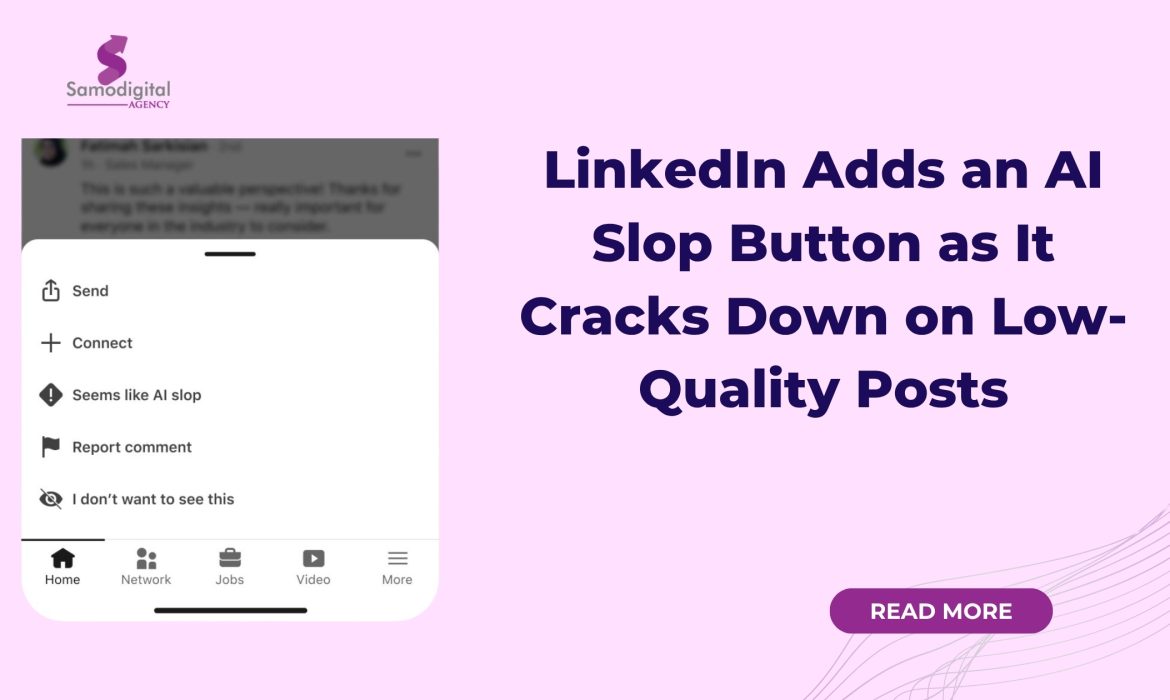
LinkedIn Adds an AI Slop Button as It Cracks Down on Low-Quality Posts
LinkedIn is rolling out a “Seems like AI slop” reporting option that allows members to flag posts and comments they believe feel automated, generic or inauthentic. The LinkedIn AI slop button is part of a wider effort to reduce low-quality content and protect the professional network’s focus on real expertise and human perspectives.
The option appears in the three-dot menu on a post. After a member selects it, LinkedIn hides the post from that person’s feed and uses the feedback as a signal to improve the systems that determine what content should be recommended.
What is AI slop?
“AI slop” generally refers to low-quality content produced or heavily shaped by artificial intelligence. It may be grammatically correct and professionally formatted but still feel empty, repetitive or disconnected from the person publishing it.
The problem is not simply that AI was used.
LinkedIn’s Chief Product Officer, Hari Srinivasan, said the company recognizes that many people use AI to refine their thoughts. The concern is content that lacks an authentic perspective, offers little value or is produced at scale to attract attention and engagement.
This distinction matters. A person can use AI to proofread a post while keeping their experience, argument and voice. However, a polished post can still be considered slop when it repeats familiar phrases without communicating anything useful.
How the LinkedIn AI slop Button will Work
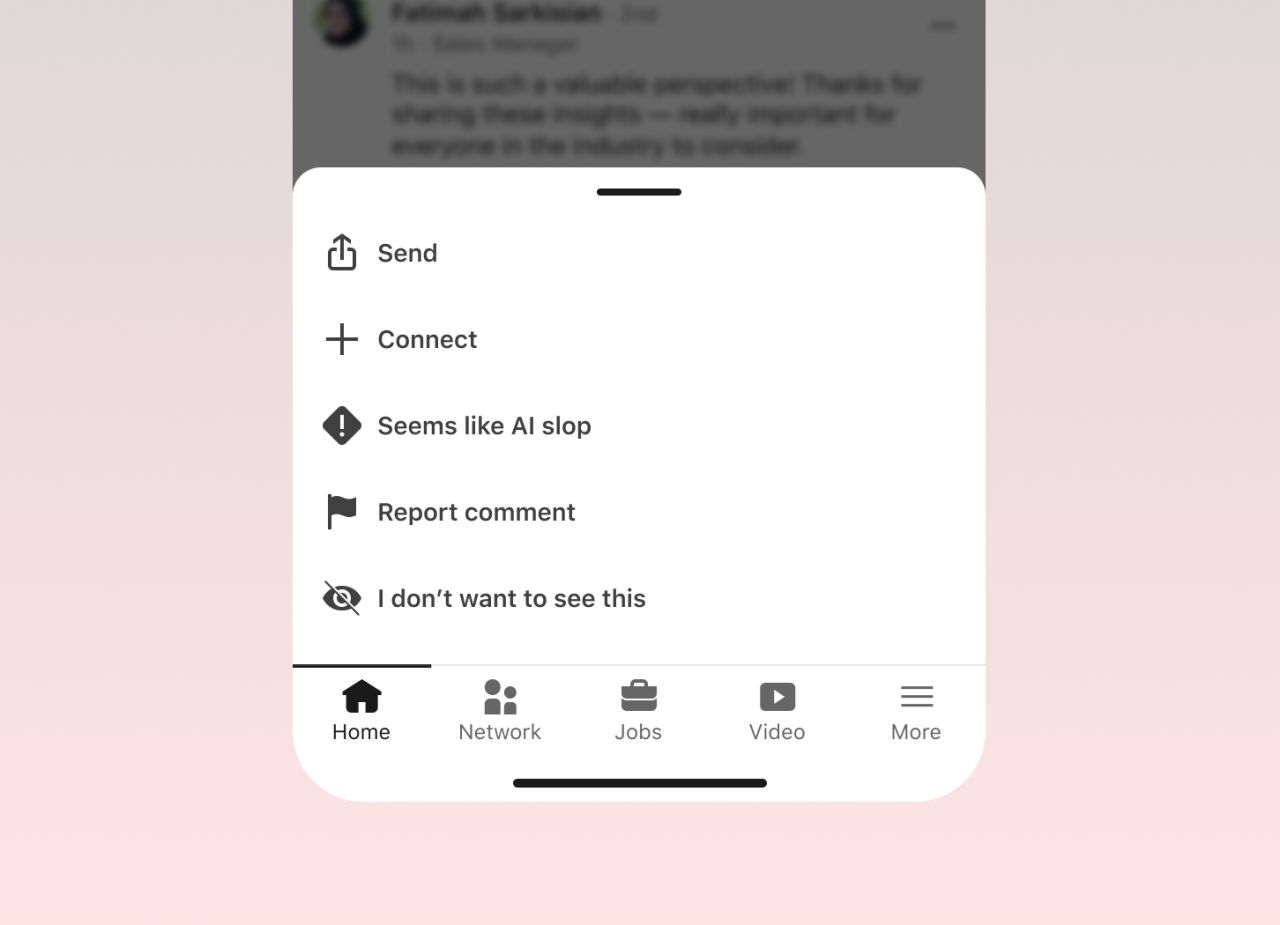
Linkedin seems like AI slop-button
LinkedIn says reports from members will help it tune its models and improve the feed.
The company is also introducing new classifiers designed to identify AI slop and other low-quality posts. This is expected to reduce such content in recommendations, particularly posts published by people outside a member’s network.
The button should therefore be viewed as a feedback tool, not necessarily an automatic penalty.
LinkedIn has not said that one report will cause a post to be removed or immediately reduce its reach. Instead, the reports will provide additional signals that help the platform understand what members consider inauthentic.
LinkedIn is also testing private feedback for creators. A person may see a notice in their analytics dashboard when members feel their post sounds inauthentic or relies too heavily on AI. The feedback will not publicly label the post or identify the members who reported it.
LinkedIn is Changing its own AI writing Tools
LinkedIn is also removing its “enhance your post” feature, which could rewrite a member’s content using AI. It will replace the feature with a proofreading tool that corrects the writing without changing the person’s voice.
This is an important change in direction. LinkedIn is not rejecting AI as a writing assistant. Instead, it is drawing a clearer line between using AI for support and allowing AI to replace personal thinking.
The company is also strengthening its automation defences. LinkedIn says it now catches hundreds of thousands of automated comment attempts every day and has blocked billions of other automation attempts, including large-scale posting, over the past few months.
LinkedIn is also expanding profile and Page verification. Members will be able to block comments from company Pages they no longer want to see.
What Does this Mean for LinkedIn users?
For people who read content on LinkedIn, the update provides a direct way to tell the platform when a post feels mass-produced or offers little value. Over time, this feedback could help LinkedIn reduce generic posts and automated comments in the feed.
For people who publish content, the message is clear: using AI is not automatically the problem, but losing your voice is.
Posts should still contain a real observation, experience, argument or lesson from the person publishing them. AI can help organize ideas, check grammar and improve clarity, but it should not invent expertise or turn every experience into the same predictable thought-leadership post.
There are also possible risks. Members may incorrectly label polished writing as AI-generated. Competitors and critics could also misuse the reporting option against content or viewpoints they dislike.
LinkedIn will therefore need to treat member reports as one signal among several rather than proof that a post is AI slop.
Final Take
The LinkedIn AI slop button is a response to a trust problem, not only a technology problem. When feeds become crowded with automated comments and interchangeable posts, users find it harder to determine whose expertise, experience and opinions are genuine.
The update does not mean people should stop using AI. It means AI should support the writer rather than become the writer.
The strongest LinkedIn content will still come from people who have something specific to say and are willing to sound like themselves.
WhatsApp Usernames: What Meta’s Move Means for Privacy, Brands and Digital Marketing
WhatsApp Usernames: What Meta’s Move Means for Privacy, Brands and Digital Marketing
WhatsApp is preparing for one of its biggest identity changes in years.
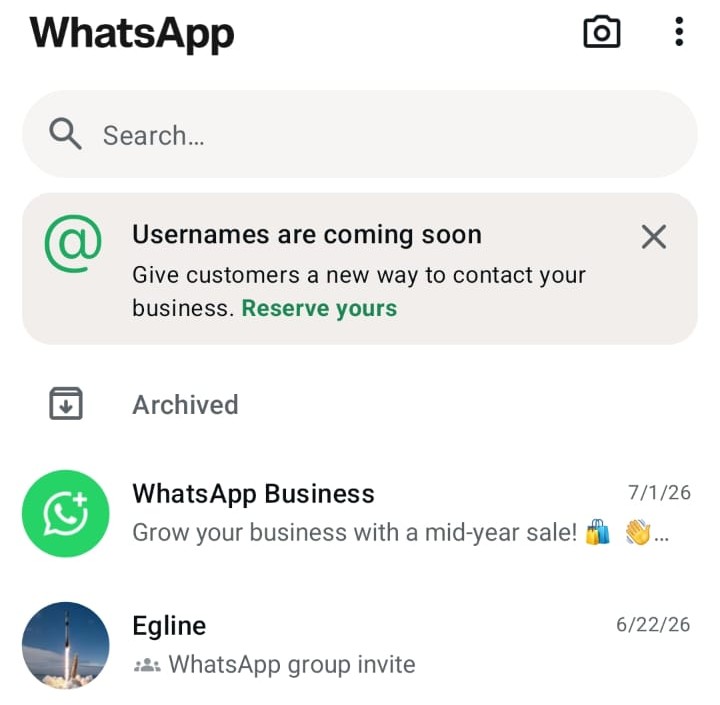
The platform is introducing usernames, giving users a way to connect without immediately sharing their phone numbers. For a platform that has always been built around mobile numbers, this is not a small product update. It changes how people are found, how businesses receive enquiries, how customers build trust, and how brands protect their identity online.
On June 29, 2026, WhatsApp announced that users can start reserving optional usernames ahead of the full rollout later in the year. The company said usernames are meant to make WhatsApp more private by allowing people to chat without handing over their phone numbers in some new conversations. WhatsApp also said there will be no public username directory and no suggestions, meaning someone will need to know your exact username before contacting you for the first time.
At Samodigital Agency, we see this as more than a WhatsApp feature. It is part of a wider shift in how brands will build direct relationships with customers in a more private, mobile-first and conversation-led digital environment.
What Are WhatsApp Usernames?
WhatsApp usernames will allow users to reserve a unique handle that can be shared instead of a phone number.
This means that instead of giving someone your mobile number immediately, you may be able to share a username such as @yourname or @brandname, depending on availability and WhatsApp’s rules.
The feature is optional. WhatsApp is not removing phone numbers completely. Users will still need a phone number to register an account, and people who already have your phone number may still see it. The privacy benefit mainly applies to new conversations with people or businesses that do not already have your number.
WhatsApp is also introducing an optional username key. This adds another layer of control because a person may need both your username and your key before they can message you. This is meant to reduce unwanted messages, spam and abuse if your username becomes public.
Why Meta Is Introducing WhatsApp Usernames
1. Privacy and Identity Protection
The biggest reason is privacy.
A phone number is not just a contact detail. It is tied to mobile money, banking, family, work, business accounts, two-factor authentication, social media, and many other parts of everyday life. Once someone has your number, they can contact you outside the original reason you connected.
This has always been one of WhatsApp’s weak points. The app offers end-to-end encrypted conversations, but it has not always protected the user’s identity at the point of contact. If you join a group, attend an event, network with new people, or contact a business, sharing your number can feel too personal.
WhatsApp usernames are meant to reduce that exposure. They give users a lighter way to connect without immediately handing over a sensitive personal identifier.
2. More Control for Users
People increasingly want to control how they are found online.
On Instagram, TikTok, X, LinkedIn and Telegram, users are already familiar with social media handles. WhatsApp has remained different because it is built around phone numbers. That has made it feel personal, but also less flexible.
Usernames give WhatsApp a modern identity layer without turning it into a fully public social network. This distinction matters. WhatsApp says there will be no public directory, no username browsing and no suggestions. Someone will need to know your exact username before contacting you for the first time.
That means WhatsApp is not trying to become Instagram. It is adding a private contact option, not a public discovery system.
3. Competition With Other Messaging Platforms
WhatsApp is also responding to what users already experience on other messaging platforms.
Telegram and other messaging apps have offered username-based contact options for years. Users now expect to have some way of connecting without exposing their phone number immediately.
WhatsApp is arriving late to this feature, but its scale makes the update significant. WhatsApp says it has over three billion users, which is one reason username reservation is being opened early to reduce overlap and give people time to claim names that matter to them.
4. Business and Customer Communication
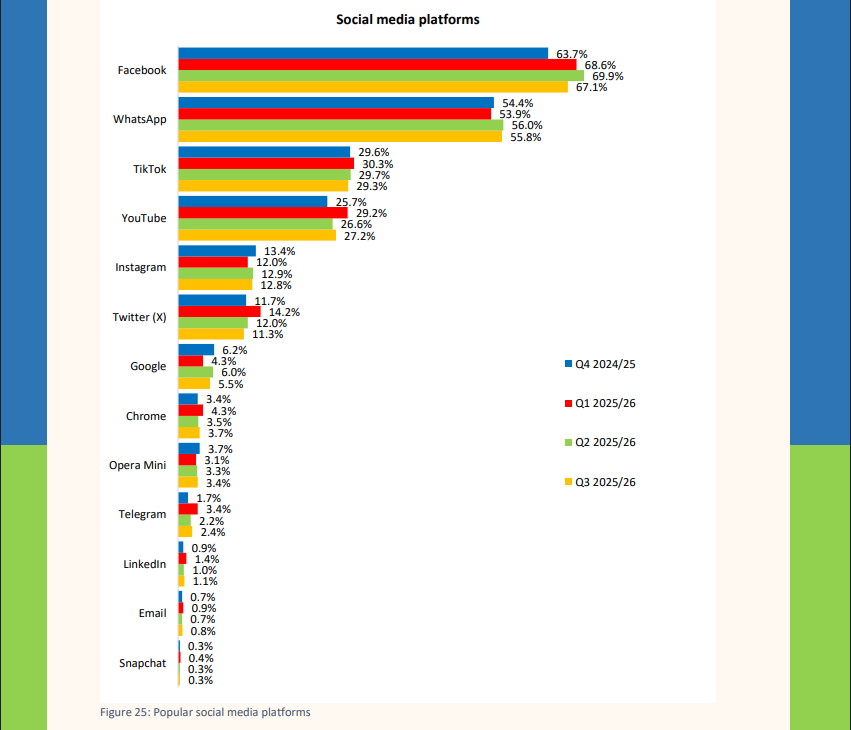
WhatsApp is no longer just where people chat with family and friends. It is where customers ask about products, schools send updates, churches coordinate members, chamas communicate, small businesses receive orders, creators build communities, and brands handle customer care. This is not surprising, given that WhatsApp ranks as Kenya’s second most-used social media platform, according to the Communications Authority of Kenya’s April 2026 Audience Measurement and Industry Trends Report. For businesses, usernames could make customer communication smoother. A customer may be more comfortable messaging a business username than saving a phone number or exposing their own number at the first interaction.
For creators, businesses and organizations, WhatsApp is also allowing eligible users to claim existing Instagram or Facebook usernames where available. This supports cross-platform consistency across Meta’s ecosystem.
What Users Gain From WhatsApp Usernames
1. Better Privacy in New Conversations
The biggest user benefit is privacy.
A username gives people another way to connect without exposing their phone number at the first point of contact. This matters in online communities, WhatsApp groups, professional networking, events, customer enquiries, training sessions and marketplace interactions.
For example, a trainer can share a WhatsApp username after a workshop instead of sharing a personal number. A freelancer can receive enquiries without exposing their direct line. A student can connect with classmates without giving out a number to everyone in a group.
This does not remove phone numbers from WhatsApp completely, but it reduces unnecessary exposure.
2. Safer Public Sharing
Many people already share WhatsApp numbers on posters, social media bios, websites, event pages, campaign material and business profiles.
That creates risk. A phone number can be copied, saved, added to spam lists, or used outside the original purpose.
A username is safer to share publicly because it is less tied to a person’s full real-world identity. This is especially useful for creators, small business owners, consultants, trainers, journalists, public-facing professionals and anyone who receives enquiries from people they do not know personally.
3. More Control Over Who Can Reach You
The optional username key is one of the most important parts of the update.
Without it, someone who knows your exact username may be able to message you. With a username key, your username alone may not be enough. The person may also need the key before they can reach you.
This gives users more control, especially when a username is shared publicly or circulates beyond the intended audience.
4. Reduced Phone Number Harvesting
WhatsApp usernames will not end spam, but they can reduce one common problem: phone number harvesting.
Today, once your number is visible in a group, poster, directory or public page, it can be copied and reused. With usernames, users can create a contact layer that does not immediately expose the number behind the account.
Scammers will adapt, but WhatsApp is removing one of the easiest ways bad actors collect personal contact details.
What Businesses and Creators Gain
1. Stronger Brand Identity
For businesses, usernames make WhatsApp more brandable.
A handle is easier to remember than a long phone number. It can be placed on websites, social media bios, ads, posters, packaging, email signatures, influencer campaigns, newsletters and customer support material.
Instead of saying “save this number,” a business can say “message us on WhatsApp at @brandname.”
That sounds simple, but it matters. Easy contact points reduce friction. In digital marketing, reduced friction can increase enquiries, conversions and customer engagement.
2. Easier Customer Entry Points
Many customers are comfortable using WhatsApp, but not everyone wants to expose their phone number to every business they interact with.
Usernames may reduce that hesitation. A customer can start a conversation with a business without feeling like they have given away too much personal information too early.
This could make WhatsApp even stronger for lead generation, bookings, product enquiries, customer service, after-sales support and social commerce.
3. Cross-Platform Consistency
A consistent handle across Instagram, Facebook, WhatsApp, LinkedIn, TikTok, X and a website domain helps customers identify the right brand. This is important because impersonation is already a major online problem. If a brand uses one name on Instagram, another on Facebook, another on WhatsApp and another on X, customers can easily get confused.
WhatsApp usernames could become part of official brand identity. For some organizations, the WhatsApp handle may soon become as important as the website domain, Instagram username or verified page.
4. Better Professional Boundaries
For founders, consultants, creators, trainers, sales teams and customer service staff, usernames can help separate personal numbers from professional communication. Many people currently use their personal phone numbers for work because WhatsApp is convenient. Over time, usernames could give professionals a cleaner way to manage public contact without exposing private numbers everywhere.
This is useful for SMEs, consultants, agencies, schools, churches, public offices, community groups and service-based businesses that already depend on WhatsApp for communication.
5. New Customer Identity Systems
There is also a technical side that businesses must not ignore.
For businesses using WhatsApp integrations, usernames affect how customers are identified in backend systems. Twilio says WhatsApp usernames introduce a Business Scoped User ID, or BSUID. When a user adopts a username, their phone number may no longer appear in some webhook payloads. Instead, the business may receive the BSUID in fields such as ExternalUserId.
This matters for businesses using CRMs, WhatsApp Business API integrations, chatbots, automation tools, helpdesks and reporting dashboards.
The simple version is this: businesses should not assume every WhatsApp customer identifier will always be a phone number. Systems may need to handle phone numbers, usernames and business-scoped IDs.
The Downsides and Risks of WhatsApp Usernames
1. User Confusion
WhatsApp’s biggest strength has always been simplicity.
You have someone’s number, you message them. That is easy to understand.
Usernames introduce another layer. Some users may not immediately understand the difference between a phone number, display name, profile name, username and username key.
This may create confusion, especially during a gradual rollout where some users have the feature and others do not.
2. Phone Numbers Are Still Required
Usernames are not a complete replacement for phone numbers.
WhatsApp users will still need a phone number to register. The feature improves privacy in some new conversations, but it does not remove the phone number from WhatsApp’s core account structure. Reuters also reported that WhatsApp said the feature was not yet live and would roll out slowly later in 2026, with phone numbers still required for registration.
This distinction matters. A username protects how you are contacted in some situations. It does not make WhatsApp completely phone-number-free.
3. Impersonation Risk
Any platform that introduces unique handles also creates competition for names. Public figures, businesses, government agencies, media houses, schools, banks, creators and organizations will need to secure official usernames early. If they do not, someone else may claim a confusingly similar name. WhatsApp has said some high-profile names, including those linked to celebrities and politicians, have already been reserved to prevent others from claiming them.
That is useful, but it does not remove the risk completely. Impersonators can still use misspellings, extra dots, underscores, abbreviations or lookalike names.
4. Username Squatting
Username reservation creates a digital land-grab moment. We are already seeing conversations online where some Kenyan users have posted about securing names linked to prominent people, while others have joked about taking up handles associated with brands. At first, it may look like harmless online banter. But it points to a real brand and reputation risk.
Usernames are digital real estate. Once people understand that a WhatsApp handle can represent a person, company, media house, public office, school, bank or creator, the race for recognizable names becomes serious.
5. Brand and Reputation Risk
For brands, the risk is not only losing a preferred username. The bigger concern is customer confusion and impersonation. A fake or confusing WhatsApp username could be used to pose as a bank, delivery company, school, government office, media brand, ecommerce store or customer care desk.That could lead to scams, fake payment instructions, personal data collection, phishing or reputational damage.
This is particularly important in markets where WhatsApp is deeply embedded in daily communication. If someone imitates a trusted name, the damage can move quickly through private chats, screenshots and groups.
6. Regulatory Concerns
The rollout has already attracted regulatory attention. Reuters reported that India asked WhatsApp to halt the username rollout in the country until consultations are complete. According to Reuters, Indian authorities raised concerns that the feature could increase online fraud, phishing and impersonation because bad actors could contact victims without revealing phone numbers. India is WhatsApp’s biggest market, with more than 500 million users. That concern is not limited to India. Any country dealing with mobile scams, phishing, fake customer support accounts and online fraud will be watching this feature closely.
The tension is clear. Users want privacy. Regulators want traceability and accountability. WhatsApp will have to prove that the feature can protect both.
7. Scammers Will Adapt
Scammers follow user behaviour. If usernames become common, fraud tactics will shift. We may see fake bank support handles, fake government service handles, fake school accounts, fake delivery support handles, fake customer care accounts and fake creator accounts. This is why businesses will need to educate customers clearly.
Just as brands tell customers not to send money to unofficial numbers, they will need to tell customers which WhatsApp username is official.
How WhatsApp Usernames Will Shape Digital Marketing
1. Messaging Will Become More Central to Customer Journeys
Social media feeds are crowded. Posts move fast. Ads are becoming more expensive. Algorithms keep changing. Messaging is different because it creates direct customer relationships. WhatsApp already plays this role for many businesses. Usernames could make the platform even more useful because customers may feel safer starting conversations without exposing their phone numbers immediately.
For marketers, this means WhatsApp should not be treated as an afterthought. It should be part of the customer journey, from awareness to enquiry, conversion, support and retention.
2. Handles Will Become Trust Signals
A WhatsApp username may soon become part of a brand’s trust infrastructure.
Customers will ask: Is this the real handle? Is this the official account? Is this the same name used on Instagram, Facebook, LinkedIn or the company website?
That means brand monitoring will need to go beyond social media pages. Businesses will also need to watch for username squatting, impersonation attempts, fake support accounts and confusing variations.
3. Brand Protection Will Become More Urgent
Many organizations are reactive when it comes to digital identity. They wait until there is a fake account, scam page or public complaint before acting. WhatsApp usernames should change that mindset. Brands should reserve official handles early, communicate them clearly and monitor lookalike names. This is especially important for banks, schools, media houses, public institutions, ecommerce brands, hospitals, churches, political actors and service businesses.
4. Customer Data Systems Will Need to Evolve
For businesses using WhatsApp at scale, customer identity will become more complex. It will no longer be enough to think only in terms of phone numbers. Businesses may need to track usernames, phone numbers, BSUIDs, CRM records, consent, customer history and support interactions.
This is especially important for brands using WhatsApp Business API, chatbots, CRMs, automated responses, lead management systems and customer support dashboards.
5. Content and Conversion Strategies Will Change
When brands promote WhatsApp usernames, calls to action will become simpler. Instead of asking users to save a number, click a long link or fill a form, brands can direct them to a memorable WhatsApp handle. This could improve conversion in campaigns, especially for service businesses, ecommerce, events, education, training, real estate, health services and customer support.
For example:
“Message @brandname on WhatsApp to book a consultation.”
“Need help choosing the right package? Chat with us on WhatsApp at @brandname.”
“Join the class updates through our official WhatsApp username @brandname.”
This creates a cleaner bridge between social media content and private customer conversations.
What Businesses Should Do Now
1. Reserve Your Official Username Early
Businesses, creators, public institutions, media houses, schools, banks, agencies and high-profile individuals should reserve their preferred WhatsApp usernames as soon as the feature becomes available.Where possible, the username should match existing handles on Instagram, Facebook, LinkedIn, TikTok, X and the brand’s website domain.
This is not a small admin task. It is brand protection.
2. Audit Your WhatsApp Presence
Organizations should check how they currently use WhatsApp. For instance, do you use one number or multiple numbers? Do you use the WhatsApp Business App or WhatsApp Business Platform? Do you have CRM integrations, bots, customer support tools or automation workflows? Or do customers know which number is official? This audit will help businesses prepare for usernames and avoid confusion later.
3. Update Customer Communication
Once your username is active, communicate it clearly. Add it to your website, social media bios, customer service scripts, email signatures, posters, packaging, ads, booking pages, newsletters and support materials. Do not assume customers will automatically know your official handle.
4. Train Customer-Facing Teams
Sales, marketing, community and customer support teams should understand how WhatsApp usernames work. They should know what customers will see, how to explain the feature, how to handle confusion, and how to report fake accounts or suspicious activity. This is especially important for businesses that deal with payments, personal data, bookings, deliveries or sensitive customer information.
5. Monitor Impersonation
Brands should monitor for fake or confusing variations of their names. This is important for banks, schools, media houses, public institutions, creators, agencies, e-commerce brands, hospitals, churches, political actors and service businesses.
A fake handle can damage trust quickly, especially on a platform where conversations are private and screenshots can move fast.
6. Prepare Your Systems
Businesses using WhatsApp APIs, CRM systems, chatbots or helpdesk tools should check whether their systems are ready for BSUIDs and username-based interactions.
If your system assumes every WhatsApp customer must be identified by a phone number, this is the time to review that setup.
What This Means for Brands in Kenya
For Kenyan businesses, this update matters because WhatsApp is already deeply woven into how customers communicate. People use WhatsApp for customer care, product enquiries, school updates, chama coordination, church groups, delivery communication, event planning, community mobilization and business transactions.
That makes WhatsApp usernames more than a privacy update. They are likely to influence how Kenyan brands manage visibility, trust, customer conversations and reputation. A business that secures a clear WhatsApp username early will have an advantage. It will be easier to promote, easier to remember and easier to verify.
A business that waits may face confusion, missed usernames or impersonation risks.
Final Thoughts
WhatsApp usernames are not just another app update.
They represent a shift in how people and businesses connect on one of the world’s most important communication platforms. The phone number will still matter, but it will no longer be the only way to start a conversation.
For users, this means more privacy and control, while for businesses, it means stronger branding, smoother customer entry points and a need to protect official handles.
On the other hand, for marketers, it means WhatsApp should be treated as part of the customer journey, not just a chat app. For scammers, it creates new tactics, which means brands and users must stay alert.
Meta is trying to solve a real user problem without turning WhatsApp into a public social network. Whether it succeeds will depend on how well the rollout handles safety, impersonation, user education and business readiness.
For now, one thing is clear: WhatsApp identity is changing.
Any brand, creator, public institution or marketer that uses WhatsApp should start preparing early. At Samodigital Agency, our advice is simple: secure your brand identity, update your customer communication, monitor for impersonation, and make WhatsApp part of a wider digital marketing and customer experience strategy. The next phase of digital marketing will not only happen on public feeds. It will also happen in private conversations, trusted handles and direct customer relationships.
How to Run Effective Facebook and Instagram Ad Campaigns: A Step-by-Step Guide
How to Run campaigns on Facebook and Instagram?
I am sure you have come across sponsored posts on Instagram or Facebook, and you are wondering how you can run ads for your business, organization or personal brand.
Well, Meta’s advertising platform, which includes both Facebook and Instagram, provides businesses with an unparalleled opportunity to reach and engage their target audience. However, running successful campaigns requires a strategic approach, precise targeting, and continuous optimization.
This guide walks you through the essential steps on how to run campaigns on Facebook and Instagram.
1. Set Up Meta Business Manager
Before launching your ads, the first step is to set up Meta Business Manager, a centralized platform that allows businesses to manage ad accounts, pages, and permissions. Start by creating a Meta Business Manager account. This tool helps you manage your Facebook Pages, Instagram account, ad accounts, and team roles—all from one place.
Here’s what to do:
- Link your Facebook and Instagram pages.
- Add or create your ad account.
- Assign access to team members.
- Add your preferred payment method under Billing.
A proper setup avoids interruptions and keeps your campaigns organized.
2. Choose the Right Campaign Objective
Meta offers a range of advertising objectives designed to align with specific business goals. Selecting the right objective is crucial, as it dictates how the platform optimizes ad delivery.
Businesses looking to increase brand awareness should opt for the reach or brand Awareness objectives, while those seeking engagement and website traffic should choose Traffic or Engagement objectives. You can read more on How to choose the right ad objective in Meta Ads Manager
For direct sales and lead generation, Conversion-based objectives work best. Meta Ads Manager offers a variety of objectives based on your marketing goal. Your selected objective tells Meta how to optimize your campaign.
Choose from:
- Awareness: Reach, Brand Awareness
- Consideration: Traffic, Engagement, Video Views, Messages
- Conversions: Leads, Sales, Website Purchases
Example: Want more sign-ups? Choose “Leads.” Promoting a blog post? Go with “Traffic.”
3. Implementing Meta Pixel for Tracking
One of the most powerful tools available to advertisers is the Meta Pixel, a piece of code that tracks user interactions on your website. To install the Pixel, navigate to the Events Manager.
If you have a website, the Meta Pixel is essential. It’s a tracking tool that helps you measure performance and retarget users who visit your site.
To install the Pixel:
- Go to Events Manager.
- Click “Connect Data Sources” → Web → Meta Pixel.
- Name your Pixel and copy the code.
- Paste it into your site’s <head> section—or use integrations like Shopify or WordPress.
This enables better ad optimization and conversion tracking.
Platforms like Shopify and WooCommerce offer built-in integrations for easy setup. The Pixel enables businesses to track conversions, retarget visitors, and gather valuable insights into audience behavior. Ensuring proper Pixel setup allows for more accurate performance measurement and improved ad optimization.
4. Target the Right Audience
Reaching the right people is key to maximizing return on investment. Meta’s advertising platform offers robust targeting options, including Custom Audiences, Lookalike Audiences, and Detailed Targeting. Custom Audiences allow businesses to retarget website visitors, upload customer email lists, and engage with users who have interacted with their content.
Lookalike Audiences enable businesses to reach new potential customers who share characteristics with existing customers. Detailed Targeting refines audience selection based on demographics, interests, and behaviors, helping businesses connect with those most likely to convert.
5. Select Ad Placements for Maximum Impact
Meta provides multiple placement options, including Facebook Feed, Instagram Stories, and the Audience Network. Beginners may benefit from Automatic Placements, which let Meta optimize ad delivery across different platforms.
However, Manual Placements allow advertisers to tailor their strategy by selecting specific placements that align with their goals.
Instagram Stories work best with engaging vertical videos, while carousel ads in the Facebook Feed are effective for showcasing multiple products. Choosing the right placement ensures better engagement and improved performance.
6. Craft Engaging Ad Creatives and Copy
Compelling visuals and persuasive copy are at the heart of successful ad campaigns. High-quality images and videos that are optimized for mobile viewing perform best. When using video ads, it’s essential to capture attention within the first few seconds and include captions for viewers who watch without sound.
Copy should focus on the benefits of the product or service, use clear and concise language, and include a strong call-to-action (CTA) such as “Shop Now” or “Sign Up.” Running A/B tests on different creatives and headlines helps determine what resonates most with the audience.
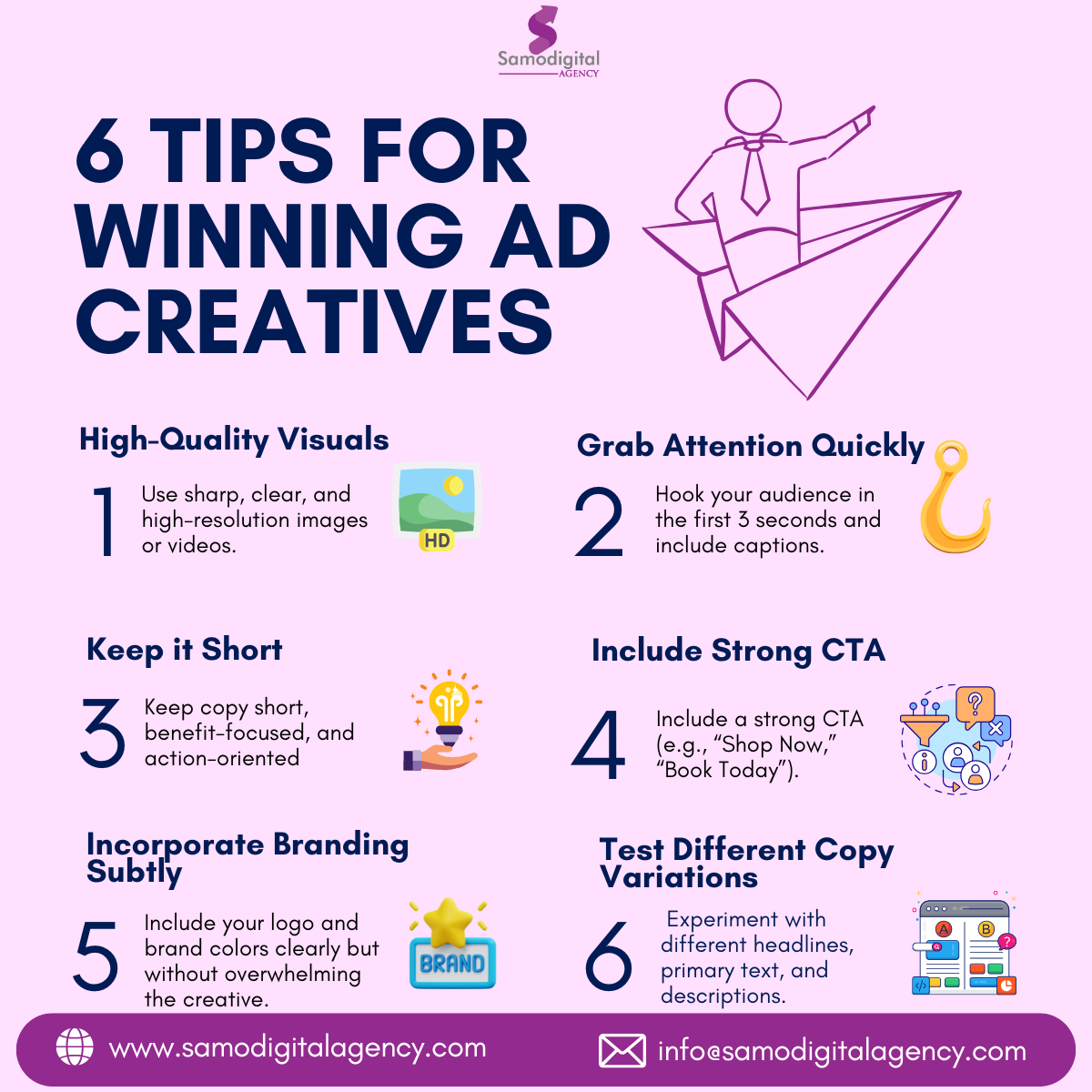
6 Tips for winning ad creatives:
- High-Quality Visuals: Use sharp, clear, and high-resolution images or videos.
- Grab Attention Quickly: Hook your audience in the first 3 seconds and include captions.
- Keep it Short: Keep copy short, benefit-focused, and action-oriented.
- Include Strong CTA: Include a strong CTA (e.g., “Shop Now,” “Book Today”).
- Incorporate Branding Subtly: Include your logo and brand colors clearly but without overwhelming the creative.
- Test Different Copy Variations: Experiment with different headlines, primary text, and descriptions.
7. Set Up a Budget and Bidding Strategy
How do you want to spend on your ads? Budgeting plays a crucial role in campaign success. You can choose between a daily budget, which sets a consistent daily spend, or a lifetime budget, which allocates a total spend over a fixed campaign duration.
Meta’s bidding strategies include Lowest Cost, Cost Cap, and Bid Cap, each serving different objectives. If you are new to paid advertising, starting with a small budget allows for testing and optimization before scaling up. Analyzing performance metrics helps determine where to allocate more budget for the best results.
8. Monitor, Analyze, and Optimize Performance
Once your ad is live, go back regularly to track its performance in Meta Ads Manager.
Key metrics to monitor:
- CTR (Click-Through Rate)
- CPC (Cost Per Click)
- Conversions and Leads
- ROAS (Return on Ad Spend)
Always pause underperforming ads, reallocate budget to strong performers, and keep testing new creatives. Meta’s breakdown reports let you dig into which placements, age groups, or devices are working best.
Final Thoughts
Running effective Facebook and Instagram ad campaigns requires a blend of strategic planning, audience targeting, compelling creatives, and continuous optimization. Staying updated with Meta’s evolving ad policies and experimenting with different strategies ensures long-term success. By following these steps, businesses can harness the full potential of social media advertising to drive growth and achieve their marketing objectives.
You can email us via info@samodigialagency.com to book a free strategy call today and we can help you run and set up Meta Ads

How to Get More Plastic Surgery Clients Without Compromising Ethics
You might be a skilled plastic surgeon or clinic but that might not be enough to attract clients! Let’s face it; this is one of those niches that is quite competitive. In other words, you need to stand out if you are to convert more clients. The good news is that you don’t need to compromise your ethics to grow your practice. You can still attract new clients whilst respecting the personal, vulnerable nature of cosmetic procedures. Here’s a guide on how to get more plastic surgery clients without crossing ethical lines.
Lead with Customer Education, Avoid Enticement!
The best place to start when it comes to getting more clients is to build your authority in the market. This is what using tailored ethical marketing in plastic surgery comes in. You are better off starting by offering value-first content.
Remember this is a space where there are tons of aggressive marketing tactics used by competitor medical clinics looking to also get more plastic surgery clients. This means that most prospective patients tend to be often overwhelmed or misinformed.
You can thus stand a cut above the rest if you can position yourself as the educator, not the salesperson.
For example, you can tap into FAQ-style posts and video explainers like say honest procedure breakdowns. Make sure you avoid flashy language in your communication approach.
Tip: If you’re already working with a plastic surgery marketing agency, make sure they focus on educational content strategy instead of the hard-sell tactics approach.
Use Transparent Messaging To Craft Trust
There is literally no ethics in your plastic surgery practice marketing without transparency! Yes, your prospective patients will love honest information.
Sure you want to get more plastic surgery clients but don’t give them any sugar-coated guarantees or unrealistic promises. In this regard, you should be upfront with everything. We are talking about things like costs, risks, recovery times, and outcomes in your marketing copy and content. Well, you have got the duty of care thus you should be medically accurate. This is why you ought to make sure you explain what the client should truly expect
Tip: You can partner with a good great marketing agency to help you refine messaging. This way you’ll be compliant, honest, and still persuasive as a medical service provider
Avoid Fear-Based or Shame-Oriented Advertising
Now, unethical marketing will tend to gear more towards insecurities. On the other hand, long-term patient relationships are more of growing respect and empathy. You should therefore avoid using language or imagery that suggests patients are “flawed” or “not enough” without your cosmetic surgery services.
You are better off focusing more on empowerment messaging: For example, something like a message that tells the client a procedure will enhance their natural features is a better approach. It also helps if you feature diverse models and real patients in your photos rather than just filtering to showcase warped “perfection”
Tip: Ethical marketing in healthcare isn’t about closing fast. It’s more of building patient confidence over time.
Practice Informed Marketing, Just Like Informed Consent
Ethical marketing in healthcare draws parallels with informed consent. Again, patients should feel educated and autonomous. That mindset should show up in all of your content written or videos-including social posts and consultation emails.
Case example; you could create some downloadable guides like: “How to Choose the Right Cosmetic Procedure for You” or something like “10 Questions to Ask Your Plastic Surgeon First.”
You could also share behind-the-scenes videos, surgeon Q&As, and staff spotlights.
After all, people out there love to connect with people, not corporate jargon. So, go for a more conversational language that aligns with your in-person demeanor.
A good plastic surgery marketing agency will help you create these kinds of assets that build long-term trust, not quick conversions.
Share Social Proofs, But Do This Responsibly!
You should also use before-and-after images and testimonials to convey your expertise albeit they must be handled ethically and legally. As a rule of thumb, always get written patient consent (not just verbal). You should also contextualize them like say you share patient stories including goals, concerns, and outcomes.
It’s also wise to use disclaimers like “Individual results may vary”. Again, avoid overpromising to your prospective clients.
It is wise to work with a plastic surgery marketing agency that specializes in crafting HIPAA-compliant content workflows. A good marketing partner should understand how to present patient success stories responsibly.
Wrapping up
In a nutshell, you can get more plastic surgery clients whilst operating within ethical frameworks of medicine. The key is to convey empathy, transparency, and expertise. This way you won’t just avoid ethical missteps but you’ll also stand out.
If you need expert support, partnering with a specialized global plastic surgery marketing agency like Samodigital Agency.
We are a specialized global plastic surgery marketing agency proudly serving clients across the US, UK, and Africa. Our mission is simple: to help your practice attract more patients, build a trusted online presence, and dominate your local market.
Our comprehensive services include:
- Advanced SEO for plastic surgery clinics, including fully managed link building to boost your Google rankings
- Strategic Social Media Management to engage your audience and drive leads
- Custom content creation, paid social and google ad campaigns, website optimization, and more
It doesn’t matter if you’re looking to expand locally or scale globally. We have the experience and expertise to get you there!
So, are you ready to elevate your cosmetic surgery practice?
Just contact us today via info@samodigitalagency.com to schedule a free consultation and discover how we can take your plastic surgery brand to the next level.
How TikTok Is Shaping the Future of Music Discovery and Streaming
TikTok has changed the way we discover, engage with, and consume music. What used to take weeks of radio play or curated playlists now happens in seconds on a 15-second video. But beyond the viral dance challenges and catchy hooks, TikTok is evolving, with its “Add to Music App” feature that creates a direct pipeline from viral clip to full-stream playback.
This blog breaks down:
- How TikTok influences music discovery and streaming
- Whether it’s a good platform to promote music
- Its overall impact on the music industry
What is the Add to Music App Feature on TikTok?
In December 2023, TikTok introduced a game-changing feature called the Add to Music feature. The goal? To leap at hearing a 15-second clip on your For You Page to stream the full track on your favorite music app as effortlessly as a tap.
This new feature is available in the U.S. and U.K. (with more countries expected soon), and it’s already transforming how users save and engage with music, while offering artists a powerful new way to convert TikTok virality into real-world streams.
TikTok Add to Music App: Source TikTok News
How Does TikTok Influence Music Discovery and Streaming?
TikTok has become a cultural accelerator for music. Its algorithm-driven content serves up sound-backed videos that often lead users to fall in love with a song before they even know the title or artist. Research shows that TikTok users are significantly more likely to both discover and share new music content in the app, while 75% of its users also find new artists via TikTok clips.
Here’s how TikTok drives music discovery and streaming:
- Algorithmic exposure: TikTok surfaces content based on what you engage with, and music plays a big part in that. Trending sounds quickly gain traction and visibility.
- Viral loops: Users create thousands of videos using a trending sound, compounding its reach.
- In-app audio identification: You can tap the song name in a TikTok video and see other content using it, leading to deeper listening.
- Now: “Add to Music App”
This feature allows users to add a song to Spotify, Apple Music, or Amazon Music directly from TikTok. It eliminates the need to manually search for a song you liked in a video—just tap and it’s in your library.
In short, TikTok isn’t just a music discovery tool anymore—it’s a music streaming funnel.
Is TikTok a Good Place to Promote Music?
Yes, arguably one of the best right now.
Whether you’re an independent artist or a major label, TikTok offers:
- Unmatched reach: A single piece of content can go viral and reach millions without paid promotion.
- Authentic fan engagement: Fans don’t just listen; they create. TikTok encourages interaction through duets, challenges, remixes, and trends.
- Short-form storytelling: Artists can tell the story behind their music, share behind-the-scenes moments, or even test unreleased tracks.
And with the new Add to Music App integration, TikTok now gives musicians a direct path to monetization. If your song gains traction, users can easily save and stream it, turning likes and shares into actual plays.
What Is the Impact of TikTok on the Music Industry?
TikTok has had a seismic impact on how music is made, promoted, and consumed for :
Artists:
- Launchpad for careers: Many artists, like Lil Nas X, Ice Spice, and PinkPantheress, gained mainstream success after going viral on TikTok.
- Data insights: Artists and labels can use real-time engagement data to decide which songs to release, promote, or even remix.
- More control for independents: You don’t need a record deal to blow up. Creativity and consistency can take you far on TikTok.
The Industry:
- Influencing charts: A viral TikTok song often climbs Billboard and Spotify charts days or weeks later.
- Shaping sound: Artists now create songs with TikTok in mind—short intros, catchy hooks, and strong beats are designed to “hit” within 5–10 seconds.
- New marketing models: Traditional music marketing has shifted toward influencer partnerships, TikTok challenges, and trend-hopping.
Listeners:
- Interactive discovery: Fans feel like they “find” a song before it hits mainstream radio.
- Faster access to music: Features like “Add to Music App” make saving and streaming immediate.
Final Thoughts
TikTok has evolved from a fun video-sharing app to a powerful music ecosystem. It blends discovery, social interaction, and streaming into one seamless experience.
Whether you’re a music lover, an artist, or a marketer, understanding how TikTok influences music—and now powers it—could be the key to unlocking new opportunities in the digital music era.
With tools like “Add to Music App” becoming more visible in the For You Feed, TikTok is no longer just about trends—it’s about what’s next in music.
10 Proven Strategies to Boost Your Business on X in 2025
X formerly Twitter remains a powerhouse for real-time engagement, thought leadership, and customer connection in 2025. For marketers, brands, social media managers, businesses, solopreneurs, and creators, mastering X can drive visibility and conversions. In this article we share 10 actionable strategies to elevate your presence on X platform.
1. Optimize Your Profile for Maximum Impact
The first thing you need to do on X is to optimize your profile. Craft a profile that stands out. Use a clear logo or headshot, a professional header. Also have a bio that nails your brand’s value proposition. As you craft your bio, include niche-specific keywords and a link to your website to boost discoverability and conversions.
You can also add location and link to your other platforms or website.
2. Post Consistently with Diverse Content
Having an account on X without posting won’t bear you fruit. You need to post content consistently.Aim for 1-2 daily posts to stay visible without spamming followers. Mix text updates, images, short videos, and polls to keep your feed engaging. Data shows visuals and emojis can lift engagement by 30%. Keep posts concise (under 280 characters) for X’s fast-moving feed.
If you need to post content beyond 280 characters, you need to subscribe to X Premium. Understand the different features offered and go for the one that you can afford. X Premium also promises to boost your visibility on X.
3. Prioritize Real-Time Engagement
On X users expect quick responses 59% use the platform for news and updates. Therefore, you need to reply to comments, mentions, and DMs promptly to build trust. Moreover, you also need to join trending conversations in your industry to establish authority and use relevant hashtags to expand reach. This enhances visibility on the platform and helps you grow your brand and build an engaging community.
4. Embrace Video and Audio Features
X is doubling down on video and audio in 2025. Over time, they have made enhancements on video features such as introducing the ability to upload longer and 4K high quality videos. With that in mind, you need to create short-form videos (e.g., product demos or behind-the-scenes clips) to capture attention. Besides posting videos, you can also host Spaces for live audio discussions on industry topics to connect authentically with your audience. You can have thematic areas and recurring days when you are hosting Spaces.
Our Corporate Banking clients are at the heart of our success. With a customer-first approach and a comprehensive suite of solutions, I&M Bank is your partner for sustainable business growth.#IMBank #OnYourSide pic.twitter.com/Jo5MxJVgD6
— I&M Bank Kenya (@imbankke) May 26, 2025
5. Tell Stories That Resonate
Trends come and go, but storytelling drives conversions. There are different approaches to story telling. You can share customer success stories, company updates, or relatable insights. Repurpose high-performing content from Instagram or TikTok, but tweak it for X’s conversational vibe.
While on a routine wildlife health assessment in Meru National Park, the Meru Mobile Veterinary Unit encountered a solitary plains zebra stallion that had distanced itself from its herd. The zebra showed signs of severe pain, lack of appetite, and difficulty walking—prompting an… pic.twitter.com/aM3rGhhH5x
— Kenya Wildlife Service (@KWSKenya) April 24, 2025
6. Leverage Analytics for Smarter Posting
Use X analytics or tools like Hootsuite to identify peak engagement times and track performance. Nowadays, X analytics can show you when most of your audience are most active. Make use of this to know when best you can post content for maximum visibility and engagement. To add on, you need to conduct monthly audits to monitor follower growth and engagement rates, benchmarking against industry standards to refine your strategy.
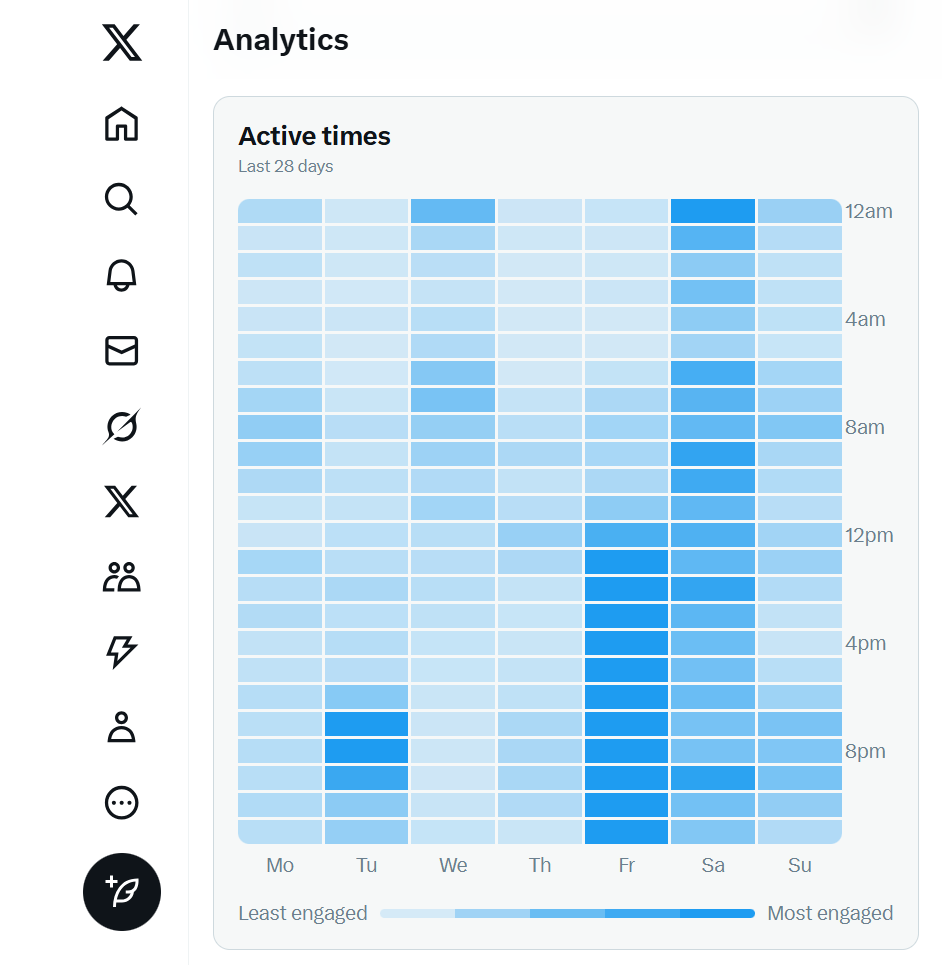
7. Build an Email List for Control
X’s algorithm and ownership shifts can affect visibility. Besides that, an outage can appear and your audience will be in the dark. You need to build and email list and drive followers to your email list with compelling CTAs, like exclusive offers or newsletters, to maintain direct audience access.
8. Invest in Paid Promotion
Over time, the organic reach on social media platforms has declined, hence you need to boost your reach with paid ads. X leaning pay-to-play, consider ads or boosted posts to ensure reach. Target by interests or demographics for precision, and amplify high-performing organic content for better ROI. To start running your ads go to X ads manager. Alternatively, you can contact us at Samodigital to help you set up converting ads on X.
9. Collaborate for Growth
Another strategy that works like magic on X is partnering with influencers. Be strategic and Partner with micro-influencers or complementary brands to expand reach. Tag non-competing creators in posts to encourage reshares. Engage in X communities or niche discussions to build credibility and attract followers.
10. Stay Agile with Platform Changes
Just like any other social media platform, X keeps evolving with new features, tweaks in algorithms. X’s ad landscape and X continues to evolve its AI tools, with its Grok AI chatbot now able to generate images, including ad variations, based on text prompts. You also need to test new formats like X Money for monetization potential and see how they help you grow. and use tools like SocialBee to streamline scheduling and monitoring.
Adapt quickly to stay ahead.
Why X Matters in 2025
X’s real-time nature makes it ideal for customer service, PR, and thought leadership. Its audience (56.8% male, 43.2% female, mostly 25-34) is highly engaged, especially in the U.S. and Europe. Combine X with 2-3 platforms like LinkedIn or Instagram to maximize impact. For ad pricing or subscription details, visit X Premium.
Focusing on authenticity, engagement, and strategic testing, you can turn X into a growth engine for your brand in 2025.
If Social Media Went Dark Tomorrow Would Your Brand Still Reach People?
Picture this: It’s the launch day for your latest campaign. You’ve been engaging with customers on X, answering queries in real-time and building buzz. Suddenly, at 10 AM, the social media platform you intend to launch campaign goes dark. Your team can’t log in, customers can’t reach you, and your carefully planned campaign stalls. Complaints pile up, and you’re left scrambling with no immediate way to respond.
This isn’t just a hypothetical. It’s what many brands faced during the X outage on May 22, 2025. A data center issue, possibly linked to a fire in Hillsboro, Oregon, knocked out login, signup, notifications, and Premium features for over 24 hours, leaving users and businesses worldwide in the lurch.
We’re still experiencing issues from yesterday’s data center outage. Login and signup services are unavailable for some users, and there may be delays in notifications and Premium features.
Our team is working 24/7 to resolve this. Thanks for your patience—updates soon.
— Engineering (@XEng) May 24, 2025
As marketers, creators, and businesses, this raises a crucial question:
What’s your plan when your primary platform goes offline?
If your brand relies on one social platform for:
- Customer service
- Community engagement
- Lead generation
- Product or content updates
…an unexpected outage could mean lost visibility, frustrated customers, and missed opportunities.
For Users:
X is a hub for news, networking, and communication. Outages disrupt these activities, causing frustration and potentially eroding trust, especially with X’s history of technical hiccups.
For Brands:
- Customer Service Disruptions: Brands relying on X for support couldn’t respond to inquiries, risking customer dissatisfaction. For instance, I tried reaching out to my internet service provider via X direct messages who has been reliable with X support but I couldn’t. I had to make a phone call!
- Reputational Risks: Unanswered queries can damage your brand’s image, pushing customers to competitors.
- Lost Engagement: Reduced visibility during outages can hurt marketing campaigns and sales.
What Smart Brands Should Do
- Diversify Your Channels Don’t rely solely on one platform. Maintain a presence on others like LinkedIn, Facebook, Instagram, TikTok, and YouTube.
- Invest in Owned Media Build direct lines to your audience through your website, blog, email newsletter, and even SMS or WhatsApp.
- Use Independent Support Tools Adopt help desks, chatbots, or ticketing systems that aren’t tied to social media.
- Back Up Customer Data Regularly export important interactions and audience insights from platforms you use.
- Have a Contingency Plan Monitor platforms, and be ready with messaging alternatives when your go-to platform goes down.
- Be Transparent: Inform customers promptly about disruptions to maintain trust.
Why avoid relying on one platform?
Depending solely on X can leave you vulnerable to:
- Single Point of Failure: An outage can halt your entire customer service operation.
- Infrastructure Risks: Issues like data center fires or cyberattacks are beyond your control.
- Policy Shifts: Platform changes can disrupt your strategy.
- Customer Frustration: Unreachable support can drive customers away.
Don’t wait for the next outage to rethink your strategy. Diversify your channels and prepare for the unexpected.
Final Thoughts
Social media has transformed how we connect, market, and support our audiences. But as recent outages have shown, platforms can and will go silent without warning. For brands, businesses, and creators, the key lesson is this:
You don’t own your audience on social media—platforms do.
Relying solely on one channel is like building your business on rented land. When the landlord has issues, your access, visibility, and communication can vanish in seconds.
Now is the time to future-proof your digital presence. It is important to diversify your platforms. Strengthen your owned media and have contingency plans. The brands that thrive long-term aren’t just social they’re strategic, resilient, and always ready.
How do you handle platform outages? Share your tips below!

