
ChatGPT Ads has reached $1 billion in annualized revenue run rate less than 200 days after launch, giving OpenAI’s advertising business a significant milestone while the company continues expanding access to advertisers around the world.
OpenAI announced on August 31, 2026 that tens of thousands of advertisers are now using ChatGPT Ads. The company has also expanded self-service buying through Ads Manager across India, Europe, the Middle East and North Africa. ChatGPT Ads is now available in more than 40 countries through OpenAI’s advertising team, agencies and technology partners.
The $1 billion figure does not mean OpenAI has already collected $1 billion in advertising revenue in less than 200 days. Annualized revenue run rate takes the current pace of revenue and estimates what that would amount to over a full year if the same rate continued.
Even so, the speed at which ChatGPT Ads has grown is worth paying attention to. OpenAI says ChatGPT serves more than 1 billion weekly active users, while advertising is becoming another part of its business alongside subscriptions, enterprise products and API usage.
For marketers, advertisers and businesses, this raises more practical questions: How do ChatGPT Ads work? What do they look like? How much do ChatGPT Ads cost? And how can a business start advertising on ChatGPT?
Does ChatGPT Have Ads?
Yes. ChatGPT now shows advertising to some users on its Free and Go plans in markets where ads are available.
Ads are not shown to users on Plus, Pro, Business, Enterprise or Edu plans. OpenAI also says it does not show ads to accounts identified as belonging to people under 18, and Temporary Chats do not show ads.
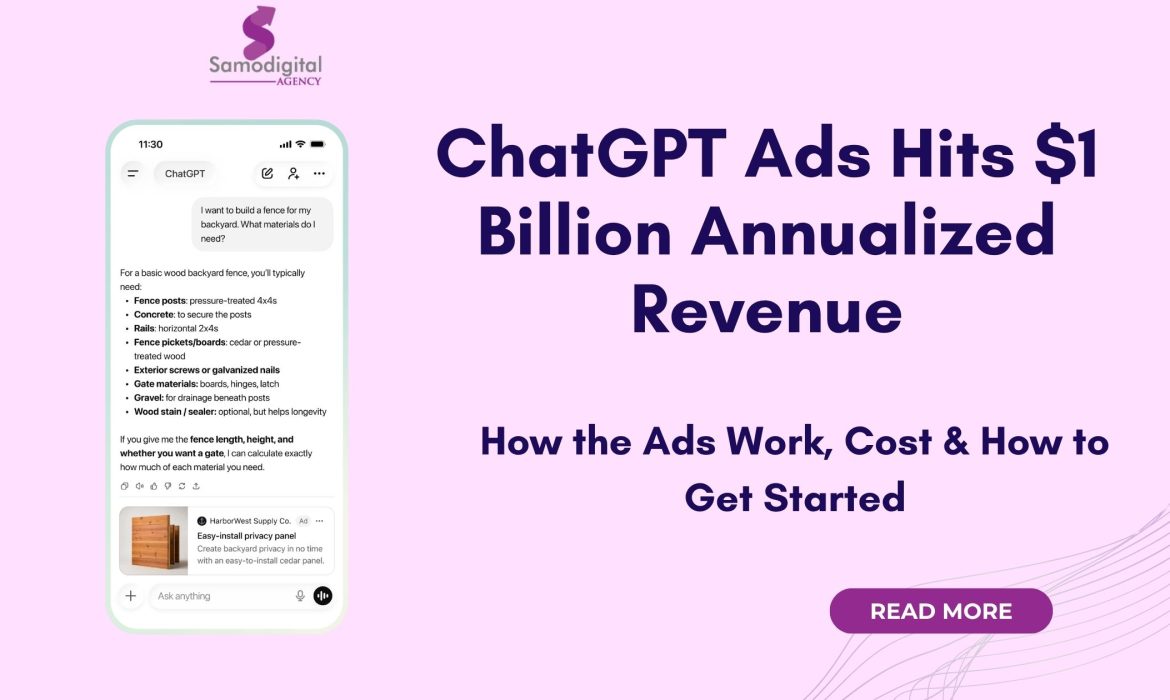
The ads appear below ChatGPT responses and are clearly marked as sponsored. They are separate from the answer generated by ChatGPT.
This is an important distinction. Advertisers are paying for an ad placement, not for ChatGPT to recommend their product inside an answer. OpenAI says advertisers cannot pay to shape, rank or alter ChatGPT responses, and seeing an ad does not mean OpenAI endorses that advertiser or product.
How Do ChatGPT Ads Work?
ChatGPT Ads uses the context and intent of a conversation to help determine whether an advertisement may be relevant.
That makes the advertising experience different from traditional keyword-based search advertising.
Someone using a search engine might type best accounting software for a small business. In ChatGPT, the same person could explain that they run a five-person company, need software that integrates with their bank, want simple invoicing and cannot afford an expensive enterprise system.
The conversation gives the system much more context about what the person is trying to achieve.
OpenAI says its advertising system considers several signals when deciding which ads may be relevant. These include the context and intent of the current conversation, the advertiser’s landing page, headline, ad copy, targeting selections and advertiser-provided context hints. When ad personalization is enabled, selected signals from a user’s wider ChatGPT experience may also contribute to ad relevance.
For marketers, this means advertising on ChatGPT cannot simply be treated as another place to upload a long list of keywords.
What Are Context Hints in ChatGPT Ads?
Context hints help advertisers describe the kinds of needs, conversations or situations where their product or service may be useful.
For example, an advertiser selling running shoes could provide a broad description such as running shoes. But OpenAI recommends giving more useful context, such as cushioned everyday running shoes for beginners training for their first 5K.
The idea is to help the advertising system understand the customer situation behind the product.
Context hints are not exact-match keywords. Someone does not need to type the exact phrase provided by the advertiser before the ad becomes eligible to appear, and adding a context hint does not guarantee that an advertisement will be shown.
This is one of the areas marketers will need to learn. Instead of thinking only about what keyword would someone search?, it may become equally important to ask what problem is this person trying to solve, and when would our product genuinely be useful?
What Do ChatGPT Ads Look Like?
ChatGPT Ads appear below ChatGPT’s response.
https://www.facebook.com/share/p/1GHN5Lqmav/
A standard ad can include the advertiser’s name, brand favicon or logo, headline, description, landing page and an image. OpenAI may show one or more sponsored items when there is a relevant match to the conversation
That placement puts advertising close to the moment when someone may already be researching something, comparing alternatives or deciding what to do next.
This could be particularly useful for businesses selling products and services that customers normally research before making a decision. The challenge for advertisers will be making sure the ad is genuinely helpful within the context of that conversation instead of simply interrupting it.
OpenAI’s own guidance encourages advertisers to use clear, useful copy that explains what a product offers, who it is for and when it may help. It advises against relying too heavily on generic slogans and broad marketing language.
What Does ChatGPT Ads Manager Do?
OpenAI Ads Manager Beta is the self-service platform advertisers use to create, launch and manage ChatGPT advertising campaigns.
Businesses can use Ads Manager to set up campaigns, create ad groups and ads, control budgets and targeting, manage billing and account access, and monitor performance. Campaigns can be built individually through the guided workflow or created at scale using bulk uploads.
Advertisers can currently monitor metrics including impressions, clicks, spend, click-through rate, average CPC, average CPM and conversions where conversion tracking has been configured. Reporting is available through tables, charts and CSV exports.
Ads Manager also supports conversion measurement, while OpenAI has introduced tools including its Pixel and Conversions API to help advertisers understand what people do after clicking an ad.
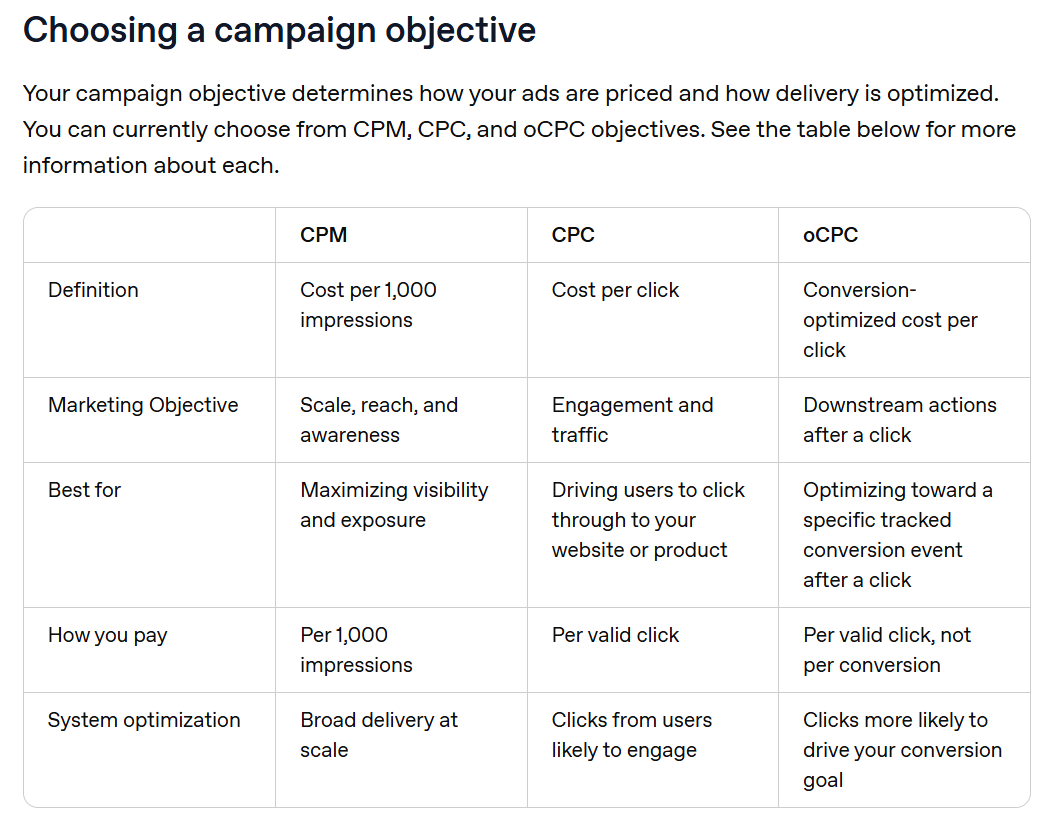
ChatGPT ad Campaigns can currently be optimized for reach, clicks or conversions. OpenAI supports CPM, where advertisers pay per 1,000 impressions; CPC, where advertisers pay for valid clicks; and oCPC, which optimizes delivery towards a selected conversion action while the advertiser is still billed for valid clicks.
How Much Do ChatGPT Ads Cost?
There is no single fixed cost for advertising on ChatGPT.
ChatGPT Ads uses an auction-based advertising system, so the amount an advertiser pays can depend on the campaign objective, bid, competition and relevance.
For CPC campaigns, OpenAI currently recommends starting with a maximum CPC bid of US$3 to US$5 per click. That does not mean every click will cost between $3 and $5. It is a recommended starting maximum bid, with the actual amount determined through the advertising auction.
OpenAI says it uses a relevance-weighted second-price auction. This means having the highest bid alone is not enough. The system also considers how relevant an advertisement is expected to be to the user and conversation.
There are also minimum campaign budgets.
For example, the current daily minimum is US$25 for advertisers billed in the United States, £15 in the UK, ₹725 in India, A$25 in Australia, C$25 in Canada and ¥2,500 in Japan. Minimums vary by country and billing currency. (OpenAI Help Center)
Advertisers should therefore think about ChatGPT Ads pricing in much the same way they would approach other auction-based platforms: set a test budget, measure results and optimize based on actual performance rather than assuming one universal cost per click.
OpenAI also says ChatGPT Ads is still an early platform and does not yet have established performance benchmarks covering all advertisers, industries and campaign types.
How to Start Advertising With ChatGPT
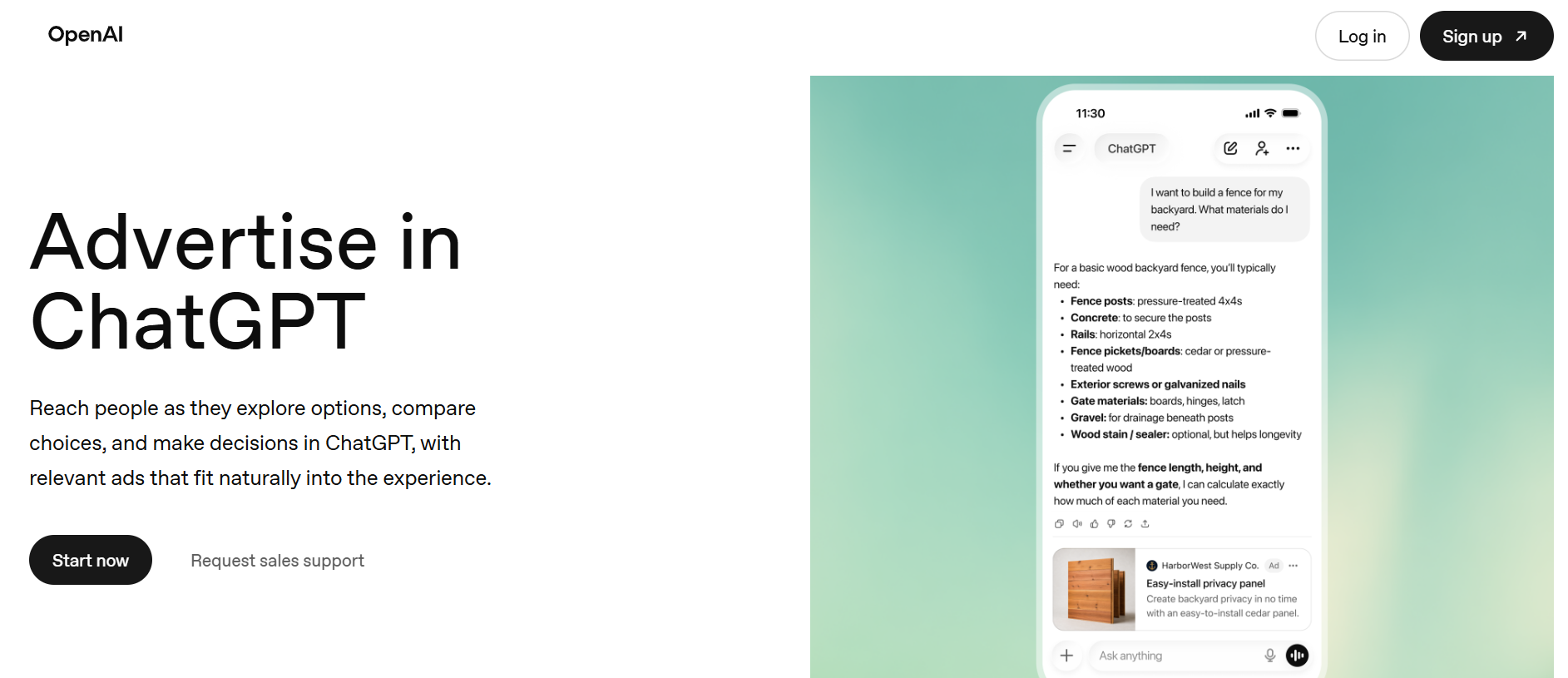
Businesses in supported countries can buy ads directly through OpenAI Ads Manager. Open ChatGPT Ads Manager
The process works as follows:
- Create your Ads Manager account. Sign in using an existing OpenAI account connected to your work email or create a new account.

- Set up your advertiser profile. Add your business information and brand logo, then complete the required advertiser verification.
- Add billing information. Set up your billing profile and payment method before your campaigns can begin running.
- Create your campaign. Choose your advertising objective, campaign budget, dates, locations and supported platforms.
- Create your ad groups. Organize ads around a particular product, customer need, theme or intent and add context hints to explain where the offer could be useful.
- Create your ads. Add your headline, description, image and landing page. Your landing page should clearly match what the ad promises.
- Submit the campaign for review. OpenAI reviews campaigns and ads before they are eligible to serve.
- Monitor the campaign. Once approved, track impressions, clicks, CTR, average CPC, average CPM, spend and conversions where measurement has been configured.
- Optimize based on results. Test different messages, context hints, bids, landing pages and creatives as you collect more performance data.
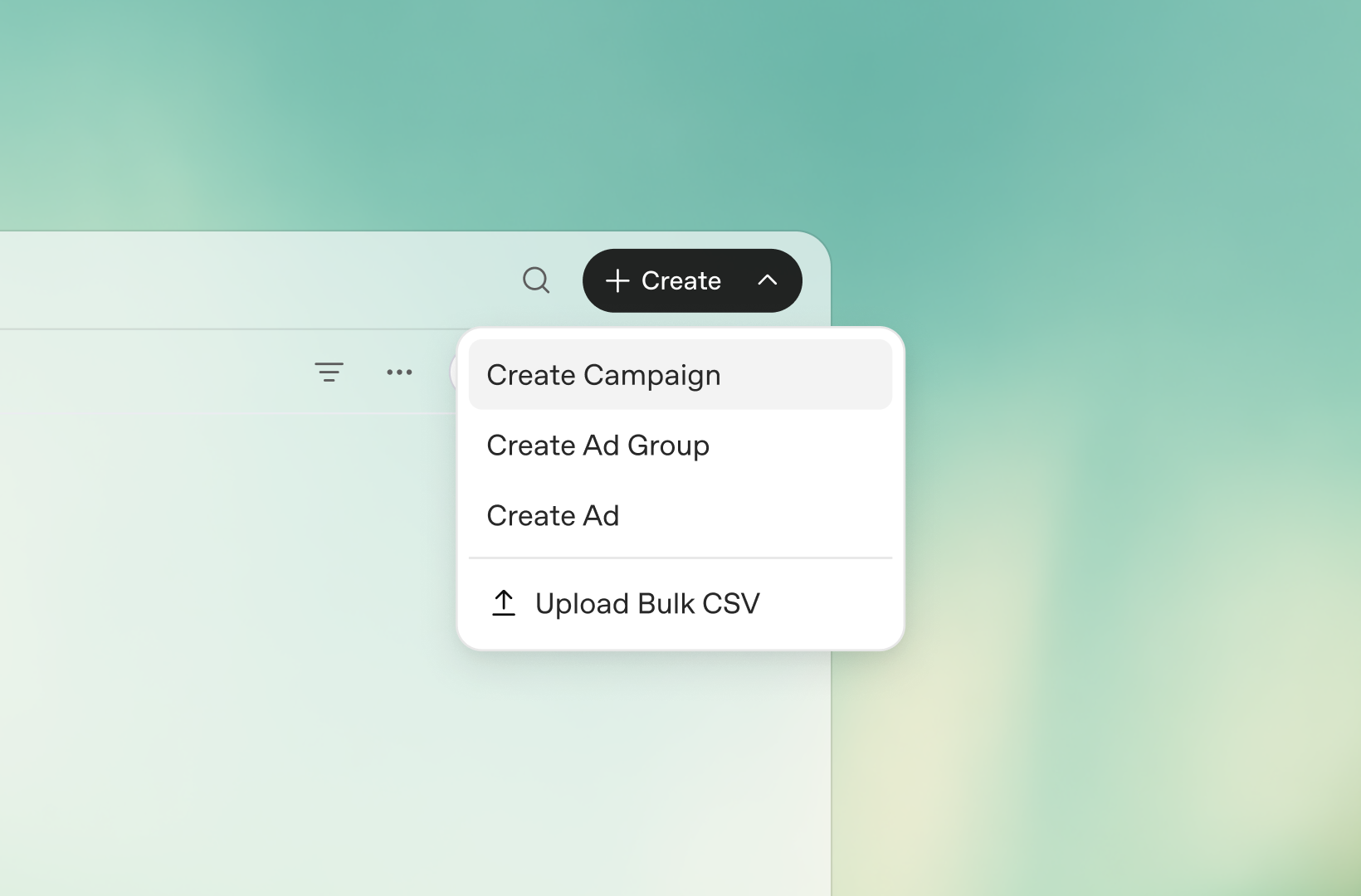
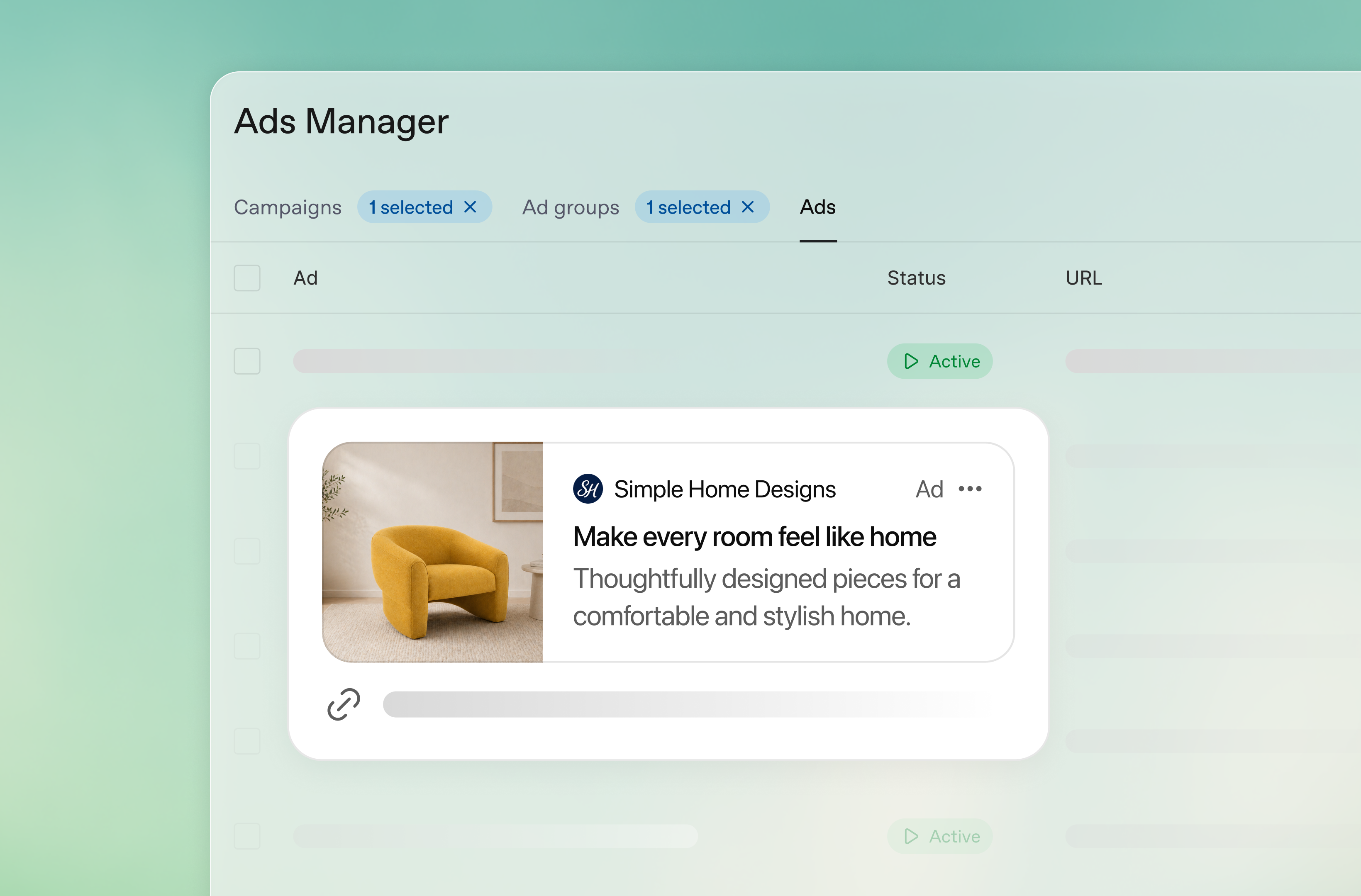
For businesses managing large numbers of ads, Ads Manager also supports bulk campaign creation and editing.
Can I Run Ads on ChatGPT?
Yes, if advertiser access is available in your market.
OpenAI has been expanding ChatGPT Ads internationally, and self-service Ads Manager access is now available across a growing number of countries in Europe, the Middle East, North Africa, Asia and other markets.
For businesses in Kenya, there is one important point to note.
Kenya is not currently listed among the countries with self-service ChatGPT Ads Manager access as of September 2026. Businesses can still create an Ads Manager account and OpenAI says it will notify advertisers when self-service becomes available in their country. Larger advertisers with more complex requirements can also contact the OpenAI Ads team about sales support.
For Kenyan marketers, this makes the current expansion worth following. Several North African and Middle Eastern markets are now supported, which shows that availability is moving beyond the initial group of countries.
Do Advertisers See Your ChatGPT Conversations?
No.
OpenAI says advertisers do not receive access to users’ ChatGPT conversations, chat histories, memories or personal information. Advertisers receive aggregated performance information such as the total number of views or clicks generated by their campaigns.
This is particularly important because conversational advertising can easily create the impression that the advertiser is somehow reading what an individual user has told ChatGPT.
According to OpenAI, that is not how the system works.
Information from the conversation can stay within ChatGPT and be used to determine whether an advertisement may be relevant, but the conversation itself is not passed to the advertiser. OpenAI also says it does not sell user data to advertisers.
Users can turn off ad personalization. When personalization is disabled, ads can still be selected based on the current conversation, but other chat threads, ad history and broader signals are not used in the same way.
Is AI Advertising Illegal?
No. Advertising through an AI platform such as ChatGPT is not inherently illegal.
Advertisers are still responsible for following the advertising, consumer protection, privacy and sector-specific laws that apply in the markets where they operate. They must also comply with OpenAI’s own advertising policies.
OpenAI prohibits or restricts several advertising categories and also controls the types of conversations beside which ads can appear. Its policies are designed to prevent advertising from appearing around sensitive or brand-unsafe conversations.
Political advertising is currently prohibited on ChatGPT, while some regulated sectors such as health, financial and legal services have additional requirements or restrictions depending on the market.
So using AI to deliver an advertisement does not remove the normal responsibilities around truthful claims, privacy, consumer protection and responsible targeting.
Why ChatGPT Ads Matter for Marketers
The most interesting part of ChatGPT advertising is not simply that OpenAI has created another place to display ads.
It is where those ads can appear in the customer decision process.
People come to ChatGPT to explain problems, research products, understand unfamiliar topics, compare alternatives and ask follow-up questions. A conversation can therefore reveal much more about what someone is trying to achieve than a single search term or social media interaction.
OpenAI describes ChatGPT as a place where discovery, consideration and decision-making can happen within one experience. The company says its advertiser base is becoming increasingly global and advertisers outside the United States now represent a growing share of revenue.
For marketers, this will require a slightly different mindset.
A ChatGPT Ads strategy should not simply copy a Google Search campaign or take a Meta ad and place it somewhere else. Advertisers will need to understand the questions customers ask, the situations that lead them towards a product, the language customers use to explain their problems and what information is useful at that point in the journey.
Landing-page experience will matter too. If an ad appears beside a detailed conversation and sends someone to a generic page that does not answer the need that brought them there, the opportunity may be wasted.
ChatGPT Ads Is Still Developing
The $1 billion annualized revenue run rate is a significant milestone, but ChatGPT Ads and Ads Manager are still developing.
OpenAI describes Ads Manager as a beta product and says additional capabilities will be introduced over time. The company is continuing to develop its advertising formats, measurement systems, buying options and tools for advertisers.
That is another reason advertisers should treat the platform as a place to test rather than assuming the rules, prices and formats available today will remain unchanged.
The more useful question for marketers now is how advertising performs when it sits alongside a conversation where somebody is actively researching, comparing or trying to make a decision.
Reaching $1 billion in annualized revenue run rate in less than 200 days, while attracting tens of thousands of advertisers, suggests businesses are already willing to test that opportunity.
For advertisers with self-service access, ChatGPT Ads is becoming another digital advertising channel worth testing alongside search and social media.
For Kenyan marketers, Ads Manager is not yet available for direct self-service buying, but now is a good time to understand how conversational advertising works. When access expands, the marketers who already understand context, intent, campaign structure and measurement will have a much easier place to start.
Want to explore ChatGPT advertising for your business or understand how AI is changing digital marketing? Samodigital helps businesses and marketing teams understand emerging digital platforms and turn them into practical marketing opportunities.


