
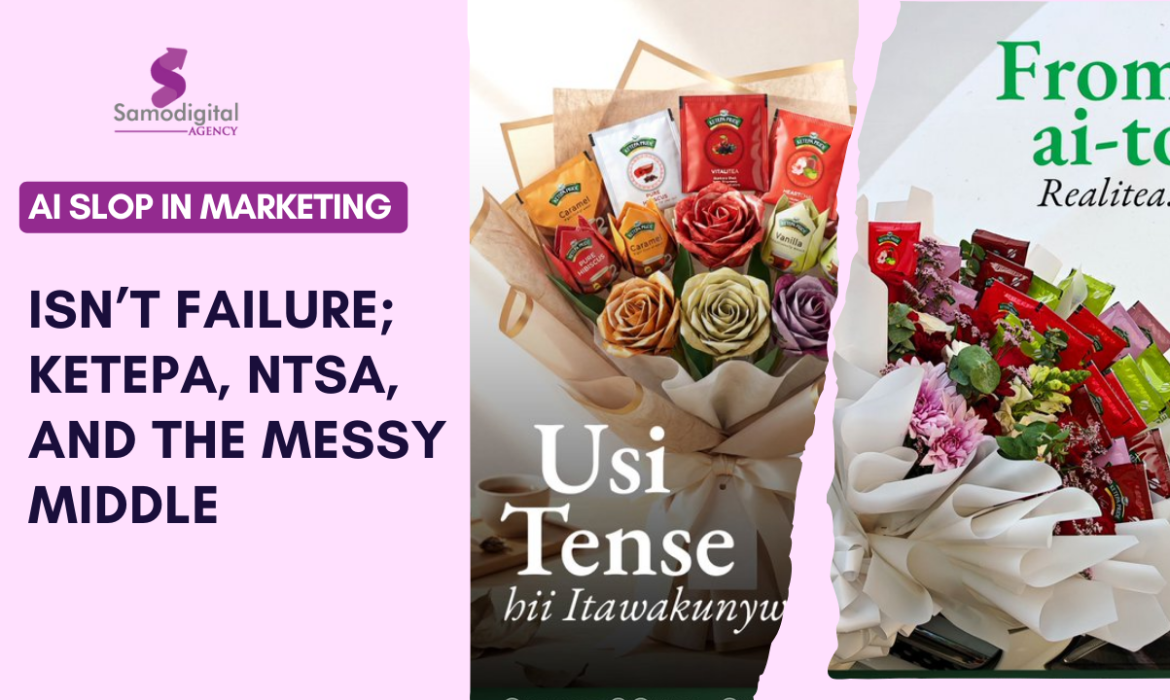
TLDR: AI-generated marketing can misfire — or create what’s called AI slop. Ketepa Tea, NTSA, and Coca-Cola show how public feedback and iteration turn AI missteps into stronger campaigns.
February is the month of love, a season when brands lean heavily into emotion, gifting, and cultural moments. This year in Kenya, however, Valentine’s conversations went beyond flowers and chocolates. The Central Bank of Kenya cautioned against the misuse of banknotes amid the growing trend of money bouquets, highlighting how cultural moments, regulations, and public behavior intersect.
Against this backdrop, brands and public institutions turned to AI-generated images to participate in the moment. Ketepa Tea shared an AI-generated image of tea sachets arranged as a bouquet, prompting criticism around tone, timing, and authenticity.
Around the same time, the National Transport and Safety Authority (NTSA) faced backlash after publishing an AI-generated #UsalamaBarabarani image that appeared to contradict its own road safety message. In both cases, audiences quickly identified the gaps and voiced their feedback.
These moments sparked a broader conversation about AI-generated images and videos in marketing and the growing phenomenon often referred to as AI slop. More than isolated missteps, they reveal how brands are learning to use AI in public — navigating feedback, iterating in real time, and refining their approach as audiences become more AI-aware.
What is AI slop in Marketing?
AI slop refers to low-quality, obviously AI-generated content that fails authenticity tests and lacks the human oversight necessary for quality marketing. It is characterized by visual tells like distorted hands, impossible physics, nonsensical text, and, perhaps most critically, missing cultural context that make content resonate.
AI slop is not simply “bad content.” It often results from:
- Over-reliance on AI tools
- Weak or rushed prompting
- Limited human oversight
- Speed prioritized over strategy
Crucially, AI slop reflects process gaps, not proof that AI itself does not work. Many of these outputs are not failures, but early-stage experiments published too quickly.
But here’s what makes AI slop particularly problematic in 2025: today’s consumers are AI-literate. They can spot it instantly, and they expect better.
Why AI Slop Happens, Especially With Images and Video
AI slop is most visible in visual marketing for several reasons.
First, AI lacks lived context. Generative tools do not understand cultural nuance, regulation, emotion, or local realities. They work from patterns, not experience. Without human review, inconsistencies slip through.
Second, AI accelerates execution faster than judgment. What once took days of creative review can now be produced in minutes. When thinking does not keep pace with production, mistakes become public.
Third, visual content leaves no room for explanation. Audiences interpret images instantly. A single contradiction can undermine an entire message.
A Global Example: Coca-Cola’s Christmas Controversy and AI-Generated Creativity
In 2024 and 2025, Coca-Cola attempted to recreate its iconic “Holidays Are Coming” Christmas campaign using AI generation. The result? A soulless recreation that lost all the warmth and nostalgia of the beloved hand-crafted original. Visible AI artifacts and uncanny valley effects prompted hashtags like #BoycottCokeAI to trend. The message from consumers was clear: when you’re a heritage brand built on emotion, AI cost-cutting feels like betrayal.
Kenyan Case Study: NTSA and the #UsalamaBarabarani Campaign
Kenya’s National Transport and Safety Authority’s campaign #Safewalking #UsalamaBarabarani (Road Safety) campaign, advocating for zebra crossing usage, offers a clear example of contextual misalignment.

One of their AI-generated image shared on social media showed both a zebra crossing and a footbridge in the same frame. The public response was immediate: “Why would anyone use a ground-level crossing when there’s a safer footbridge option?” The image undermined the entire safety message, demonstrating AI’s inability to understand contextual logic.
NTSA deleted the post, but the damage to credibility was done. Here is the next post they shared on X.
Every minute saved is not worth a life lost.
Use the footbridge, it’s there to protect you.
#SafeWalking #UsalamaBarabarani pic.twitter.com/NBsFRiLWW3— NTSA KENYA (@ntsa_kenya) February 4, 2026
Ketepa Tea: Turning AI Backlash Into Iteration
Unlike the others, Ketepa’s response became a masterclass in crisis management. Ketepa Tea’s response stands out as a positive example of how brands can move forward after criticism.
After backlash over its AI-generated sachet bouquet, Ketepa did not defend the output or disengage. Instead, the brand listened. Here is the post that received a lot of criticism online.
Ketepa wishes to remind the public that section 1 of the Love Languages Code – aka the gifting of Ketepa Tea bags in decorative and romantic bouquet displays during this month of love is an enshrined freedom that all Kenyans across all walks can engage in without fear of… pic.twitter.com/c6rmS4ZGgb
— Kenya Tea Packers (@KetepaLtd) February 3, 2026
Kenya Tea Packers followed up with a new post featuring real flowers, real tea sachets, and a human presence, accompanied by the message “From AI to real tea.”
Ilibidi tutea.
Ketepa Tea Bouquet iko official,
romantic, inabrew love live.
Mapenzi ni vitendo… na tea ni lugha yetu.#KetepaTeaBouquet#ChaiNiKetepa#BrewLove pic.twitter.com/bbdehAiMOD— Kenya Tea Packers (@KetepaLtd) February 6, 2026
This shift mattered. It showed responsiveness, humility, and an understanding that AI should support storytelling, not replace human connection.
The Messy Middle of AI in Marketing
These examples illustrate what can be described as the messy middle, the phase between experimentation and mastery.
Marketing has always evolved this way. Early social media content was awkward. Early mobile ads were intrusive. AI is no different. The difference today is visibility. AI compresses timelines and exposes learning curves publicly.
The case of Coca-Cola, Ketepa Tea, and NTSA, among others, who have boldly shared their AI-generated campaigns are example of brands that are no longer iterating behind closed doors. They are doing so in real time, with audiences actively participating in the feedback loop.
They proved that listening and adapting create more trust than getting it perfect the first time.
Each public failure trains marketers on what doesn’t work. Failed examples become case studies that refine our collective understanding of AI’s appropriate use. Community feedback improves prompt engineering industry-wide. The messy middle isn’t where brands get stuck; it’s where they build the institutional knowledge that leads to mastery.
Today’s Awakened Consumer
What makes 2026 different from even two or three years ago is audience sophistication. Some consumers can increasingly spot AI-generated content through visual tells, tonal genericness, and logical inconsistencies. More importantly, they expect better. The sentiment you see on social media isn’t “don’t use AI”, it’s “if you’re using AI, at least make it good.”
This creates what is known as the authenticity paradox: brands must use AI for efficiency and creativity, yet audiences crave human connection and genuineness. The solution is not choosing between AI and authenticity. It needs brands to use AI as a tool while keeping humans as decision-makers.
Moving From AI Slop to AI-Smart Marketing
The difference between AI slop and AI success comes down to process. Successful AI marketing follows this framework:
- Generate multiple versions using AI for speed and scale.
- Review through multi-stakeholder quality checks that include cultural consultants and brand guardians. Refine based on expert input and cultural context.
- Test with small audience segments before full rollout. Approve only after final human sign-off confirming brand alignment.
- Monitor real-time sentiment post-publication. Iterate continuously based on learnings.
The critical element? Human oversight at every stage. AI should accelerate creativity, not replace judgment.
Brands must also build internal AI governance: documented learnings, prompt libraries with proven results, brand-specific guidelines, and team training on AI literacy. Quality thresholds should be established before generation begins, not after problems arise.
Conclusion
AI slop is not the end state of AI in marketing. It is a transitional phase that reflects experimentation, learning, and adjustment.
What defines strong brands is not the absence of mistakes, but how they respond. Brands that listen, iterate, and humanize their use of AI will build stronger trust and more resilient connections with their audiences.
In marketing, progress has never been perfectly polished. With AI, the learning just happens in public and when handled well, that visibility can become a strength rather than a weakness.